BESS is the Sustainable Design Scorecard for Moreland.
While a greater emphasis on sustainable building design is a Good Thing, the BESS should be better.
The BESS is a scorecard that is completed during the planning application stage. However, building plans are submitted to Planning at a very late stage in their development. By the time plans are submitted to Council they are effectively “final” and conducting a sustainability audit at this point is too late to guide good design. This is an important “back stop” for sustainable design but also suffers from being “too little, too late”.
These criticisms come from personal experience using the BESS as a residential building customer:
- We were directed to do a BESS by the Council planner
- We incurred additional costs to complete the BESS
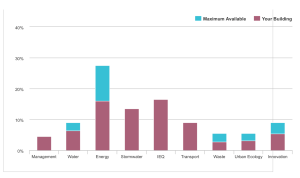
- Draft BESS – 99 Union St, Brunswick VIC 3056, Australia 77% Excellent
- We were explicitly told that the BESS would not be used to assess our application
Design standard for sustainable buildings are complex and controversial. See:
- https://renew.org.au/our-news/outdated-6-star-standard-short-changing-consumers/
- https://www.abc.net.au/news/2017-10-10/construction-loophole-leaving-buyers-with-higher-energy-bills/9033916
Despite having a 7+ star energy rating due to passive design and excellent insulation plus near self-sufficiency in electricity the Energy score was only 58%. The Urban Ecology ratings give preference to vegetation and landscaping, including food production but no allowance for habitat or biodiversity in planting.
We are fortunate to be able to prioritise energy efficiency in our build. These decisions were made at the concept phase of the building. Other residents may be in the situation of low scoring after their planning application is done when the cost of re-work is unacceptably high. “Failing” this scorecard so late in the process would be traumatic for most residents. The constraints of building on very blocks, with no viable discretion in building orientation, makes achieving good design extraordinarily difficult.
As always, commercial projects have far more scope to meet the standards in a variety of ways, and that does not always result in optimum outcomes. It is much cheaper to install solar hot water than improve building orientation, or put in vegetable beds which look good in the brochure, rather than installing adequate shading.
The Energy Star system gives consumers a chance to make better choices in energy efficiency. Aligning Planning with the Green Star would simplify it for consumers and provide a national comparison standard to drive the building industry. BESS’ great strength is its status as an initiative of the Municipal Association of Victoria and so can align more broadly across Victoria, however, successful standards need to have the broadest scope possible to genuinely drive behaviour and not simply increase costs in individual municipalities.
US https://www.wbdg.org/resources/green-building-standards-and-certification-systems
EU http://wiki.cesba.eu/wiki/Main_Page


Leave a Reply