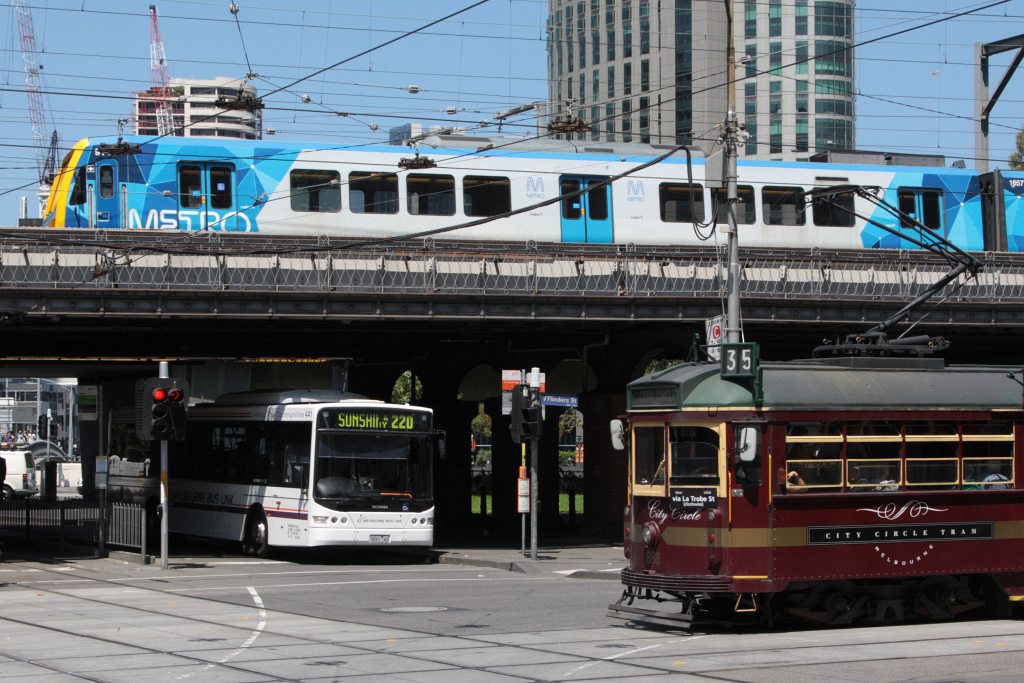
Taking Back Our Network: A Fairer, Integrated, Fully Public Transport System For Victoria
Our public transport system is working for private profit, not Victorian passengers. While the state builds the tracks through the “Big Build,” private corporate operators pocket the returns. This leaves taxpayers to fund $31.00 of the total $35.97 cost for every single kilometre a train travels. We will end this failed 1999 privatisation experiment and return our trains, trams, and buses to public hands.
📋 Phase Out Corporate Franchises
- Zero Contract Renewals: Allow existing private operator agreements to naturally expire.
- No Penalty Fees: Avoid expensive contract termination payouts through strategic non-renewal.
- Eliminate Hidden Waste: Dissolve the 9% public service bureaucracy currently spent on managing private contracts.
- Unified State Management: Consolidate network operations under a single, highly accountable public authority.
💰 Reinvesting in Social Outcomes
- Protect Fairer Fares: Protect and lock in critical cost-of-living fare subsidies.
- Support Regional Services: Protect unprofitable suburban and regional routes that private operators neglect.
- Redirect Inspector Funding: Shift the $55 million annual cost of 545 ticket inspectors into localised community safety.
- Transparent Accounting: Publish the true, all-inclusive cost per kilometre openly to the public.
🔄 A Seamless Transition to Public Ownership
- Protect Frontline Workers: Guarantee secure job transfers for operational staff with existing enterprise agreements.
- Reclaim Public Depots: Absorb private leases and operational rolling stock back into state custody.
- Global Best Practice: Align Victoria with successful public network models in the UK, New Zealand, and Europe.
📊 The Broken Maths of Privatisation
Taxpayer Share vs Passenger Share per Kilometre[███████████████████████████████████████████████████████████░░░░░░]Taxpayer Cost: $31.00 (86%) | Passenger Fare: $4.97 (14%)
- Massive Taxpayer Subsidies: You already pay for 86% of the network’s true running costs.
- Severe Revenue Gaps: Annual fare revenue ($736 million) covers less than a quarter of system costs.
- Massive Forgone Revenue: Crucial cost-of-living fare relief means forgoing $432.5 million this year alone.
- The Reality: Since the public already pays for the network, the public should own it.
Google backgrounder
The “success” of public transport privatisation in Australia is a subject of intense debate, with the answer largely depending on whether you value economic efficiency or service quality and social equity. [1]
While private operators now manage approximately 60% of metropolitan trips, a strong “re-nationalisation” movement has emerged in states like NSW as of 2026.
Arguments for Success (Economic & Efficiency)
Proponents, such as industry bodies like the Tourism & Transport Forum, argue that the “franchise model” (private operation of public assets) has delivered:
- Cost Savings: Competitive tendering has historically reduced the per-kilometre operational cost compared to direct government delivery.
- Operational Discipline: High-frequency networks like the Sydney Metro and Gold Coast G:link are run by private consortia that consistently meet strict performance and punctuality targets.
- Innovation: Private operators have been faster to integrate new technologies, such as telematics for bus tracking and early trials of zero-emission fleets. [2, 3, 4, 5]
Arguments against Success (Service & Labor)
Critics and recent reports from groups like the McKell Institute characterize the experiment as a “failure” due to: [6]
- Service Degradation: In areas like Newcastle and Sydney’s inner west, privatisation has been linked to route cancellations, “disjointed” timetables, and poor on-time performance.
- Higher Long-Term Costs: A 2026 report found that Newcastle’s privatised bus contract “ballooned” from $450 million to over $600 million while service quality fell.
- Workforce Impact: Unions frequently cite “fire and rehire” tactics, lower wages for new drivers, and worsened working conditions, which have contributed to the national driver shortage. [6, 7, 8, 9, 10]
State of Play by Region (2025–2026)
| State [7, 11, 12, 13, 14] | Status of Privatisation | Current Sentiment / Trend |
|---|---|---|
| NSW | Heavy | Reversing. The current government is under pressure to “unpick” bus privatisations and return them to the state-run State Transit Authority. |
| VIC | Hybrid | Stable but Critical. Trains and trams remain private (e.g., Metro Trains), but the state is increasing direct control over the “Big Build” infrastructure and new bus manufacturing. |
| QLD | Low (Rail) | Public-Led. Heavy rail remains public, while bus services are a mix. The focus has shifted to massive fare subsidies (50-cent fares) rather than further sell-offs. |
| WA | Low | State-Owned focus. WA maintains strong public sector involvement, particularly with its METRONET expansion and local bus manufacturing. |
The 2026 “Value for Money” Verdict
Modern analysis suggests that while privatisation can lower the initial cost of running a service, it often fails to account for social outcomes. Governments are increasingly finding that when a private operator’s profit motive conflicts with public welfare (like running unprofitable regional routes), the state must step back in with heavy subsidies anyway, often negating the original “savings”. [1, 15]
[1] https://www.melbournefoe.org.au
[3] https://www.busnews.com.au
[4] https://www.parliament.nsw.gov.au
[6] https://rtbuexpress.com.au
[8] https://mckellinstitute.org.au
[10] https://mckellinstitute.org.au
[11] https://www.budget.vic.gov.au
[12] https://www.theguardian.com
[13] https://www.pta.wa.gov.au
[14] https://nswliberal.org.au
When a government privatises a transport network, it doesn’t simply “walk away.” Instead, it shifts from being a service provider to a contract manager. This transition creates a layer of permanent government overhead that is rarely included in the “cost per kilometre” figures shown to the public.
In 2025–26, these “hidden” costs typically account for 5% to 12% of total contract value.
1. Contract Management and Compliance Bureaucracy
Governments must maintain large departments to ensure private operators meet their Key Performance Indicators (KPIs).
- The “Shadow” Workforce: Transport for NSW and Victoria’s Department of Transport employ hundreds of staff solely to monitor private contracts, process performance data, and audit safety reports.
- Reporting Costs: Private operators charge the government for the administrative burden of the government’s own reporting requirements.
2. Procurement and Legal Fees
The process of tendering a network is incredibly expensive.
- Tendering Cycles: Every 7–10 years, a state spends millions on commercial lawyers, financial advisors, and technical consultants to write new contracts and evaluate bids.
- Contractual Disputes: Unlike a public system where the Minister can simply issue a directive, a privatised system requires legal negotiation. If the government wants to change a bus route or add a train service, the private operator often triggers “variation clauses” that require expensive legal settlement.
3. The “Cost of Capital” and Profit Margins
While not an overhead in the traditional sense, these are costs that do not exist in a public system.
- Operator Profit: Private companies (like Transdev or MTR) typically target a 5% to 8% profit margin. In a public system, this “profit” would be reinvested into more services.
- Risk Premiums: Private operators build a “risk premium” into their bids to protect against unforeseen events (like power price spikes). Taxpayers pay for this protection upfront, even if the risk never eventuates.
4. Asset Handover and Maintenance “Cliff-Edges”
Toward the end of a 10-year contract, private operators may have a financial incentive to reduce maintenance to maximize final profits.
- Infill Funding: Governments often have to spend heavily at the end of a contract to bring assets (trains, tracks, or buses) back up to standard before handing them to the next operator.
- Knowledge Loss: When a contract changes hands, the government often loses the “institutional memory” of how the network runs, leading to expensive “re-learning” periods funded by the taxpayer.
5. Redundancy and Integration Costs
Privatisation often leads to “fragmentation”—where the train is run by one company and the bus by another.
- Interoperability: The government must pay for the technology and staff to make sure different private companies’ systems talk to each other (e.g., making sure a bus waits for a delayed train).
- Branding and Marketing: Governments spend millions ensuring a “seamless” brand (like Opal or myki) across multiple private operators who would otherwise market themselves individually.
The “Unpicking” Cost
In NSW, the current debate around “re-nationalising” bus services has highlighted the ultimate hidden cost: Termination Fees. Breaking a long-term private contract early to return it to public hands can cost taxpayers hundreds of millions in compensation to the private operator.
For 2025–26, Victoria‘s public transport costs are heavily influenced by the “operationalisation” of the Metro Tunnel and aggressive cost-of-living fare subsidies. When combining the direct costs paid to private operators with the “hidden” government overheads required to manage these contracts, the true cost per kilometre is significantly higher than the base operator fee.
True Cost per Service Kilometre (Victoria 2025–26)
These figures include the direct payment to operators (Metro Trains, Yarra Trams, and bus consortia) plus a 9% public service overhead for contract management, compliance, and departmental administration.
| Mode | Base Operator Cost (per km) | Public Service Overhead (9%) | Total Government Cost (per km) |
|---|---|---|---|
| Heavy Rail | $33.00 | $2.97 | $35.97 |
| Tram | $23.50 | $2.12 | $25.62 |
| Metropolitan Bus | $7.50 | $0.68 | $8.18 |
Calculation Breakdown: The Victorian Context
1. The Base Operator Payments
Payments to private operators in Victoria are currently at record highs. For the 2024-25 year, payments were roughly:
- Metro Trains Melbourne: ~$1.4 billion annually.
- Yarra Trams: ~$550 million annually.
- Buses (Metro & Regional): ~$1.3 billion annually.
For 2025-26, an additional $727 million was allocated specifically to “switch on” the Metro Tunnel, which has pushed the per-kilometre cost for heavy rail up as the state funds massive 24/7 testing and driver training programs.
2. Estimating the 9% Overhead
The Department of Transport and Planning (DTP) is the largest procurement body in the state, managing $8.3 billion in contracts for FY25. The “hidden” overhead includes:
- Contract Management: Roughly $240 million in departmental staff costs dedicated solely to monitoring operator KPIs, punctuality data, and safety compliance.
- Legal & Consultancy: Appendix 9 of the DTP Annual Report typically shows millions in consultancy fees for re-tendering major contracts, such as the new nine-year Melbourne Tram Contract awarded in 2024.
- System Integration: The cost of managing the myki ticketing system and the Public Transport Ombudsman is entirely a government overhead, not an operator cost.
The Efficiency Gap: Cost vs. Fares
The financial reality in Victoria has changed drastically in 2026. [1]
- Fare Revenue: Collected just $736 million last year, covering less than 25% of costs.
- 2026 Fare Crisis: With free public transport extended until the end of May 2026 and half-price fares for the rest of the year, the government is forgoing $432.5 million in revenue.
- Net Cost: For every kilometre a train travels in Victoria, the taxpayer is now paying roughly $31.00 of the $35.97 total cost, with passengers contributing only a small fraction. [2, 3]
Operational Impact of “Hidden” Overhead
While the 9% overhead seems like a bureaucratic burden, it is the only mechanism the government has to hold private companies like Metro Trains or John Holland/Transdev (trams) accountable. Without this “shadow workforce” in the DTP, there would be no independent verification of the punctuality and reliability bonuses paid to these private companies.
As of mid-2026, every major Australian state is undergoing a massive multi-hundred-million-dollar ticketing overhaul. While these projects aim to modernize travel with “tap-and-go” credit card payments, they have become some of the most expensive and legally complex government IT projects in the country. [1]
Ticketing System Spend by State (2025–26)
| State [1, 2, 3, 4, 5] | System | Project Status | Total Estimated Investment | Annual Operational Cost |
|---|---|---|---|---|
| Victoria | myki (Conduent) | Overhaul & Modernisation | $2.8 billion (over 15 years) | ~$186 million |
| NSW | Opal (Next Gen) | “Opal 2.0” Upgrade | $820 million | ~$100–120 million (Est.) |
| Queensland | Smart Ticketing | Rollout & Integration | $433.75 million | ~$50–65 million (Est.) |
| Western Australia | SmartRider | Upgraded to Account-Based | $64 million (Recent Upgrade) | ~$15–20 million (Est.) |
Key State Comparisons
Victoria: The High-Cost Leader
Victoria’s ticketing spend remains the highest in Australia. Following a $1.7 billion 15-year contract awarded to Conduent in 2023, the total project cost has recently blown out to $2.8 billion. [2, 6]
- Operational Burden: Victoria spends approximately $186 million per year just to keep the ticketing system running and supported.
- Performance Issues: As of May 2026, the Victorian Auditor-General has labeled the project’s value for money as “unclear” due to an 18-month delay and a $136 million budget blowout during the transition from the previous operator, NTT Data. [2, 7, 8]
New South Wales: The “Opal 2.0” Overhaul [3]
NSW is currently investing $820 million in “Opal Next Generation”. [4]
- Scope: This project involves replacing 25,000 card readers across the entire network and introducing digital Opal cards for smartphone wallets.
- Progress: In April 2026, the state successfully enabled credit/debit card tapping for concession and pensioner fares, closing a significant gap between the old and new systems. Full hardware replacement is slated for 2027. [9, 10, 11]
Queensland: The Delayed Rollout [12]
Queensland’s Smart Ticketing project has seen its budget increase from an initial $371 million to $433.75 million. [1, 5]
- Outcome: While “tap-on” with credit cards is now active on all SEQ trains, trams, and ferries, the full rollout across Brisbane’s massive bus network has been plagued by delays and is not expected to be officially complete until December 2027.
- Hidden Costs: The government is currently funding two systems simultaneously (Smart Ticketing and the old Go-Card) to ensure no passengers are left behind during the transition. [1, 5]
The “Hidden” Efficiency Gap
Ticketing systems often cost more to run than they are worth in pure fare revenue for certain states.
- The Subsidy Paradox: In Queensland, where fares are now a flat 50 cents, the administrative cost of processing a single “tap” is estimated to be nearly as high as the fare itself.
- Enforcement Costs: None of the figures above include the cost of Authorized Officers (Ticket Inspectors). In Victoria, employing roughly 545 inspectors adds an estimated $55 million per year to the “cost of fare collection”. [13, 14]
[1] https://www.governmentnews.com.au
[4] https://www.transport.nsw.gov.au
[5] https://statements.qld.gov.au
[6] https://www.theguardian.com
[7] https://www.parliament.vic.gov.au
[10] https://www.theguardian.com
[12] https://www.mobility-payments.com
[13] https://documents.parliament.qld.gov.au
[14] https://thomasthethinkengine.com
To renationalise Victorian public transport, the state government would need to undo the privatization framework established in 1999. Under the current system, the government retains ownership of the physical infrastructure, while the daily operation of metropolitan trains, trams, and buses is contracted out to private entities through franchise agreements. [1, 2, 3]
A transition back to full public ownership and operation involves a specific sequence of legal, financial, and logistical steps:
1. Contract Non-Renewal or Termination
The most legally secure and cost-effective mechanism to return services to public hands is to allow existing franchise contracts to expire without offering extensions or retendering them. [3, 4]
- Wait for Expiry: The government lets current metropolitan train and tram contracts run their full duration.
- Early Termination: Alternatively, the state could break contracts early. This requires invoking exit clauses, which would likely trigger massive compensation payouts to private operators for breach of contract or lost profits.
- Buyback Agreements: The government could negotiate a mutual commercial settlement to purchase the remaining terms of the operations. [3, 5, 6]
2. Legal and Institutional Restructuring
The state must establish a dedicated public entity to absorb and manage the operations. [4]
- Legislation Amendments: Parliament would need to pass amendments to the Transport Integration Act 2010 to change the statutory powers of the Department of Transport and Planning (DTP). [7]
- Establish a Public Agency: A singular statutory body—similar to Transport for London or the historical Victorian Railways—would be created to plan, operate, and maintain the network under a unified structure. [4, 8, 9]
- Dissolve Partnerships: The existing public transport partnership agreements that manage private-operator performance would be legally wound up. [1]
3. Workforce and Asset Transfer
Operating the network internally requires absorbing the existing private machinery into the public service.
- Employing Frontline Workers: Thousands of private sector employees—including drivers, authorized officers, network controllers, and maintenance crews—must have their contracts transferred over to the public sector. [8, 10]
- Absorbing Enterprise Agreements: The state would need to renegotiate directly with unions like the Rail, Tram and Bus Union (RTBU) to align varied pay structures and working conditions into public service bands. [3, 10, 11]
- Fleet Control: While a large portion of rolling stock (trains and trams) is already leased or state-owned, private bus fleets and specialized maintenance depots would need to be formally acquired by the state. [8]
4. Financial Absorption
Renationalisation fundamentally shifts financial risks back to the Victorian budget.
- Subsidy Transition: Instead of paying massive yearly subsidies to private operators to guarantee their profits, the government directly covers 100% of the operational costs.
- Fare Revenue Reinvestment: All fare box revenue collected through the ticketing system goes directly back to state coffers to offset operational deficits. [3, 11, 12, 13, 14]
[3] https://www.audit.vic.gov.au
[4] https://figshare.swinburne.edu.au
[9] https://figshare.swinburne.edu.au
[11] https://www.theage.com.au
The United Kingdom, New Zealand, and various European municipal models offer prominent international case studies of public transport renationalisation. Over the last decade, and accelerating through 2024 to 2026, several regions have transitioned heavily away from the 1990s privatization template to address issues with reliability, rising costs, and fragmentation.
The financial and operational mechanics of how these jurisdictions managed the transition provide a direct blueprint for how a similar shift could look in Victoria:
1. United Kingdom: The Rolling Expiry Model
The UK is executing the world’s most high-profile rail renationalisation. Following decades of fragmented private franchising, the Labour government passed the Passenger Railway Services (Public Ownership) Act, mandating that passenger rail services return to public hands. [1, 2, 3]
- The Mechanism: To avoid catastrophic exit fees, the government is waiting for private National Rail contracts to hit their core expiry terms before transferring them. It brings a new private operator into public hands roughly every three months. [1, 4]
- The Transition: Major operators like South Western Railway (May 2025), Govia Thameslink Railway (May 2026), and Great Western Railway (scheduled for December 2026) have been systematically moved under the control of the DfT OLR (Operator of Last Resort). [3, 4, 5, 6, 7]
- The Final State: All of these operations are being folded into a single, unified statutory public body called Great British Railways (GBR), which brings track management and train operations back under “one directing mind.” [2, 8]
- Key Takeaway for Victoria: This perfectly models the “MR5 Train Expiry” path. Victoria could let Metro Trains Melbourne’s lease run out in late 2027 and hand operations seamlessly to a newly minted public authority for zero contract-breaking fees.
2. New Zealand: Overturning the “PTOM” Mandate
New Zealand completely overhauled its public transport legislation by repealing the Public Transport Operating Model (PTOM), which had forced councils to open bus and rail services to private commercial tendering. It was replaced with the Sustainable Public Transport Framework (SPTF).
- The Mechanism: The legislative shift gave regional councils the explicit legal right to own and directly operate public transport services themselves, rather than acting purely as contract managers.
- The Application: In major hubs like Auckland and Wellington, this has allowed local transport authorities to start directly hiring bus drivers as public employees to combat severe private-sector workforce shortages, while systematically investing in public assets like the City Rail Link.
- Key Takeaway for Victoria: This shows how altering the overarching legislative framework is required before councils or state departments can structurally change how asset buybacks and driver employment operate. [9, 10]
3. Germany & France: Local “Remunicipalisation”
Throughout continental Europe, the trend of bringing outsourced services back into city-run hands—known as remunicipalisation—has dominated municipal politics. [11]
- Nice, France (Bus Network): In 2020, the French city of Nice chose not to renew its contract with a major private transport multinational. It moved the entire city bus network into a fully public company (Régie Lignes d’Azur). The city cited better route flexibility, direct control over the transition to electric buses, and a 10% reduction in overhead administrative costs previously lost to private profit margins.
- German “Stadtwerke” Model: Cities like Munich and Frankfurt utilize a consolidated, publicly owned multi-utility company (Stadtwerke) that runs public transport alongside water and energy. This structure allows the city to cross-subsidize public transport operational deficits directly using revenue generated from energy utilities, stabilizing the network’s finances without draining the general tax pool. [11, 12]
Summary Comparison for Policy Planning
| Jurisdiction | Primary Asset Class | Method Used | Financial Benefit | Main Challenge |
|---|---|---|---|---|
| United Kingdom | Heavy Rail | Contract Expiry | Eliminated private shareholder dividends | Inheriting rolling stock private leases |
| New Zealand | Buses & Commuter Rail | Legislative Reform | Direct control over driver wages to fix shortages | Upfront cost of buying depots from operators |
| Nice, France | Metropolitan Buses | Remunicipalisation | 10% reduction in corporate overhead costs | Reorganizing workforce under civil service rules |
[8] https://www.theguardian.com


Leave a Reply