I support practical, affordable recycling solutions that reduce waste, protect the environment, and avoid unnecessary costs for Victorian households. I support the replacement of the one-size-fits-all 4-bin mandate with a more flexible, evidence-based approach that delivers better outcomes for residents, councils, and the environment.
The Challenge
The Victorian Government’s mandated 4-bin kerbside system has generated significant concerns from councils and residents regarding cost, complexity, and operational efficiency. Many communities have reported higher collection costs, increased pressure on local government budgets, additional truck movements on suburban streets, and confusion around waste separation requirements.
At the same time, contamination in recycling and organics streams continues to reduce the effectiveness of waste recovery programs, while households face increasing cost-of-living pressures.
1. End the Statewide 4-Bin Mandate
I will advocate for the removal of the compulsory statewide requirement for councils to adopt the 4-bin system and restore flexibility for local governments to choose waste solutions that best suit their communities.
This will:
- Reduce unnecessary implementation costs for councils.
- Allow local solutions based on population density and infrastructure needs.
- Minimise additional collection vehicle movements and congestion in residential streets.
2. Expand Victoria’s Container Deposit Scheme
Strengthen the Container Deposit Scheme (CDS Vic) by expanding eligible containers to include glass wine and spirit bottles, subject to consultation with industry and stakeholders.
This will:
- Increase glass recovery and recycling rates.
- Provide households with a direct financial incentive to recycle.
- Reduce demand for separate kerbside glass collection systems.
3. Support Producer Responsibility
Work with the Commonwealth and industry to implement a national Extended Producer Responsibility (EPR) framework for packaging.
Under this approach:
- Producers and packaging manufacturers contribute to the costs of collection, recycling, and processing.
- Financial responsibility shifts away from ratepayers and councils.
- Businesses are encouraged to design packaging that is easier to recycle and reuse.
4. Improve Recycling Quality
We will invest in community education and targeted contamination reduction programs to improve the quality of recycling and organics streams.
This includes:
- Clear statewide recycling guidance.
- Public awareness campaigns.
- Better support for councils to reduce contamination in FOGO and recycling bins.
Expected Outcomes
This policy will:
- Reduce pressure on household rates and council budgets.
- Improve recycling efficiency and recovery rates.
- Encourage industry responsibility for packaging waste.
- Deliver a simpler and more practical recycling system for Victorian households.
- Maintain progress toward Victoria’s circular economy and landfill diversion goals.
Victorians deserve a recycling system that is effective, affordable, and easy to use. A fairer waste management model that rewards recycling, reduces costs to households, and places responsibility where it belongs: on those who produce waste, not just those who dispose of it.
Google backgrounder
Victoria is standardising household waste and recycling services across the state by moving all council kerbside services to a uniform 4-bin system. Managed under the Circular Economy (Waste Reduction and Recycling) Act 2021, this policy requires all local councils and Alpine Resorts Victoria to transition households to a four-stream system for glass, food and garden organics (FOGO), mixed recycling, and general rubbish. The Victorian Government has set a mandatory legislative deadline for all councils to fully implement this separate kerbside system. [1, 2, 3]
The 4-Bin Colour Guide
Your household waste sorting depends on a uniform colour-coded lid system, meaning the rules are standard across the state: [2]
- 🟨 Yellow Lid (Mixed Recycling): For clean plastic bottles/containers, metal aluminium cans, steel cans, paper, and flattened cardboard. [4, 5]
- 🟪 Purple Lid (Glass Recycling): A dedicated bin strictly for glass bottles and jars. Separating glass prevents shards from shattering and contaminating valuable paper or plastic streams. [2, 4]
- 🟩 Lime Green Lid (FOGO): For Food Organics and Garden Organics, including fruit/vegetable scraps, meat leftovers, coffee grounds, grass clippings, and small branches. [1]
- 🟥 Red Lid (General Rubbish): For non-recyclable household waste destined for landfill. [1, 4]
What Cannot Go In Your Kerbside Bins
To avoid truck fires and hazardous contamination, certain items are strictly banned from all household kerbside bins: [6]
- Electronic Waste (E-waste): Anything with a plug, battery, or power cord cannot go in any household bin.
- Household Chemicals: Toxic liquids, paints, fuels, or heavy cleaners must be disposed of via community drop-off programs.
- Soft Plastics: Bread bags, bubble wrap, and plastic wrappers are not processed in mixed recycling bins. [5, 6]
Direct System Comparison: Kerbside vs. CDS Vic
Alongside the 4-bin kerbside system, Victoria operates the Container Deposit Scheme (CDS Vic). The two systems are designed to work together to divert waste from landfill: [4, 7]
| Feature | 🏠 Household Kerbside Recycling | 🪙 Container Deposit Scheme (CDS Vic) |
|---|---|---|
| Primary Purpose | Broad packaging waste disposal. | High-quality reduction of drink container litter. |
| Financial Return | Included in standard council rates. | 10-cent refund per eligible item. |
| Accepted Glass | Food jars, condiment bottles, medicine glass. | Small glass beverage bottles (beer, cider, soft drinks). |
| Excluded Glass | Broken mirrors, window glass, drinking cups. | Wine and spirit bottles, milk bottles, juice bottles over 1L. |
| Where to Go | Collected from your nature strip. | Reverse vending machines and local depots. |
Footnotes & Official Resource Links
- Victorian Government Standardised Recycling Policy – Mandated guidelines for the statewide 4-bin framework.
- City of Melbourne Waste & Recycling Guide – Prohibited kerbside waste and e-waste details.
- Brimbank City Council 4-Bin Transition Overview – Comparison of color coding, bin types, and interactions with CDS Vic.
- Waste Management Review Report – Circular economy goals and separation of food-grade glass from container deposit eligibility.
- City of Casey Kerbside Waste Reform Update – Information on the Circular Economy Act 2021 mandates.
- Whitehorse City Council Recycling Directory – A–Z list of items permitted or restricted from yellow mixed recycling bins.
- Recycling Victoria Framework – Overview of the 4-stream infrastructure, collection modes, and environmental targets.
- Circular Economy Waste Service Standards Draft – Official operational definitions for kerbside collections and municipal definitions. [1, 2, 3, 4, 5, 6, 7, 8]
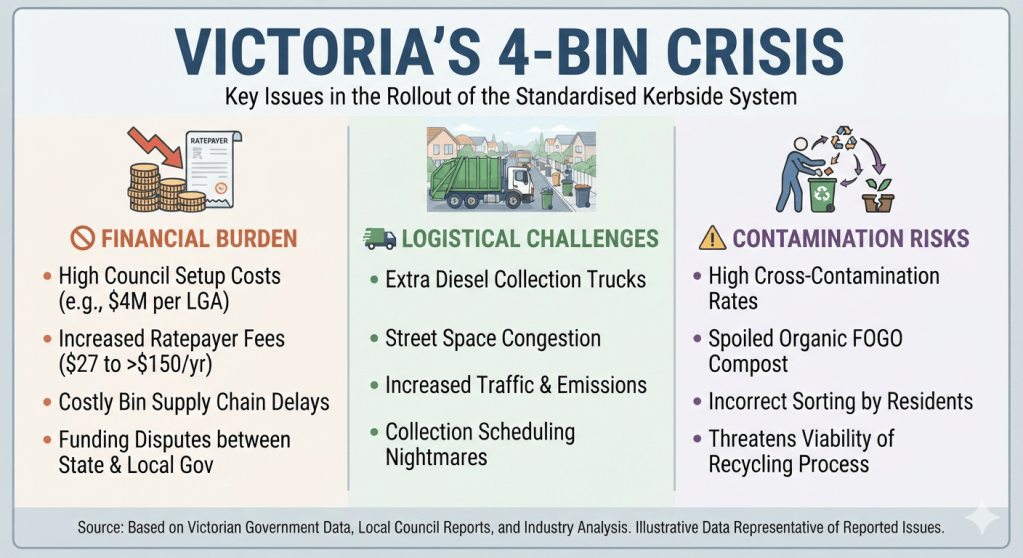
Victoria’s transition to the mandatory 4-bin kerbside recycling system has faced significant pushback from local councils, community resistance, operational inefficiencies, and mounting financial strain. While the policy aims to divert 80% of waste from landfills by 2030, the rollouts have triggered widespread debate regarding economic pragmatism and street-level logistics.
1. Cost and Ratepayer Inefficiencies
The underlying economic model of deploying a fourth residential bin is a primary source of complaint:
- Passed-on Council Costs: Independent modelling indicates that implementing the separate glass kerbside bin costs a typical council roughly $4 million to establish, with ongoing operational costs translating to an extra $27 to $150 per household each year added to local property rates.
- Total State-Wide Burden: The cumulative cost to Victorian councils to deploy the purple glass-only infrastructure is estimated to reach $75 million across just the immediate metropolitan regions.
- Premature Rate Invoicing: Residents in some municipalities reported being billed higher rates for compulsory green FOGO bins months before they were physically delivered due to supply chain backlogs.
2. Duplication and Redundancy Concerns
Many local government areas argue that the state’s mandate creates a redundant system:
- The CDS Vic Clash: A total of 35 Victorian councils joined forces to campaign against the purple bin, arguing that the Container Deposit Scheme (CDS Vic) already handles bulk glass container recycling efficiently.
- Overwhelming Public Opposition: A massive multi-council survey of nearly 25,000 Victorians revealed that 83% of respondents rejected the fourth bin, while over 91% preferred expanding the CDS to accept glass wine and spirit bottles instead.
- Low Bin Utility: Council leaders note that because a high volume of glass goes directly to 10-cent refund points, many households take months to fill a residential glass bin, meaning councils are paying to collect near-empty bins.
3. Logistical Risks and Urban Delays
Adding separate collection streams introduces complex issues to neighborhood streets:
- Street Congestion: Navigating narrow suburban streets with up to four massive garbage trucks creates traffic bottlenecks and safety hazards, particularly in high-density areas with heavy street-side parking.
- Environmental Hypocrisy: Forcing extra heavy-duty diesel trucks onto municipal collection routes directly drives up carbon emissions, contradicting local sustainability goals.
- The Fortnightly Odour Trade-off: To accommodate the new streams, some councils have reduced general rubbish collections to a fortnightly roster, sparking complaints about overflowing bins and foul odours.
4. Severe Material Contamination
Even when the bins are physically deployed, sorting behavior undermines the circular loop:
- Compost Spoilage: Food Organics and Garden Organics (FOGO) lines frequently suffer from high cross-contamination rates from non-compostable plastic bags and soft plastics, which ruins the resulting farm compost.
- Hazardous Materials: Regional waste processing sites have reported instances of dangerous materials—including plastics, glass, and metals—improperly dumped inside organic collections, threatening soil quality.
- Economic Unviability: Only 12% of plastics are successfully recovered overall. Incorrect sorting leaves mixed recycling loads highly contaminated, forcing facilities to reject entire truckloads and bury them directly in landfill anyway.
Footnotes & Official Resource Links
- [1] Victorian Government Circular Economy Policy Target – Outlines the state’s 10-year transition strategy and waste authority structure.
- [2] Infrastructure Victoria Community Focus Research – Assessment of residential willingness to separate waste streams and ratepayer friction.
- [3] Cardinia Shire Council Public Survey Report – Independent data on the $4 million rollout cost and community opposition statistics.
- [4] Whitehorse City Council 35-Council Coalition Update – Collective municipal statement urging a freeze on the purple bin deadline.
- [5] News.com.au Ratepayer Financial Impact Report – A regional list of councils protesting the financial impact of the fourth bin rollout.
- [6] Waste Management Review 4-Bin Debate Analysis – Criticisms from local government officials regarding zero consultation on state mandates.
- [7] Sustainability Victoria Agricultural Compost Quality Studies – Investigates how severe plastic contamination ruins regional farm soil restoration.
- [8] Wyndham TV Local Supply Chain Delay Coverage – Investigative report regarding premature billing for delayed infrastructure deliveries.
- [9] Manningham Council Local Kerbside Assessment – Outlines the $75 million shared council transition bill and neighborhood street truck congestion.
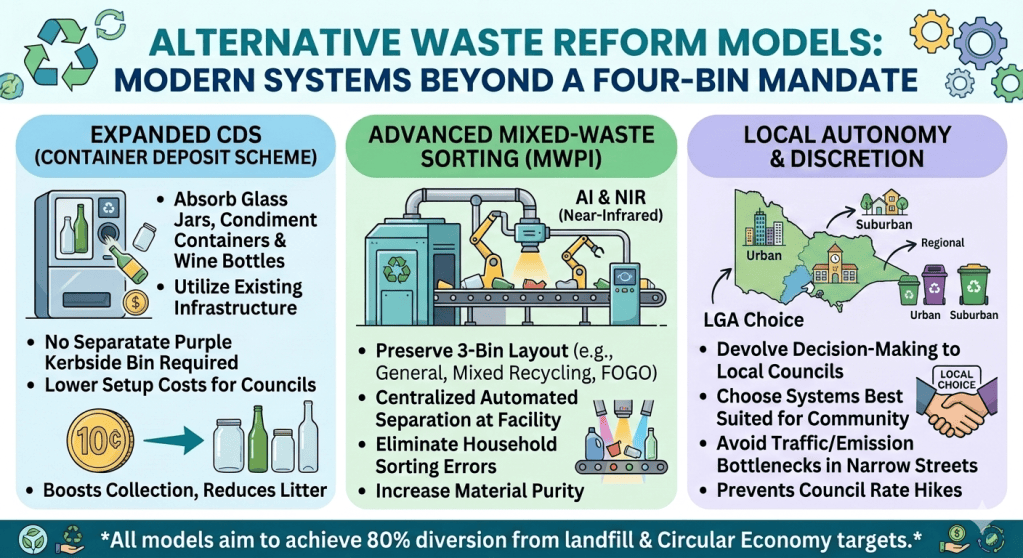
To address the financial and logistical strain of the mandated 4-bin rollouts, several credible reform alternatives have been put forward by local government coalitions, waste management experts, and political groups. These proposals aim to salvage Victoria’s circular economy targets by substituting rigid statewide mandates with flexible, cost-effective infrastructure models.
1. The 35-Council “Let’s Be Clear on Glass” Coalition Proposal
Led by a united group of 35 Victorian local governments—including Manningham, Campaspe, and Mansfield—this model advocates for leveraging existing deposit infrastructure:
- Scrapping the Purple Bin Mandate: The primary policy demand is for the state government to completely repeal or indefinitely freeze the mandatory July 2027 purple glass bin roll-out deadline. [1]
- Expanding the Container Deposit Scheme (CDS Vic): Instead of collecting glass at the kerbside, councils propose updating the scheme to accept glass food jars, condiment bottles, wine bottles, and spirit bottles. [1, 2]
- Fiscal Relief for Ratepayers: Removing the purple glass stream would instantly save millions in upfront capital costs—such as the $5.8 million initialization cost cited by Wyndham City Council—directly preventing a surge in residential property rates. [1, 3]
2. The Liberal-National Coalition “Local Discretion” Platform
The formal political opposition platform offers a total legislative shift away from the centralized mandate:
- Repealing the One-Size-Fits-All Policy: The Coalition has formally pledged to dismantle the strict purple-lidded glass recycling bin mandate. [2, 4]
- Devolving Power to Local LGAs: Under this reform, individual councils would be granted full autonomy to choose the waste separation and collection system that best fits their specific topography, street width, and community budget. [2, 4]
- Regional Exclusion Zones: High-density metropolitan areas with heavy street parking or narrow inner-city alleys could legally bypass the fourth bin entirely to eliminate traffic congestion. [2, 5]
3. Advanced Mixed-Waste Processing Infrastructures (MWPI)
Waste engineering firms and sustainability advocates propose shifting the sorting burden from households to technology:
- Deploying AI and Near-Infrared Sorting: Instead of forcing households to sort plastics and glass into separate bins, investments would focus on expanding municipal Material Recovery Facilities (MRFs) with automated optical sorters.
- Preserving the Standard 3-Bin Layout: By keeping the familiar 3-bin system (General, Mixed Recycling, and FOGO) and using automated sorting hubs downstream, councils can completely prevent citizen sorting errors and cross-contamination.
- Lower Fleet Emissions: Keeping a maximum of three bins per property ensures that councils do not have to put extra diesel-powered collection vehicles onto the roads, avoiding a net increase in local carbon footprints. [6, 7]
Footnotes & Official Resource Links
- Liberal Victoria Policy Release – Official pledge to scrap the fourth bin mandate and expand the Container Deposit Scheme.
- Hume City Council Official Statement – Overview of public opposition rates and support for returning autonomy to local councils.
- Manningham Council Mayoral Release – Urgent calls for the Environment Minister to halt the mandatory July 2027 rollout.
- Campaspe Shire Council Coalition Data – Multi-council independent modelling showing the $4 million setup cost and 83% public rejection rate.
- Geelong Times Waste Management Analysis – Examination of downstream industrial container sorting alternatives versus separation at the kerb.
- Yahoo News Australia Environmental Report – Outlines local government concerns over diesel emissions and truck traffic duplication.
- Wyndham City Council Infrastructure Cost Breakdown – Real-world data mapping out the multi-million dollar local delivery and operational shortfalls. [1, 2, 3, 4, 5, 6, 7]
Australian states operate under independent statutory targets and frameworks, resulting in drastically different household kerbside models and diversion outcomes. While the Federal National Waste Framework establishes a uniform macro goal to reach an 80% resource recovery rate by 2035, execution remains highly fragmented.
State Policy Frameworks & Strategic Targets
Each state utilizes distinct legislative instruments, infrastructure targets, and municipal funding mechanisms to manage residential waste diversion:
- Victoria: Governed by the Circular Economy Act 2021, the state enforces a strict, centralized top-down mandate forcing all municipal councils to roll out a prescriptive 4-bin kerbside infrastructure layout.
- New South Wales: Managed via the NSW Waste and Sustainable Materials Strategy, the state utilizes targeted mandates—such as requiring separate Food Organics and Garden Organics (FOGO) source separation by 2030—while relying primarily on escalating landfill levy economic penalties to alter council behavior rather than banning bin variations.
- Western Australia: Governed by the WA Waste Avoidance and Resource Recovery Strategy 2030, policy focuses tightly on a standard 3-bin layout (General, Recycling, FOGO) across high-density metro zones, alongside regional market development grants to expand localized reprocessing infrastructure.
- South Australia: Operating under Green Industries SA, the state avoids highly rigid infrastructure mandates, relying instead on long-term infrastructure funding, early FOGO organic collection adoption, and advanced sorting system frameworks.
Structural Comparison Matrix
The table below highlights the divergence in state rules, municipal layout constraints, and overall resource recovery milestones:
| Jurisdiction | 📋 Statutory Kerbside Framework | 🗑️ Household Bin Standard | 🎯 Target Recovery Rate | 📈 Realized Diversion Outcomes |
|---|---|---|---|---|
| Victoria | Centralised State Mandate [4] | 4 Bins Required (Red, Yellow, Green, Purple) | 80% diversion by 2030 | Not on track; severe council rollout bottlenecks and supply pushback. |
| New South Wales | Landfill Levy & Organic Mandates [2] | 3 Bins (FOGO mandatory by 2030) | 80% average recovery by 2030 | Moderate progress; high commercial recovery but stubborn household landfill volumes. |
| Western Australia | Local Council Waste Plans [3] | 3 Bins (FOGO rollout across Perth/Peel) | 75% material recovery by 2030 | High regional performance; rapid organic diversion but lower plastic yields. |
| South Australia | Economic Incentives & Market Creation [1] | 3 Bins (High mature organic system integration) | Zero waste to landfill trajectory | National Leader; consistently logs highest municipal recovery rates across Australia. |
Practical Operational Disparities
These competing regulatory approaches cause direct discrepancies in consumer waste systems:
- The Glass Sorting Dilemma: A Victorian household must store and separate glass shards into a dedicated purple container at the kerb. Conversely, in NSW and South Australia, glass is processed as co-mingled material inside the yellow container or diverted via the automated Material Recovery Facility optical sorting arrays.
- Organic Waste Discrepancies: South Australian councils have successfully processed food scraps alongside garden vegetation for over a decade. Meanwhile, Victorian and NSW municipalities are experiencing logistics delays, residential sorting friction, and severe agricultural compost contamination issues.
- Financial Disparities: Victorian residents face escalating property rate hikes to subsidize the raw cost of purchasing and carting extra wheelie bins. In contrast, states focused on market demand models (like SA) cushion local rates by selling high-purity recycled plastic resins and compost materials back into commercial agricultural sectors.
Footnotes & Official Resource Links
- **** Federal Department of Climate Change (DCCEEW) National Waste Report – Comparative national analytics detailing real-world waste recovery metrics across states.
- **** NSW Waste and Sustainable Materials Strategy Target Framework – Legislative guidelines mapping out New South Wales’ 2030 organic and recycling goals.
- **** Western Australia Waste Authority Strategy 2030 – Detailed operational directives regarding the three-bin kerbside execution in Perth.
- **** Victorian Auditor-General’s Office Recycling Capacity Report – Formal audit assessing Victoria’s failure to meet its statutory circular economy targets.
- **** National Circular Economy Targets Directory – Consolidated state-by-state resource tracking resource productivity frameworks.
- **** MDPI Environmental Governance Systems Study – Academic comparative critique detailing the uneven progress and systemic barriers across 520 councils.
International comparisons show that while Victoria enforces separate kerbside collections, nations like Canada are transitioning toward producer-funded operational infrastructure. Alternative administrative philosophies exist —varying from centralized state sorting codes to strictly corporatized product frameworks.
Policy Frameworks & Global Strategy Models
Varying global jurisdictions implement separate regulatory tools to divide processing costs and achieve high-yield loop cycles:
- Germany: Widely recognized as a global leader in waste management, Germany utilizes the Verpackungsgesetz (Packaging Act) and a highly rigorous “Green Dot” (Der Grüne Punkt) dual system [1]. Rather than depending solely on local government bin collections, the corporate sector financially funds the downstream recovery of the packaging materials they put out into the market.
- Japan: Operating under the Act on the Promotion of Sorted Collection and Recycling of Containers and Packaging, Japan relies heavily on intensive, community-enforced sorting [2]. Residents manually wash, flatten, and separate household waste into up to 10 or more distinct sub-categories, which are strictly inspected at local community collection points.
- Canada: Waste policy is shared between provincial frameworks and municipal execution, but the country is aggressively transitioning to Full Extended Producer Responsibility (EPR) systems. Under Ontario’s Resource Recovery and Circular Economy Act, oversight of the “Blue Box” residential recycling framework completely transfers to Circular Materials, a corporation funded 100% by packaging producers. [1, 2]
Structural Comparison Matrix
The table below details the execution of household sorting structures, producer funding rules, and localized resource recovery outcomes globally:
| Nation / Jurisdiction | 📋 Statutory Sorting Strategy | 🗑️ Residential Separation Method | 🎯 Target Recycling Rate | 📈 Realized Diversion Outcomes |
|---|---|---|---|---|
| Germany | Corporate Dual Loop Responsibility | 5–6 Streams (Bio-waste, Paper, Glass, Plastics/Metals, Residual) [1] | 63% packaging recycling by weight [1] | Global Leader; consistently hits over 65% total municipal waste diversion [1]. |
| Japan | Community-Enforced Sorting | Multi-stream (Meticulous manual washing and flattening required) [2] | 85% PET bottle recycling target [2] | Exceptional Material Purity; boasts the world’s highest recovery and loop yields for clean plastics [2]. |
| Canada | Transition to Full Extended Producer Responsibility (EPR) | Province-dependent (E.g., Ontario Single Blue/Black Bin; BC separate flexible films) | Materials-specific phased targets (e.g., 25% flexible plastics by 2032) | Moderate/Uneven Diversion; National diversion sits around 48%, with BC leading at ~32.7% local yield. |
| Victoria (Australia) | Centralized State Government Mandate | 4 Bins (Red, Yellow, Green, Purple streams) | 80% diversion from landfill by 2030 | Developing system; severely impacted by local council rollout friction and infrastructure delays [4]. |
Practical Operational Disparities
Comparing Victoria’s model with Canada’s evolving infrastructure provides distinct structural contrasts:
- The Funding Shift: In Victoria, ratepayers directly absorb property fee hikes to pay for municipal council bin rollouts and collection vehicles. In contrast, Canada’s newest systems (like Ontario) strip the financial and operational burden away from local municipal taxes completely, forcing consumer corporations to contract private providers like Miller Waste to operate household bins. [1, 3]
- Targeting Core Materials: While Victoria forces a structural split across four physical bins to separate basic materials, Canadian research shows that optimizing municipal sort lines to strip out “non-core” materials lowers total operation costs without reducing pure recycling yields. [4]
- Flexible Plastic Capabilities: British Columbia stands out in North America as an international benchmark for collecting and recovering flexible soft plastics at the kerbside. Meanwhile, Victoria prohibits soft plastics from entering mixed household streams due to severe facility sorting restrictions. [5]
Footnotes & Official Resource Links
- [PDF] Germany Federal Environment Agency Waste Guide – Detailed statutory breakdown of the Verpackungsgesetz, dual systems, and realized European packaging yields.
- Japan Ministry of the Environment Recycling Policy – Official regulatory directives detailing container packaging acts and plastic recycling initiatives.
- Circular Materials Canada Policy Update – Structural outline explaining Ontario’s transition to full producer-operated Blue Box frameworks.
- Victorian Auditor-General’s Office Recycling Capacity Report – Formal audit assessing Victoria’s failure to meet its statutory circular economy targets.
- [PDF] ResearchGate Study on Canadian System Efficiencies – Academic review tracking expenditure ratios and multi-province waste output indexes.
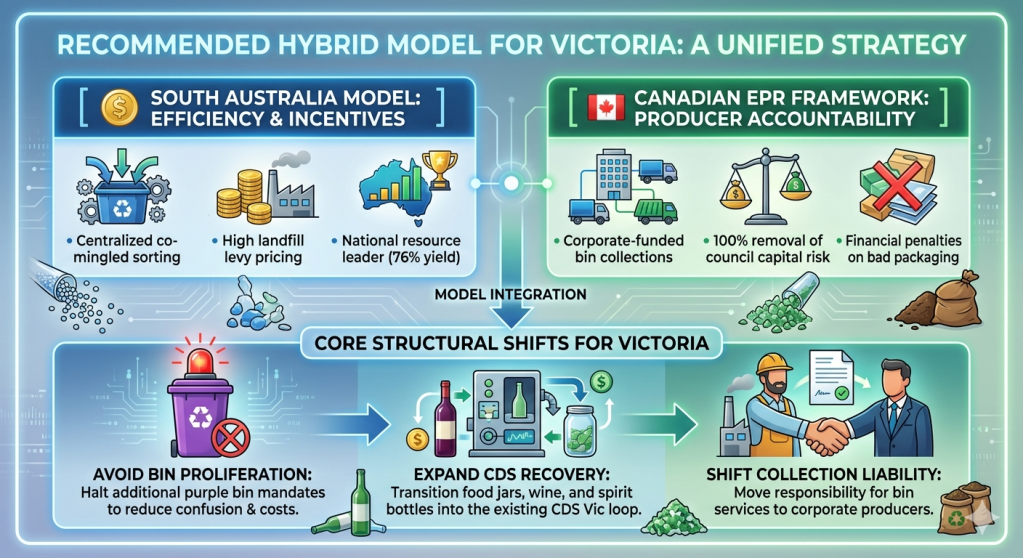
To resolve Victoria’s ongoing 4-bin deployment bottlenecks and high contamination rates, independent waste management audits suggest shifting to either South Australia’s incentive-driven market framework or Canada’s Extended Producer Responsibility (EPR) model. Rather than relying on strict, state-mandated kerbside separation, these systems lower consumer confusion and completely remove financial strain from municipal property rates.
1. The Best Interstate Model: South Australia
South Australia is consistently recognized as Australia’s resource recovery leader, logging a 76% national-peak recycling rate compared to Victoria’s lagging metrics. [1]
- Advanced Centralized Co-Mingling: South Australia does not require households to separate glass at the kerbside. Instead, glass is thrown into standard co-mingled recycling containers and processed using advanced optical, mechanical, and near-infrared sorters downstream at centralized recovery hubs. [1]
- High Landfill Levy Pricing: Rather than using legal bin mandates, South Australia leverages a highly aggressive landfill levy framework to make dumping waste cost-prohibitive. This forces commercial providers to naturally invest in sorting technologies to bypass heavy government fees.
- Mature Market Integration: By treating waste as a high-purity economic commodity for over two decades, the state provides a consistent, clean supply of organic soil inputs and raw structural glass aggregates back to its commercial farming and manufacturing sectors.
2. The Best International Model: Canada (Full EPR)
Canada’s rapidly expanding Full Extended Producer Responsibility (EPR) frameworks—specifically Ontario’s Resource Recovery and Circular Economy Act—offer a complete solution to Victoria’s ratepayer cost crisis.
- Total Financial De-Risking for Councils: Under the Canadian system, the corporate entities that manufacture plastic and glass packaging must fully operate and fund the residential recycling framework. Forcing corporations to cover 100% of collection costs would immediately eliminate the multi-million dollar setup burdens forcing up local Victorian council rates.
- A-Z Private Infrastructure Control: Private producer coalitions like Circular Materials contract waste logistics operators directly, completely removing municipal councils from managing collection vehicle trucks, bin distribution networks, or facility shortfalls.
- Packaging Eco-Design Incentives: Because consumer corporations must pay for the physical disposal of their own products, they face a direct financial incentive to stop manufacturing hard-to-recycle multi-layer plastics, which naturally purifies the household recycling loop at the factory source.
Recommended Path Forward for Victoria
To rescue its circular economy goals, waste experts suggest Victoria merge the structural strengths of both models into a localized hybrid framework:
                            PROPOSED CORE STRUCTURAL SHIFTS

   [ STEP 1: STOP BIN MANDATES ] ➔ Freeze the July 2027 purple glass bin rollouts.
   [ STEP 2: EXPAND CDS RECOVERY ] ➔ Absorb wine, spirits, and food jars into CDS Vic.
   [ STEP 3: ESTABLISH EPR CODES ] ➔ Pivot bin collection liabilities onto corporate producers.
- Abolish the 4-Bin Mandate: Freeze the prescriptive, top-down purple bin rollout requirements to ease immediate suburban street congestion and council expenditure crises.
- Expand CDS Vic Capacity: Update the Container Deposit Scheme (CDS Vic) to accept glass wine and spirit bottles, matching South Australia’s highly successful deposit scheme.
- Transition to National EPR: Align with the emerging Extended Producer Responsibility Scheme for Packaging Bill 2026 to permanently strip operational recycling liabilities out of municipal rate notices and place them onto commercial brands. [2]
Footnotes & Official Resource Links
- **** Inside Waste National Recovery Performance Report – Analytical review showcasing South Australia’s 76% national-peak resource recovery victory.
- **** Circular Materials Canada Operational Updates – Structural outline detailing the corporate-funded transformation of Canadian residential sorting lines.
- **** Australian Senate Packaging EPR Bill 2026 Committee Tracking – Federal legislative timeline mapping out Australia’s transition to mandatory producer packaging accountability frameworks.
- **** Victorian Auditor-General’s Resource Efficiency Evaluation – Formal audit reviewing Victoria’s historical waste framework gaps and collection sorting bottlenecks.


Leave a Reply