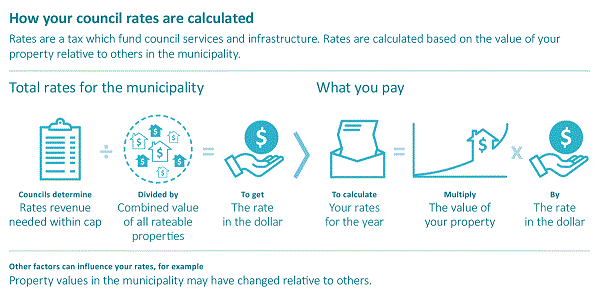
Victorian councils face a growing imbalance in how local government is funded and managed.
Asset-to-Population Mismatch
Metropolitan councils benefit from large populations concentrated within relatively small geographic areas, allowing infrastructure costs to be shared across many ratepayers. In contrast, rural and regional shires manage vast road networks and extensive public assets with a much smaller ratepayer base. Some regional councils are responsible for significant portions of Victoria’s road network while serving only a fraction of the state’s population.
Unfunded Responsibilities and Cost Shifting
Local councils are increasingly required to deliver and administer state government programs and regulatory functions without receiving adequate ongoing funding. This places additional pressure on council budgets and diverts resources away from core local services and infrastructure maintenance.
Infrastructure Pressures
Victorian councils generally maintain low levels of debt compared with local governments in other states. While this reflects prudent financial management, it also highlights a growing challenge: aging infrastructure, increasing maintenance costs, and limited revenue sources. Many councils face substantial renewal backlogs that cannot be addressed through rates revenue alone.
1. Reform the Fair Go Rates System ✅
I will press for reform Victoria’s rate-capping framework to provide greater flexibility for councils facing significant infrastructure and asset-management pressures.
How It Works
- Retain safeguards against excessive rate rises.
- Introduce a flexible, tiered approach that recognises differences between metropolitan and regional councils.
- Allow infrastructure-intensive rural councils greater capacity to raise revenue where justified and transparent.
Outcome
- More sustainable local government finances.
- Reduced structural deficits in regional communities.
- Better maintenance of roads and community assets.
2. Establish a Guaranteed State–Local Revenue Sharing Agreement ✅
My priority will be a permanent share of state-generated revenue to be distributed directly to local government.
How It Works
- Allocate a fixed percentage of an agreed state revenue stream to councils.
- Provide predictable, ongoing funding rather than relying heavily on competitive grant programs.
- Ensure funding grows alongside state revenues and community needs.
Outcome
- Greater financial certainty for councils.
- Improved long-term infrastructure planning.
- Reduced dependence on short-term funding announcements.
3. Regional Shared Services and Joint Venture Hubs ✅
I support the creation of regional shared-service hubs for small and medium-sized councils.
How It Works
- Combine administrative, legal, procurement, and technology services across neighbouring councils.
- Preserve local governance and community representation.
- Direct efficiency savings into frontline services, engineering capacity, and asset maintenance.
Outcome
- Lower administrative costs.
- Stronger regional capability and expertise.
- More funding available for essential local infrastructure and services.
These steps will strengthen the financial sustainability of local government by recognising the unique challenges faced by rural and regional councils. Through fairer revenue arrangements, smarter regulation, and more efficient service delivery, we will ensure communities receive the infrastructure and services they deserve, regardless of where they live.
Google backgrounder
Local government funding in Victoria is structured as a highly constrained financial model, where municipal councils generate the vast majority of their revenue locally but rely on state and federal grants to build and maintain their infrastructure. [1, 2, 3]
Unlike state and federal governments, Victorian councils operate under a strict, legally mandated fair go rates system (rate cap) that severely limits their ability to increase independent revenue. [4, 5]
📊 The Victorian Council Revenue Mix
According to financial data from the Essential Services Commission (ESC), the typical funding profile for a Victorian municipal council splits into four main streams:
[ Municipal Rates: 55-60% ] ──> [ Grants (Fed/State): 20-25% ] ──> [ User Fees: 10-15% ] ──> [ Developer Levies: 5% ]
- Municipal Property Rates (55% – 60%): The primary funding baseline. This is property tax levied on residential, commercial, and agricultural land valuations within the municipality.
- Government Grants (20% – 25%): A combination of untied ongoing federal cash and competitive state capital infrastructure injections.
- User Fees and Charges (10% – 15%): Localized fee-for-service collections including parking meters, waste disposal tips, childcare center fees, leisure center memberships, and planning permit applications. [6]
- Statutory Developer Contributions (~5%): Cash or physical infrastructure levies handed over by property developers to fund local roads, drainage networks, and open park spaces in new sub-divisions.
🛑 1. The Rate Capping Constraint
The single biggest factor shaping Victorian local government finance is the Fair Go Rates System, introduced in 2016 and administered by the ESC. [7, 8]
- How it Works: Every year, the Victorian Minister for Local Government sets a maximum percentage cap (typically tracking close to baseline CPI inflation) by which councils can increase their overall rate revenue. [9, 10]
- The Disadvantage: While it protects ratepayers from steep tax hikes, rural and regional councils strongly criticize the cap. Because rural councils have massive road networks but tiny populations, the rate cap prevents them from raising the funds required to repair crumbling infrastructure following extreme weather events. [11, 12, 13, 14]
- The Higher Cap Escape: Councils can formally apply to the ESC for a “higher rate cap” exemption, but they must provide extensive evidence of structural financial distress or clear community consensus to secure approval. [15]
🏛️ 2. The Federal Funding Stream (Untied Grants)
Because councils cannot collect income tax or GST, the Federal Government transfers cash downwards via the Financial Assistance Grants (FA Grants) program. [16]
- The Allocation: These grants are completely “untied,” meaning councils can choose to spend the cash exactly where they see fit, whether on library staff salaries or fixing a local bridge. [17]
- The Victoria Grants Commission: The federal pool is handed to the state-level Victoria Grants Commission, which uses a complex horizontal equalization formula to distribute the money. The formula heavily tilts funding away from wealthy metro councils and routes it toward isolated outer rural micro-towns with low property value tax bases.
🧱 3. The State Funding Stream (Tied Capital Grants)
The Victorian State Budget injects funding into local councils, but unlike federal grants, this money is strictly “tied” to specific capital projects and policy programs. [18]
- Infrastructure Grants: Distributed via targeted, competitive grant funds. Examples include the Tiny Towns Fund (for towns under 5,000 residents), the Growing Suburbs Fund (for city fringe growth corridors), and emergency regional road repair funds.
- Co-Investment Mandates: To secure state cash, councils are frequently forced to match the funding dollar-for-dollar using their own rate revenue. This often leaves poor rural councils unable to apply for state grants because they lack the spare local cash to meet the co-investment threshold. [19, 20, 21, 22, 23]
⚠️ The Regional Council Funding Crisis
The structural design of local government funding has created a widening financial divide between metropolitan and regional Victoria:
- The Asset-to-Population Mismatch: Metropolitan councils enjoy dense populations spread over tiny geographical footprints, meaning thousands of ratepayers fund each kilometer of local road. In contrast, rural shires like those in the Mallee or Wimmera manage up to 10% of the state’s total road network but hold less than 1% of the ratepaying population.
- Cost Shifting: Councils frequently accuse the State Government of “cost-shifting”—handing down new regulatory enforcement tasks (such as expanded swimming pool safety checks, emergency management planning, and complex library management) without providing corresponding ongoing state funding to pay for the staff. [24, 25, 26]
[2] https://www.parliament.vic.gov.au
[3] https://www.tandfonline.com
[4] https://www.parliament.vic.gov.au
[5] https://www.audit.vic.gov.au
[6] https://news.councilwise.com.au
[7] https://www.parliament.vic.gov.au
[8] https://www.murrindindi.vic.gov.au
[9] https://www.audit.vic.gov.au
[10] https://www.localgovernment.vic.gov.au
[11] https://www.parliament.vic.gov.au
[12] https://www.audit.vic.gov.au
[13] https://www.viccouncils.asn.au
[14] https://www.victoriawalks.org.au
[15] https://www.audit.vic.gov.au
[17] https://www.localgovernment.vic.gov.au
[19] https://www.planning.vic.gov.au
[20] https://www.rdv.vic.gov.au
[21] https://www.rdv.vic.gov.au
[22] https://www.premier.vic.gov.au
[26] https://www.parliament.vic.gov.au
When comparing its broader fiscal, legislative, and council frameworks to other Australian states, Victoria stands out for its high level of fiscal centralization, strict regulatory interventions, and heavy infrastructure-associated debt load. [1]
📊 Financial & Structural Breakdown Across the States
| Feature / Metric [2, 3, 4, 5, 6] | Victoria (Vic) | New South Wales (NSW) | Queensland (Qld) | Western Australia (WA) |
|---|---|---|---|---|
| State & Local Tax Per Capita | $6,605 (Highest in Australia) | Slightly Lower than Vic | Lower (Protected by resource boom) | Lower than Vic |
| Local Rate Capping Mechanism | Strict Statewide Cap (Fair Go Rates System administered by the ESC). | Rate Pegging (Administered independently by IPART). | No Legislative Cap (Councils possess complete budget autonomy). | No Legislative Cap (Councils possess complete budget autonomy). |
| Federal FA Grant Allocation | $830.30 Million (24.1% of national pool) | $1,051.64 Million (30.5% of national pool) | $688.36 Million (20.0% of national pool) | $423.38 Million (12.3% of national pool) |
| Council Debt Profile | Extremely Low (Low per capita debt reliance) | Moderate to High | Moderate | Moderate |
🏛️ 1. The Highest-Taxed State in the Nation [7, 8]
According to independent Australian Bureau of Statistics (ABS) analysis, Victoria has officially overtaken New South Wales and Western Australia to become the highest-taxed jurisdiction in Australia. [2]
- The Figure: Combined state and municipal taxes in Victoria equate to $6,605 per person, tracking roughly 10% higher than the national aggregate average of $6,023. [2]
- The Driver: This high per capita tax burden is driven directly by state-level fiscal choices under the Allan Government. It is fueled by specialized revenue-raising instruments—including the COVID-19 debt levy, expanded land tax brackets, and high payroll tax rates—used to service the state’s multi-billion-dollar metropolitan transport infrastructure pipeline. [2, 9, 10]
🛑 2. Rigid Local Rate Controls vs. Northern Flexibility
Victoria’s approach to regulating local government income differs completely from the systems operating in northern and western Australia.
- The Southern Model (Vic & NSW): Victoria and New South Wales are the only two states that legally enforce independent rate capping. Victoria’s Fair Go Rates System restricts local council budget expansion to a baseline percentage typically tracking consumer price movements. [11]
- The Decentralized Model (Qld & WA): In stark contrast, councils in Queensland and Western Australia operate with total fiscal autonomy. Local mayors and councillors can independently adjust municipal property rates higher or lower to instantly react to infrastructure emergencies, such as rebuilding washed-out regional freight roads after major flood or weather events.
💰 3. Minimal Council Debt vs. Inter-State Reluctance
While the Victorian State Government carries massive debt on its sovereign ledger to fund city mega-projects, its municipal councils follow the opposite strategy. [2, 12]
- Low Debt Baseline: Data compiled by Local Government Victoria shows that Victorian municipal councils collectively carry significantly less per capita debt on their balance sheets than local government areas in any other state or territory. [4]
- The Asset Risk: Because Victorian councils avoid borrowing money, they remain overwhelmingly dependent on federal Financial Assistance Grants and state-tied capital funding to complete basic renewals. Local government bodies point out that while they have tiny operating debts, they are heavily “infrastructure-laden”—carrying massive maintenance and depreciation backlogs for aging public assets that simple rate revenue cannot fix. [11, 13, 14]
[4] https://www.localgovernment.vic.gov.au
[5] https://www.themandarin.com.au
[6] https://www.themandarin.com.au
[10] https://www.heraldsun.com.au
[11] https://www.regionalcitiesvictoria.com.au
[12] https://www.afr.com
Serious proposals for local government funding reform in Victoria focus on removing the restrictive rate cap, introducing state-wide tax sharing, restructuring rural councils, and eliminating cost-shifting. [1]
As regional and rural councils face increasing financial strain from severe weather events and infrastructure backlogs, peak bodies like the Municipal Association of Victoria (MAV), FinPro, and independent reviews have put forward several structural reform blueprints: [2, 3, 4, 5, 6]
1. Overhauling or Abolishing the Fair Go Rates System [7]
- The Proposal: Replace the rigid, state-mandated inflation-linked rate cap with a flexible, tiered system, or abolish it entirely to match the fiscal autonomy enjoyed by councils in Queensland and Western Australia.
- The Mechanism: Under a tiered model, high-growth metropolitan councils would remain under a strict cap, while infrastructure-heavy, low-population rural councils would be given the freedom to set rates that accurately reflect their real asset maintenance costs.
- The Goal: To stop the compounding structural deficits hitting regional shires that manage massive road networks but have tiny rating bases.
2. Establishing a Fixed State-Local Tax Sharing Agreement
- The Proposal: Legislate a guaranteed, permanent percentage slice of a broad-based state tax stream—such as the Goods and Services Tax (GST) pool or Land Tax revenue—to be distributed directly to local government. [8, 9]
- The Mechanism: This would mirror the German federal model, shifting councils away from their heavy reliance on unpredictable, short-term, competitive state capital grants (like the Tiny Towns Fund).
- The Goal: To provide a predictable, growing operational funding stream that allows councils to independently plan long-term infrastructure renewals without state political interference.
3. An Anti-Cost-Shifting Act (The “No Mandate Without Funding” Rule)
- The Proposal: Introduce strict legislation that legally bans the Victorian Government from passing new regulatory responsibilities onto councils unless it explicitly provides the ongoing funding to pay for them.
- The Mechanism: If the state hands down new compliance tasks—such as expanded emergency management planning, roadside weed control, or complex swimming pool safety registries—it must attach a permanent funding stream to cover the administrative and staffing costs. [10]
- The Goal: To protect local municipal rate revenue from being diverted into executing state-level policy portfolios.
4. Direct Federal-to-Local Funding Models
- The Proposal: Permanently bypass the state government layer by expanding direct federal funding mechanisms, specifically by raising the national Financial Assistance Grants pool to a fixed minimum of 1% of total federal tax revenue.
- The Mechanism: Funding would flow directly from the Commonwealth Treasury straight to local council bank accounts, expanding untied allocations and programs like the Roads to Recovery initiative.
- The Goal: To reduce the ability of state governments to redirect infrastructure funding into city-centric mega-projects at the expense of regional assets. [11, 12, 13]
5. Shared Services and Regional Joint Venture Hubs
- The Proposal: Mandate the structural amalgamation of “back-of-house” administrative, IT, legal, and procurement operations across clusters of small rural councils, without forcing a full political amalgamation of the shires themselves.
- The Mechanism: Multiple micro-town councils would utilize a single, shared corporate services hub, drastically lowering administrative overheads. The saved operational cash would then be legally locked into frontline asset maintenance and local engineering teams.
- The Goal: To build institutional and financial scale within struggling rural shires while preserving local democratic representation for small communities.
[3] https://www.murrindindi.vic.gov.au
[4] https://www.centralgoldfields.vic.gov.au
[6] https://engagingmitchellshire.com
[7] https://www.premier.vic.gov.au
[9] https://www.dtf.vic.gov.au
[10] https://www.horowhenua.govt.nz
[11] https://alga.com.au
[12] https://www.heraldsun.com.au
The Fair Go Rates System (FGRS) was implemented by the Victorian State Government in December 2015to limit uncontrolled municipal rate hikes and ease cost-of-living pressures. [1, 2, 3]
Why it was implemented
The framework was established to address a decade of steep local council tax hikes, during which council rates across Victoria grew by an average of 6% every year. The system targets two major objectives: [1, 3]
- Ratepayer protection: Shielding households from sudden financial strain by capping annual municipal property tax increases to a stable baseline, typically aligned with the Consumer Price Index (CPI). [4, 5]
- Financial accountability: Forcing municipal governments to improve sound financial management, find internal efficiencies, and justify any major spending directly to an independent oversight body. [1, 3, 4]
When it was implemented
The legislation officially passed the Victorian Parliament in December 2015. The concrete rate-capping restrictions went into active effect starting from the 2016–17 financial year. [1, 2, 6]
Who implemented it
The system was driven into law by the Victorian Labor Government under Premier Daniel Andrews, specifically led by the then-Minister for Local Government, Natalie Hutchins. It delivered on a major election platform promise made by the party in the lead-up to the 2014 state election. [1, 4, 6, 7]
While the State Government holds the authority to legislate the system and set the actual annual cap percentage, it appointed the Essential Services Commission (ESC) to act as the independent regulator. The ESC is tasked with reviewing compliance, providing annual cap recommendations, and evaluating heavy-scrutiny applications from councils requesting a special “higher cap” beyond the inflation baseline. [2, 3, 8, 9, 10]
The NSW Rate Pegging system was implemented by the New South Wales State Government under the Labor Premier Neville Wran in 1977 to protect ratepayers from soaring property taxes. [1, 2, 3, 4]
While it was originally managed directly by the Minister for Local Government, the responsibility to independently calculate and set the cap was officially delegated to the Independent Pricing and Regulatory Tribunal (IPART) in 2010. [1, 5]
Why it was implemented
The framework was introduced to structurally reform how municipal councils generated revenue, solving three primary issues:
- Ratepayer financial relief: Inflation was exceptionally high during the mid-1970s. The state government needed a legislative mechanism to stop local councils from passing unrestricted, compounding cost increases onto households. [1]
- Controlling municipal spending: It forced local councils to exercise strict budget discipline, optimize internal productivity, and control operational expenditures rather than relying on automated tax hikes. [1, 6]
- Political strategy: Historically described as a potent piece of electoral policy, it gave state politicians a popular mechanism to show voters they were directly intervening to curb cost-of-living pressures. [2]
When it was implemented
- 1977 (Origin): The system was first codified into law under amendments to the original Local Government Act. [2, 7]
- 1993 (Modern framework): The system was carried over as a core fixture under Section 506 of the modernized NSW Local Government Act 1993. [8]
- 2010 (IPART takeover): To remove political bias from the process, the NSW Government formally handed the duty of setting the annual percentage limit over to IPART ahead of the 2011–12 financial year. [5, 9, 10]
Who implemented it
The architecture was originally created by the Wran Labor Government. Decades later, the structural shift to an independent administrator was implemented by the Keneally Labor Government in late 2010, which officially transferred the calculation powers to IPART. [2, 5]
Today, IPART functions as the objective umpire. It utilizes a tailored Local Government Cost Index (LGCI) alongside population growth adjustments to dictate the final percentage cap individual councils are allowed to apply. [5, 11]


Leave a Reply