For many low-income Victorians, financial insecurity is driven less by a lack of temporary relief and more by structural failures in housing quality, access to support services, and navigation of government systems.
Victoria already operates a wide range of concessions, emergency relief schemes, educational supports and tenancy protections. Rather than creating duplicate programmes, this platform focuses on closing identifiable gaps within Victorian Government jurisdiction through stronger compliance, earlier intervention and better service integration.
Tier 1: Rental Compliance Certification Scheme
Jurisdiction: Victorian Government
Objective: Shift rental regulation from complaint-driven enforcement to proactive compliance verification.
Proposal
Require rental providers and rooming house operators to obtain an independent compliance certificate confirming that all Victorian minimum standards have been met before a property can be advertised, leased, or have a tenancy renewed.
Certification would verify compliance with existing requirements including:
- Heating and weatherproofing standards.
- Electrical and gas safety obligations.
- Rooming house minimum standards.
- Security and amenity requirements.
- Health and safety standards.
Why this is needed
Victoria already requires rental properties and rooming houses to meet minimum standards. However, enforcement largely occurs after tenants identify problems and initiate complaints.
A certification model would reduce reliance on vulnerable tenants to police the system and would identify non-compliant properties before occupation.
Expected Outcomes
- Reduced substandard housing.
- Earlier identification of unsafe properties.
- More consistent enforcement of existing laws.
- Reduced tribunal and compliance disputes.
- Improved living standards for low-income renters.
Government Overlap
| Level | Responsibility |
|---|---|
| Victoria | Lead responsibility |
| Local Government | Information sharing and registration systems |
| Commonwealth | None |
Tier 1: Financial Counselling Workforce Expansion and Funding Reform
Jurisdiction: Victorian Government
Objective: Strengthen Victoria’s ability to prevent financial crises before they escalate into homelessness, family violence, court action or severe debt.
Proposal
- Replace short-term funding rounds with guaranteed five-year indexed funding agreements.
- Expand the financial counselling workforce in high-demand regions.
- Embed financial counsellors within housing, homelessness, family violence and community health services.
- Incorporate financial counselling as a permanent stream within Victoria’s Early Intervention Investment Framework.
- Develop a statewide workforce attraction and retention strategy.
Why this is needed
Victoria already funds financial counselling services. The key gap is workforce capacity and funding certainty rather than the creation of a new network.
Early intervention is consistently cheaper than responding after households enter crisis.
Expected Outcomes
- Reduced evictions and tenancy breakdown.
- Lower levels of unmanageable debt.
- Reduced demand on emergency housing and court systems.
- Greater household financial resilience.
Government Overlap
| Level | Responsibility |
|---|---|
| Victoria | Lead responsibility |
| Commonwealth | Partial community and legal assistance funding |
| Local Government | Community facilities and referrals |
Tier 2: Integrated Crisis Support Gateway
Jurisdiction: Victorian Government
Objective: Simplify access to existing support programmes and prevent eligible households from falling through administrative gaps.
Proposal
Create a single assessment and referral platform that connects households to existing Victorian assistance programmes through one entry point.
Participating programmes would include:
- Utility hardship assistance.
- Rental assistance programmes.
- Housing Establishment Fund services.
- Family violence support packages.
- Financial counselling.
- Homelessness prevention services.
Households would complete one assessment rather than multiple applications to different agencies.
Why this is needed
Victoria already funds most major crisis-intervention programmes. The weakness is fragmentation, complexity and inconsistent navigation between services.
This proposal improves access to existing support rather than creating new welfare programmes.
Expected Outcomes
- Faster access to assistance.
- Improved uptake of existing programmes.
- Reduced administrative burden.
- Better homelessness prevention.
- Stronger coordination across government-funded services.
Government Overlap
| Level | Responsibility |
|---|---|
| Victoria | Lead responsibility |
| Commonwealth | Data sharing and related income-support interactions |
| Local Government | Referral pathways and local partnerships |
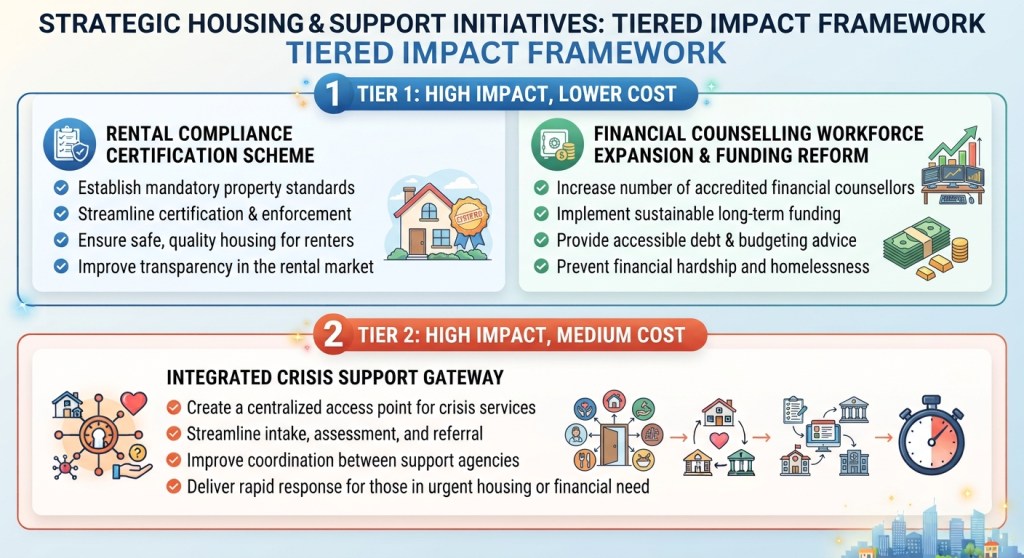
Priority Ranking
Tier 1 (High Impact, Lower Cost)
- Rental Compliance Certification Scheme
- Financial Counselling Workforce Expansion and Funding Reform
Tier 2 (High Impact, Medium Cost)
- Integrated Crisis Support Gateway


Leave a Reply