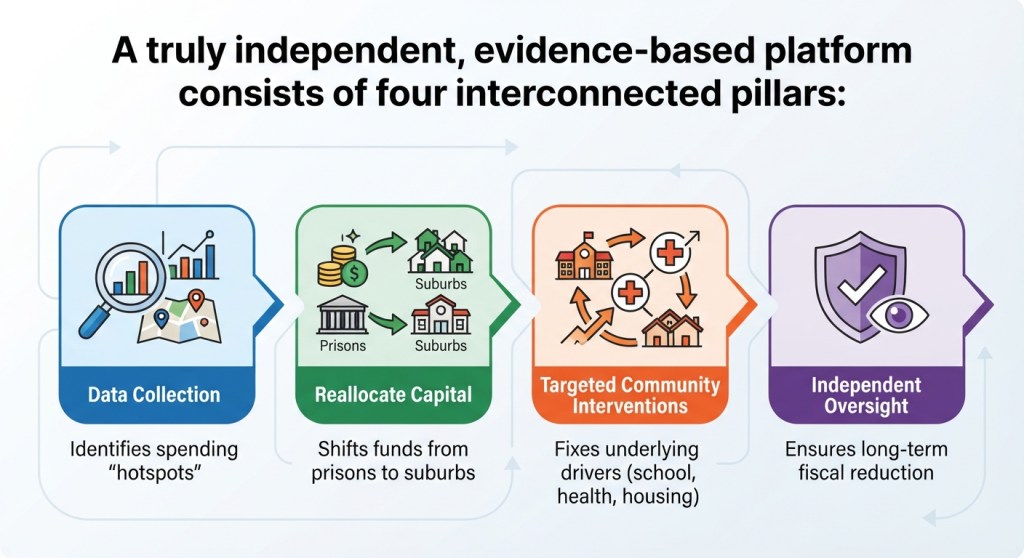
The current youth justice system is failing on three fronts. It is expensive, it produces high rates of reoffending, and it often fails to address the underlying causes of crime.
In Victoria, it costs approximately $7,304 per day to detain a young person, equivalent to around $2.6 million per year. Yet 56.6% of young people released from sentenced supervision return to supervision within 12 months, indicating that detention alone is not delivering the long-term outcomes taxpayers deserve.
Justice Reinvestment offers a practical alternative. Rather than continually expanding expensive prison capacity, it redirects resources toward evidence-based early intervention, rehabilitation and community safety initiatives that reduce offending before it occurs.
This approach is supported by growing evidence from Australia and overseas and is built around a simple principle:
Invest more in preventing crime and less in managing the consequences of failure.
1. Data-Driven Capital Reinvestment
Governments should identify communities with the highest rates of youth offending and examine the costs associated with detention, court proceedings, policing and repeat offending.
Where successful interventions reduce demand on the justice system, a portion of those savings should be reinvested into locally designed programs addressing the root causes of crime, including educational disengagement, family instability, housing insecurity and unmet health needs.
This approach reflects the core principles of justice reinvestment advanced by organisations such as Just Reinvest NSW and other community-led reform advocates. The most prominent Australian example, the Maranguka Justice Reinvestment Project in Bourke, demonstrated measurable reductions in offending and significant economic benefits for both government and the local community.
2. Expanded Diversion and Restorative Justice
Non-violent youth offenders should, wherever appropriate, be directed into diversionary and restorative processes before entering the formal court system.
These processes bring together the young person, their family, victims, police and trained facilitators to develop practical plans focused on accountability, restitution and behavioural change.
Victoria already operates Youth Justice Group Conferencing programs based on restorative justice principles, while recent reforms have introduced Early Diversion Group Conferences modelled in part on New Zealand’s Family Group Conferencing system. These programs aim to reduce reoffending, increase victim satisfaction and strengthen community reintegration.
Serious violent offenders would continue to face detention where necessary to protect public safety.
3. Health and Education-Led Early Intervention
Evidence consistently shows that many young people who enter the justice system have experienced significant disadvantage, including trauma, educational disengagement, disability, residential care placement and unmet health needs.
Policy should focus on identifying and supporting at-risk children before they become involved in offending.
Key priorities include:
- Ensuring students excluded from mainstream education are immediately connected to alternative learning pathways.
- Expanding therapeutic supports for children experiencing trauma and family violence.
- Improving access to assessment and treatment for neurodevelopmental conditions such as ADHD, FASD and other disabilities.
- Providing more stable and therapeutic care arrangements for vulnerable young people.
Research, parliamentary inquiries and the Commission for Children and Young People Victoria have repeatedly highlighted the relationship between these factors and youth justice involvement.
4. Independent Evidence-Based Oversight
Youth justice policy should be guided by evidence rather than political cycles.
An independent statutory body should regularly evaluate programs against transparent measures including:
- Recidivism rates
- Educational engagement
- Employment participation
- Housing stability
- Community safety outcomes
Programs that consistently fail to demonstrate measurable results should be reviewed, while successful interventions should receive continued support and expansion.
This would help ensure taxpayers’ money is directed toward programs that actually work.
Evidence That This Approach Can Work
Bourke, New South Wales
The community-led Maranguka Justice Reinvestment Project produced significant outcomes, including:
- 23% reduction in police-recorded domestic violence
- 38% reduction in charges across the top five juvenile offence categories
- 31% increase in Year 12 retention
- 42% reduction in days spent in custody
- Estimated economic impact of $3.1 million in a single year
These results were identified in an independent evaluation conducted by KPMG.
New Zealand
New Zealand’s youth justice system places strong emphasis on diversion, restorative justice and Family Group Conferencing.
Judicial analysis of these reforms reports that approximately 80% of youth offending is dealt with through community-based alternatives rather than formal Youth Court proceedings, helping maintain relatively low levels of youth incarceration.
International Experience
Jurisdictions around the world have increasingly explored justice reinvestment approaches that prioritise prevention, treatment and diversion alongside community safety measures. While outcomes vary between jurisdictions, the common principle remains the same: reducing long-term offending is often more effective and less expensive than relying exclusively on incarceration.
Why This Matters
Justice Reinvestment aims to achieve three goals simultaneously:
Reduce Public Spending
Detention is among the most expensive responses available to government. Effective prevention and diversion programs generally cost a fraction of the price of incarceration. Victoria’s current detention costs illustrate the magnitude of potential savings. [jss.org.au], [nationaltr…une.com.au], [jss.org.au]
Reduce Reoffending
With more than half of Victorian young people returning to supervision within 12 months of release, there is clear room for improvement. Effective interventions address the underlying drivers of offending rather than simply responding after the fact. [aihw.gov.au]
Create Safer Communities
The ultimate objective is fewer victims, fewer crimes and better outcomes for young people. By keeping vulnerable children connected to education, families, employment pathways and support services, governments can improve community safety while reducing future justice system costs.
Conclusion
The choice is not between being “tough on crime” or “soft on crime”. The real choice is between policies that are expensive and ineffective, and policies that are evidence-based and deliver results.
Justice Reinvestment offers a practical path toward safer communities, lower government expenditure and better outcomes for vulnerable young people. Rather than spending millions dealing with crime after it occurs, Victoria should invest in preventing it in the first place.
Google backgrounder
The core metrics of youth crime in Victoria are derived from official quarterly data and independent oversight reviews. According to data from the Crime Statistics Agency (CSA) Victoria, alleged youth offending incidents decreased by 6% in the year ending March 2026, dropping to 22,654 incidents. Continuing this trend, broader figures through June 2026 recorded an 8.1% drop in overall youth offending, driven by major decreases in high-profile crimes like home invasions, carjackings, and robberies. [1, 2, 3]
A breakdown of verified facts from government datasets and independent bodies outlines the state of youth justice in Victoria:
1. Offence Trends & Reductions (CSA & Police Data)
- First-Time Offenders: Official numbers show the number of first-time youth offenders dropped by more than 1,000, reaching the lowest level recorded in over a decade. [1]
- Significant Drop in Serious Crimes: In the year ending March 2026, aggravated burglaries fell by 22% and robberies dropped by 15%. Extended data through mid-2026 showed home invasions dropping 27% and carjackings down 25%. [1, 2]
- Demographic Breakdown: Crimes committed by young males experienced a distinct decline, dropping by nearly 9% over the year to March 2026. [1]
2. Recidivism and Economic Reality (Independent Audit)
An independent evaluation conducted by the Victorian Auditor-General’s Office (VAGO) published in 2026 revealed long-term systemic challenges:
- High Reoffending Rates: VAGO’s report found that 56.6% of young people reoffend and return to custody under sentence within one year of release. [1]
- Escalating Costs: According to Productivity Commission data cited by VAGO, each person in youth detention in Victoria costs $7,304 per day—the highest daily detention cost of any Australian state or territory. [1]
3. Government Interventions and Policy Discrepancies
- Bail Enforcement Impact: Victoria’s total “breach of bail conditions” offences spiked by 7,039 additional offences across all age brackets. The Premier of Victoria attributed overall community safety gains to tougher legislative mandates, though independent legal analyses note that stricter bail measures have largely shifted the metrics toward higher adult numbers and incarceration rates.
- Youth Crime Prevention Program (YCPP): Since 2016, the Victorian Government has invested over $45 million into the YCPP across 14 target areas (including Latrobe, Ballarat, and Wyndham). While internal government evaluations claim a 29% reduction in offending for individual participants, the 2026 Victorian Auditor-General report noted that broader departmental tracking lacked centralized evidence proving the program had systematically lowered overall regional reoffending rates. [1, 2, 3, 4, 5]
When evaluated alongside other Australian states and territories, Victoria historically maintains some of the lowest youth offending and youth detention rates in the country. However, like its interstate counterparts, it faces localized, intense challenges involving a small cohort of high-harm, repeat offenders. [1, 2, 3]
Data from the Australian Bureau of Statistics (ABS) and the Australian Institute of Health and Welfare (AIHW) highlights how Victoria compares across key metrics: [1, 2]
1. Youth Detention Rates
Victoria relies significantly less on youth incarceration than most other jurisdictions, consistently recording the lowest or near-lowest rates of young people in custody. [1, 2]
- The Numbers: According to the AIHW Youth Detention Population Report, Victoria’s nightly youth detention rate sits at roughly 1.4 per 10,000 young people. [1]
- The Comparison: By contrast, the Northern Territory records the nation’s highest rate at 17 per 10,000. Among the major states, Queensland holds the highest average nightly population of youths in detention—peaking at over 300 individuals compared to Victoria’s significantly lower double-digit averages. [1, 2]
2. Offender Proportions and Reoffending
While the total volume of youth crime is a major public discussion point nationwide, youth offending makes up a smaller portion of total crime in Victoria than in other states. [1, 2]
- Share of Total Crime: Youths account for roughly 12% to 13% of all crime in Victoria. Nationally, this aligns with or sits slightly below states like New South Wales. [1, 2, 3]
- Frequency of Police Action: The ABS Recorded Crime – Offenders Dataset tracks the mean number of times an individual youth offender is proceeded against by police in a financial year. Victoria sits firmly in the middle of the spectrum: [1]
| State / Territory | Mean Number of Times Proceeded Against Per Offender |
|---|---|
| South Australia | 2.4 times |
| Queensland | 2.3 times |
| Tasmania | 2.3 times |
| Victoria | 2.2 times |
| Northern Territory | 2.1 times |
| New South Wales | 2.0 times |
| Australian Capital Territory | 1.8 times |
3. Policy Alignment vs. Interstate Responses
Australian states have experienced a parallel political shift toward tightening bail and introducing more punitive measures for severe youth offenses, though their legislative baselines differ: [1, 2]
- Victoria: Championed a “split” framework. It was the first state to raise the minimum age of criminal responsibility from 10 to 12. Simultaneously, the government introduced “Adult Time for Violent Crime” targeting severe offenses for youths aged 14 and over.
- Queensland: Operates under highly publicised, strict “adult crime, adult time” legislation. Queensland allows children as young as 10 to be targeted by these laws, which have historically seen state youth detention facilities and police watchhouses operating at maximum capacity.
- New South Wales & Northern Territory: Both jurisdictions introduced strict bail laws making it significantly harder for repeat youth property or vehicle offenders to secure release, driving up their respective unsentenced detention numbers. The Northern Territory also lowered its age of criminal responsibility back down to 10. [1, 2, 3, 4]
When compared against similar Western democracies (such as the UK, New Zealand, Canada, and the United States), Victoria‘s youth justice approach sits firmly between highly punitive frameworks and progressive welfare models.
While Victoria aligns closely with the United Kingdom and New Zealand in legal origin, its actual detention numbers track closer to progressive European and Canadian standards, though it operates with a lower legal minimum age of criminal responsibility.
The cross-jurisdictional landscape based on data from the Australian Institute of Health and Welfare (AIHW) and international justice briefs outlines distinct areas of variation:
1. The Detention Metrics Spectrum
Victoria is highly unique globally for having a massive disparity between a vocal media focus on youth crime and a consistently low youth detention population. On any given night, Victoria’s rate of roughly 1.4 per 10,000 youth in custody is remarkably low by international standards AIHW Youth Detention Population Report:
- The United States (Highly Punitive): The US maintains an average youth detention rate of roughly 6.3 to 13.9 per 10,000, heavily relying on youth correctional facilities and sometimes trying minors as adults systematically AIHW Youth Detention Population Report.
- Canada (Balanced Welfare/Justice): Canada sits at roughly 3.0 per 10,000. While higher than Victoria, Canada utilizes a strict Youth Criminal Justice Act that heavily mandates community-based rehabilitation, prioritizing it over custody for property crimes.
- England & Wales (High Diversion): Features a low detention rate of roughly 0.7 per 10,000. The UK relies deeply on immediate statutory youth cautioning and local Youth Offending Teams (YOTs) to keep children out of cells entirely.
2. Age of Criminal Responsibility
The minimum age of criminal responsibility (MACR)—the age at which a child can be arrested and prosecuted—is a primary point of divergence:
| Jurisdiction | Minimum Age (MACR) | Policy Context |
|---|---|---|
| Scandinavia (e.g., Norway, Sweden) | 15 | Completely decriminalises youth actions. Under 15s are handled entirely by social welfare systems, not courts. |
| United Nations Recommendation | 14 | The standard international human rights baseline. |
| Canada | 12 | Raised via federal mandate to align with developmental psychology. |
| Victoria (Australia) | 12 | Victoria raised its age to 12, making it a national leader in Australia but leaving it behind the UN standard. |
| England, Wales & New Zealand | 10 | Retains a low age threshold, though heavily mitigated by court diversion options. |
3. Structural Models: Where Victoria Fits
International youth justice models generally fall into three categories. Victoria currently attempts a hybrid of all three:
- The Welfare Model (New Zealand & Scandinavia): New Zealand pioneered “Family Group Conferences,” which divert over 80% of youth offenses out of courts by forcing the child, their family, and the victim to mutually establish restorative penalties. Victoria utilizes a similar restorative tracking system, but lacks NZ’s legislative mandate to bypass the courts by default.
- The Corporatised/Diverted Model (United Kingdom): The UK utilizes multi-agency panels combining police, social workers, and health professionals to manage an offender. Victoria’s $45 million Youth Crime Prevention Program mimics this model, though it is applied as a regional pilot rather than a blanket statutory law.
- The Punitive/Bifurcated Model (Victoria & US States): Victoria has increasingly embraced a “bifurcated” approach. Minor offenders are heavily diverted (similar to Europe), but the new “Adult Time for Violent Crime” provisions mimic elements of the United States, where serious repeat offenders face adult jury structures and maximum prison terms.
Credible reform proposals for youth crime generally fall into three categories: structural law reforms, evidence-based intervention models, and early childhood prevention strategies. These proposals are widely backed by legal bodies, criminologists, the Victorian Ombudsman, and the Law Institute of Victoria (LIV).
Rather than focusing solely on punishment, these frameworks target the underlying drivers of youth offending—such as cognitive disability, trauma, and socioeconomic disadvantage—while aiming to reduce reoffending.
1. Structural and Legislative Reforms
Prominent legal and human rights organizations advocate for structural shifts within the justice system to align Victoria with international standards:
- Raising the Age of Criminal Responsibility to 14: Legal bodies like the Law Institute of Victoria strongly push to raise the minimum age of criminal responsibility from 12 to 14. This is backed by developmental neuroscience showing that the prefrontal cortex (responsible for impulse control and risk assessment) is highly underdeveloped in young adolescents.
- Bail Act Overhauls: Reformers call for the removal of reverse-onus bail laws for children. In Victoria, strict bail laws have historically meant that children accused of low-level property offences are frequently remanded in custody before their trial, entrenching them in the criminal justice system alongside more serious offenders.
- Expanding Restorative Justice Mandates: Criminologists propose legislating a mandatory diversion framework modeled after New Zealand’s “Family Group Conferencing.” This model requires minor offenders to face victims and community elders to repair the harm caused, keeping up to 80% of low-level youth cases out of traditional courts entirely.
2. Multi-Agency and Health-Led Interventions
Recognising that youth crime is often a symptom of complex social and health issues, credible proposals frequently suggest taking youth out of the punitive justice system and placing them into health-led systems:
- Justice Reinvestment: This model proposes redirecting funds away from high-cost youth prisons and directly into the communities with the highest youth offending rates. The funds are used to build localized youth centers, mental health clinics, and employment pathways.
- The “Multi-Agency” Panel Model: Modeled after successful frameworks in the UK, this proposal involves creating statutory panels where Victoria Police, the Department of Families, Fairness and Housing (DFFH), mental health clinicians, and education specialists co-manage a single high-risk youth. This ensures housing stability and psychological support are addressed immediately upon arrest.
- Therapeutic Detention over Punitive Custody: For the small cohort of violent repeat offenders who do require detention for public safety, reform proposals advocate for small, secure, trauma-informed therapeutic units. These prioritize intensive psychological rehabilitation, drug and alcohol treatment, and mandatory schooling over standard correctional prison bars.
3. Early Intervention and Prevention Models
Data consistently shows that the most cost-effective way to reduce youth crime is to intervene years before a child ever interacts with a police officer:
| Reform Proposal | Target Area | Mechanism & Expected Impact |
|---|---|---|
| School Retention Programs | Education | Keeping vulnerable students from being expelled or suspended. Educational disengagement is the single highest predictor of youth justice involvement. |
| Out-of-Home Care Structural Fixes | Child Welfare | Children in residential state care are highly vulnerable to “system-induced” offending (e.g., police being called to a care home for minor property damage). Reforms aim to ban police callouts for minor behavioral issues in state care. |
| Intensive Family Support | Family Dynamics | Deploying specialized therapists to work in-home with families experiencing severe domestic conflict, substance abuse, or extreme poverty to stabilize the child’s home life. |
Public sector spending on youth justice in Victoria is exceptionally high. According to the Productivity Commission, incarcerating a single young person costs the Victorian taxpayer roughly $7,304 per day—the highest rate of any Australian state. Furthermore, 56.6% of youth returning from custody reoffend within 12 months, meaning high operational expenditure is yielding low returns on community safety. [1, 2]
To curb these rising costs, economists, legal bodies, and audit agencies have proposed specific policy options designed to reduce public sector outlays by shrinking the numbers entering expensive custodial or court infrastructure.
1. Justice Reinvestment Frameworks
- The Policy: Instead of spending millions on prison bed capacity, a percentage of the existing youth corrections budget is legally sequestered and redirected (“reinvested”) into local community resources (e.g., localized family therapy, school retention, housing support). By funding place-based early interventions, the intake into the formal justice system drops, permanently cutting police, court, and prison operational costs. [1, 2, 3, 4]
- Proposed By:
- Youthlaw and Smart Justice for Young People (SJ4YP): Actively lobby the state government to adopt a 10-year crime prevention and justice reinvestment plan.
- The Federal Albanese Government: Established a precedent by rolling out a National Justice Reinvestment Program ($69 million over 4 years plus $20 million annually from 2026–27) to prove the fiscal sustainability of community-led crime prevention. [1, 2, 3]
2. Pre-Charge Diversion Frameworks
- The Policy: Mandating that Victoria Police exhaust “pre-charge diversion” mechanisms (like official cautions or youth triage panels) for all low-level, non-violent property or social offenses. By preventing minor offenses from escalating into formal charges, the state immediately bypasses the cost of legal aid, prosecution hours, and court time. [1, 2]
- Proposed By:
- The Law Institute of Victoria (LIV): Advocates for statutory, non-discretionary police diversion schemes to prevent young people from being unnecessarily “trapped” in the expensive judicial pipeline.
- The Victorian Government (via the Youth Justice Act): Partially integrated this option into the legislated Youth Justice Act, establishing a formalized pre-charge diversion network to reduce structural strain on the state budget. [1]
3. Ending Unnecessary Remand (Bail Reform)
- The Policy: Removing “reverse-onus” bail requirements for children accused of non-violent property crimes. When children are refused bail, they are kept on remand in high-cost youth justice centers while awaiting trial. Reversing this ensures only high-risk violent offenders take up $7,300-a-day beds, drastically lowering custodial operational expenditure. [1, 2]
- Proposed By:
- The Victorian Ombudsman & Human Rights Legal Centres: Have repeatedly argued that using maximum-security youth beds to hold unconvicted children awaiting trial for minor theft is an inefficient, highly expensive misuse of public capital.
4. Overhauling “System-Induced” Offending in State Care
- The Policy: Implementing strict operational guidelines that prohibit residential out-of-home care staff from calling the police for minor behavioral issues or property damage within care homes. Currently, children in state care are frequently “criminalized” for actions that would be handled domestically in a typical household, pushing them into the state-funded court system.
- Proposed By:
- The Commission for Children and Young People (CCYP): Proposed establishing protocol mandates to prevent the public sector from essentially funding both sides of a cyclical loop (paying for child protection services, which then uses police and court resources to process the same child).
Summary of Fiscal Strategies
| Policy Option | Primary Source of Public Sector Savings | Main Champions / Proponents |
|---|---|---|
| Justice Reinvestment | Long-term drop in prison infrastructure and operational demands. | Youthlaw, Amnesty International. |
| Mandatory Pre-Charge Diversion | Drastic drop in Children’s Court operational and legal aid expenses. | Law Institute of Victoria, Victorian Government. |
| Bail/Remand Reduction | Eliminates the $7,304 daily cost of housing unconvicted youths. | Victorian Ombudsman, Just Reinvest NSW. |
The debate over youth crime in Victoria features a distinct set of punitive “tough-on-crime” counter-proposals. Rather than focusing on reducing public sector spending via diversion, these frameworks prioritize immediate community safety, victim outcomes, and stricter legal deterrence.
Proponents argue that while these models require high upfront public expenditure (such as expanding court capacity and prison infrastructure), they protect the community and save state capital long-term by removing high-risk offenders from the streets. [1, 2]
1. The Coalition’s “One-Strike” Bail Rule and Expanded Adult Sentencing
- The Counter-Proposal: The Victorian Liberal-National Coalition has proposed sweeping legislative escalations to overhaul the bail and sentencing systems. Their platform includes:
- A “One-Strike” Bail Rule: Automatically denying bail to any youth offender who breaches their existing bail conditions or reoffends while on bail.
- Expanding “Adult Crime, Adult Time”: Adding five new categories—including motor vehicle theft, burglary, serious assault, and attempted carjacking—to the state’s existing adult court trial framework for youth offenders.
- Removing the Youth Bail Exemption: Eliminating the current “youth exemption” for the offense of breaching bail, ensuring young people face the same legal consequences for breach as adults. [1, 2]
- Proposed By: The Victorian Opposition (The Liberal-National Coalition). [1, 2]
2. Lowering or Freezing the Age of Criminal Responsibility
- The Counter-Proposal: While legal bodies advocate for raising the minimum age of criminal responsibility to 14, hardline counter-proposals suggest halting or reversing this trend. Proponents point out that organized crime syndicates and outlaw motorcycle gangs actively recruit 12- and 13-year-olds to execute severe offenses (like firebombings or carjackings) because they know younger adolescents face fewer criminal repercussions. [1, 2]
- Proposed By:
- Victoria Police Commissioner Shane Patton: Publicly opposed raising the age of criminal responsibility to 14, citing the sheer severity of offenses committed by 12- and 13-year-olds.
- Pauline Hanson’s One Nation & Community Petitioners: Pushed parliamentary petitions to freeze or lower the age baseline to ensure young adolescents are held legally accountable for extreme acts of violence. [1, 2, 3]
3. Fast-Tracked Youth Courts and Custodial Expansion
- The Counter-Proposal: Rather than scaling back carceral spending, this policy path invests heavily in expanding court processing speeds and detention capacity to manage demand. By fast-tracking violent youth crime cases straight through specialized court channels, the state aims to administer swift judicial consequences. [1, 2]
- Proposed By:The Victorian Labor Government (via the State Budget).
- Fiscal Context: In response to public pressure, the Allan Government allocated $117.5 million for a specialized, fast-tracked youth court list in the County Court. This came alongside commitments in their strategic corporate planning to continuously expand capacity across state prisons and youth justice facilities to meet custodial demand. [1, 2, 3, 4]
4. Auditing and Defunding Non-Performing Prevention Programs
- The Counter-Proposal: Advocates for fiscal accountability argue against blanket funding for social intervention programs that fail to show measurable crime reductions. They propose freezing or withdrawing public grants from non-performing youth programs, redirecting those funds into frontline police resources. [1, 2, 3]
- Proposed By: Highlighted by the Victorian Auditor-General’s Office (VAGO).
- Context: A VAGO audit tabled in parliament revealed that about two-thirds of young people engaged in the state’s multi-million-dollar Youth Crime Prevention Program reoffended within six months, finding no definitive evidence that the program successfully lowered broader youth crime. Consequently, hardline policy groups suggest defunding these frameworks in favor of visible frontline policing, such as funding regional police reservists and Protective Services Officers (PSOs). [1, 2]
Summary of Punitive Counter-Strategies
| Policy Counter-Option | Fiscal and Infrastructure Impact | Main Proponents |
|---|---|---|
| “One-Strike” Bail & Expanded Adult Sentencing | Significant increase in youth prison numbers and trial costs, offset by intended reduction in community property damage. | Victorian Liberal-National Coalition. |
| Freezing/Lowering the Age of Criminal Responsibility | Maintains the legal pipeline allowing police to arrest and process 12- and 13-year-olds for serious crimes. | Victoria Police Senior Leadership, One Nation. |
| Fast-Tracked Judicial Infrastructure | $117.5M state injection to recruit judges, prosecutors, and build new youth court cells. | Victorian Labor Government. |


Leave a Reply