Public Delivery, Specialist Partners
The problem. Over three decades, Victorian social services have been split into short contracts, unit-priced outputs and competitive tenders. Workers and providers are paid per episode, per hour or per client contact, which is piecework in practice. It rewards throughput over outcomes, pushes costs onto wages and insecure work, fragments the client journey across providers, and strips government of the skills it needs to design and oversee services. Critics of marketisation have long argued that outsourcing human services has eroded the experience, skills and policy toolkits the public sector needs. The sector itself now says it needs long-term, stable funding that reflects the true cost of delivering services.
My principle. Government should directly deliver core services. It should fund independent specialist providers only where they offer something government can’t, and never as a result of competitive price pressure.
What we will do
- Define a “core services” schedule in legislation. It would cover child protection and family services intake and statutory functions, family violence crisis response and risk assessment, public and social housing allocation and tenancy management, care coordination and navigation, and acute mental health intake. These services involve statutory powers, duty of care, and system-wide data and accountability. They should sit inside public agencies with public-sector employment conditions.
- Insource by default. Expiring contracts for scheduled core services would be reviewed under a public interest test, similar in spirit to the UK’s recent framework. That framework prioritises insourcing for services that are complex, government-created markets, subject to market failure, or have a history of poor performance or poor value for money. Insourcing would be staged, with workforce transfers on no-less-favourable terms.
- Fund specialists through partnership, not tender. Niche providers would be funded under long-term (7–10 year) grants and cost-reflective agreements. This covers Aboriginal Community Controlled Organisations, culturally and linguistically specific services, LGBTIQ+ services, peer-led and lived-experience organisations, and small place-based or rare-condition services. The test is that economies of scale don’t apply and that the provider’s value lies in trust, cultural authority or specialist knowledge. This is consistent with the existing commitment to transfer child and family services resources to ACCOs.
- End piece-rate funding. Prohibit per-unit, per-hour and price-competitive contracting for human services. Funding would be block or capacity-based, with outcomes reporting that doesn’t turn into payment-by-result.
- Rebuild public capability. Create a Social Services Commissioner to set quality standards, publish cost-of-delivery benchmarks and review contract decisions.
- Protect the existing workforce. Pay and conditions parity between public and funded specialist workers over a set period, plus a transition guarantee for staff in services that move.
Costing and sequencing. To be finalised. This needs Treasury modelling on public-sector wage parity, transfer costs and any offsetting savings from lower tendering, contract-management and turnover costs.
Google backgrounder
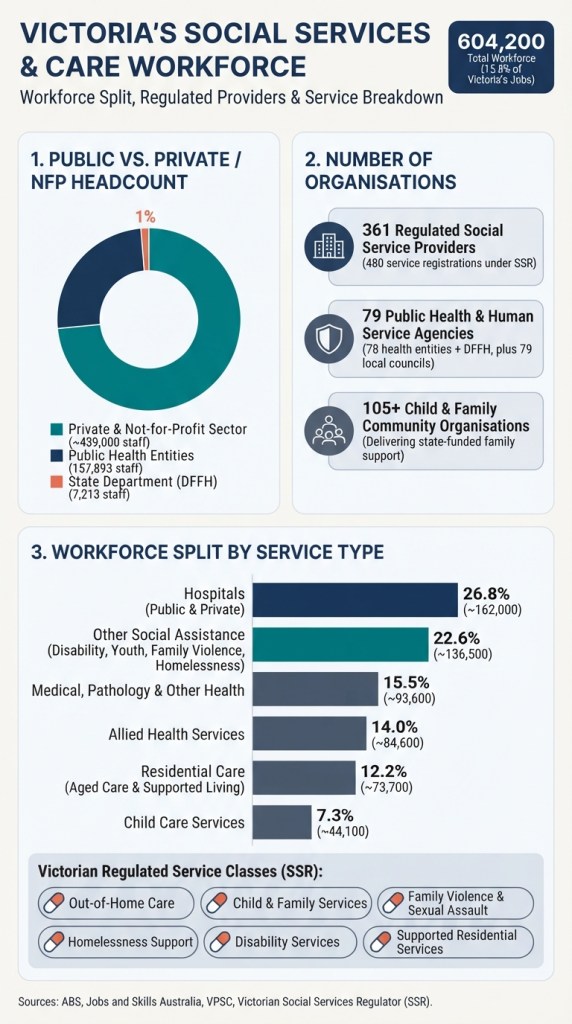
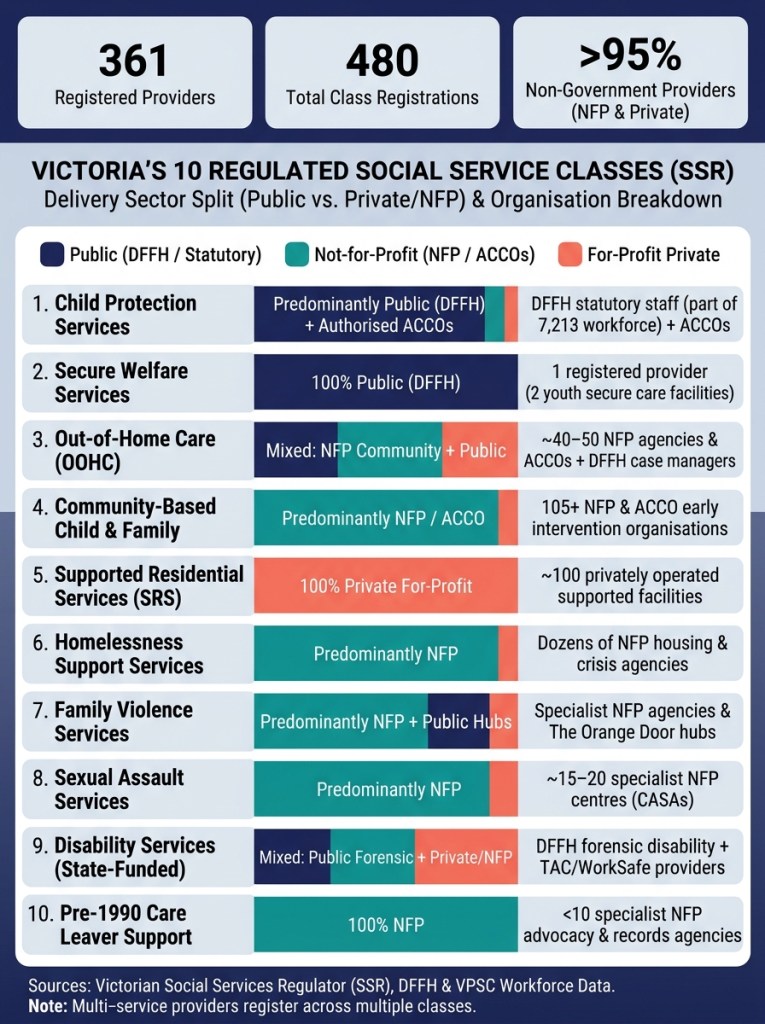
Over the past several decades—accelerating through competitive tendering reforms in the 1990s—the Victorian State Government has shifted from directly delivering many frontline social services to funding and regulating Community Service Organisations (CSOs), charities, and private providers to deliver them on its behalf. [1, 2]
Today, the Department of Families, Fairness and Housing (DFFH) and the Department of Health fund more than 1,300 non-government organisations to run programs that were once staffed and operated directly by state agencies (such as the former Community Services Victoria and Department of Health and Human Services). [1, 2, 3, 4]
Out-of-Home Care and Child Welfare
- Residential and foster care. While statutory Child Protection investigations remain with the state government, the day-to-day operation of residential care homes, foster care placements, and kinship support has been largely outsourced to CSOs (such as Berry Street, MacKillop Family Services, and Anglicare). [1, 2]
- Family preservation and support. Early intervention, parenting programs, and intensive family services formerly run by state welfare officers are now delivered by contracted non-profit agencies. [1, 2]
Disability and Aged Care Services
- Supported accommodation and group homes. Historically, the state operated large institutional facilities (like Kew Cottages) and state-run group homes. Following deinstitutionalisation and the rollout of the National Disability Insurance Scheme (NDIS), the Victorian Government transferred almost all direct disability accommodation and support services to non-government and private providers. [1, 2, 3]
- Home and community care. Direct in-home support, respite, and community aged care services previously managed through state and local government partnerships have been transitioned to contracted providers and federal aged care programs. [1]
Housing and Homelessness Support
- Homelessness crisis accommodation and outreach. Frontline homelessness services, crisis refuges, and transitional housing management are overwhelmingly delivered by funded charities and community housing providers rather than state public servants.
- Social and community housing management. While the state still owns public housing stock, a substantial portion of social housing development, tenancy management, and maintenance has been transferred or outsourced to registered Community Housing Associations. [1]
Mental Health, Alcohol, and Other Drugs (AOD)
- Community mental health and psychosocial support. While clinical acute care remains largely within public hospital networks, non-clinical community mental health recovery, outreach, and supported accommodation are contracted out to non-government organisations.
- Drug and alcohol counselling and rehabilitation. State-run alcohol and drug treatment centres and counselling services were progressively tendered out to community health centres and specialist non-profits. [1, 2]
Family Violence and Crisis Support
- Refuges, crisis hotlines, and case management. Emergency accommodation, specialist family violence counselling, and perpetrator intervention programs are funded by the state (including through The Orange Door network) but staffed and operated by partner community organisations. [1, 2]
Corrections and Justice-Related Social Services
- Prison operations and post-release support. Victoria contracted out the management of specific prisons (such as Ravenhall and Port Phillip) to private operators, alongside outsourcing prisoner rehabilitation, reintegration, and community corrections support programs to non-profits and private firms. [1]


Leave a Reply