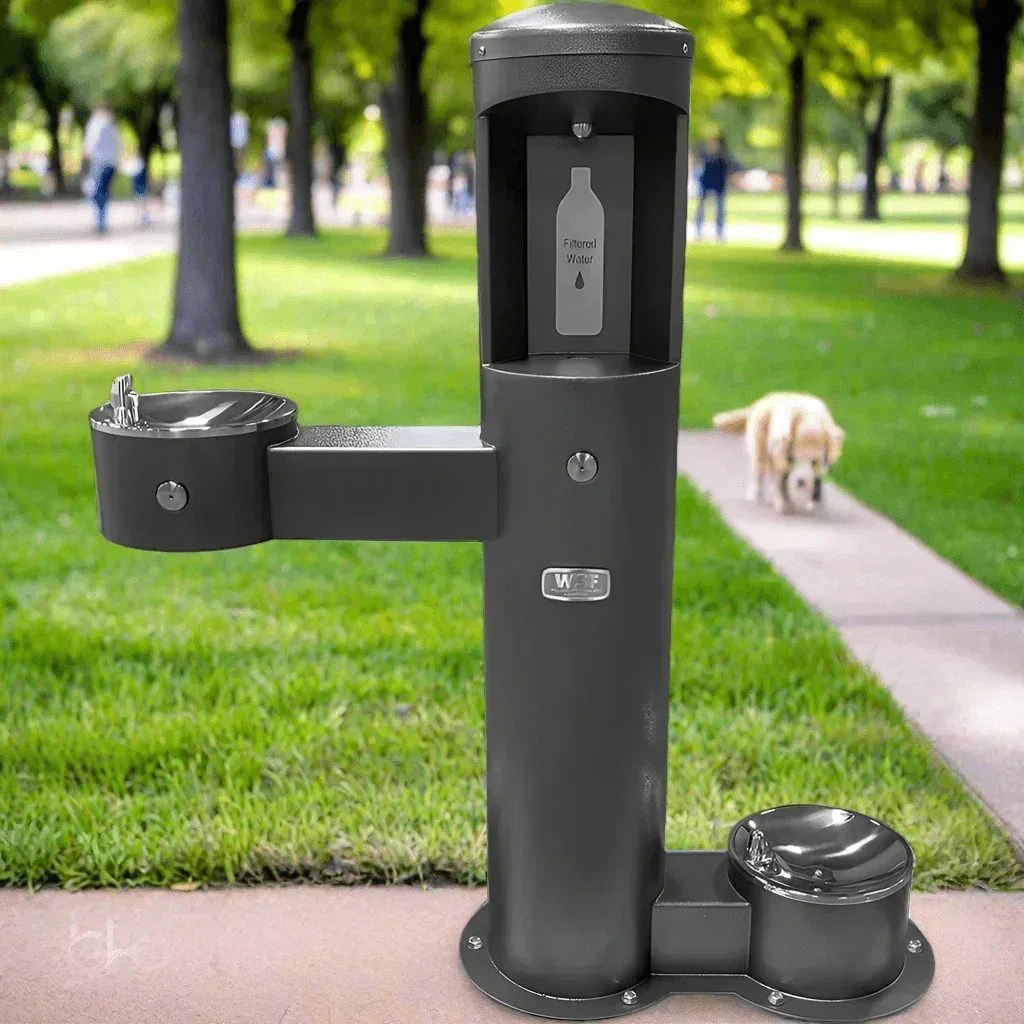
Victoria can lead Australia in climate resilience by treating public hydration as essential infrastructure. Mandating advanced drinking fountain standards directly combats rising extreme heat, eliminates plastic waste, and protects vulnerable communities. Public hydration into a core climate defence strategy.
1. Public Open Space & Building Standards
- Density Metrics: Mandate at least one dual-use drinking fountain per 250-400 meters of high-traffic pedestrian corridors, regional parks, and active transport trails.
- Building Integration: Require all newly constructed or majorly retrofitted public buildings (such as libraries, council offices, and community hubs) to feature publicly accessible hydration points near main entrances.
- Universal Design: Enforce strict compliance with AS1428 (Design for Access and Mobility), ensuring fountain heights, push-button mechanisms, and clearance zones accommodate wheelchair users, children, and the elderly.
- Thermal Protection: Mandate shaded canopies or chilled internal mechanisms for all new outdoor installations to prevent water from reaching unpalatable or unsafe temperatures during extreme heatwaves.
2. Universal “Cool-Down” Pet Stations
- Mandated Dog Bowls: Require all new and existing public outdoor drinking fountains to be retrofitted with integrated, ground-level pet bowls that feature automated overflow or easy-drain systems.
- Biodiversity Support: Expand the mandate to include urban wildlife water attachments in designated green wedge zones to protect native birds and fauna during severe droughts. Channel overflow directly into adjacent rain gardens or bio-retention tree pits to sustain urban canopies and reduce local microclimate heat.
- Heatwave Safety: Position pet-friendly stations along shaded, non-asphalt paths to protect animal paws while they hydrate during peak summer temperatures.
3. Bottle Filling Stations (The California Model)
- Bottle-First Mandate: Adopt legislation modelled on California’s Assembly Bill 2486, requiring all new public fountains to feature dedicated, rapid-flow bottle-filling nozzles alongside traditional bubblers.
- Contactless Operation: Phase in sensor-activated, hands-free interfaces for bottle-filling components to maximise hygiene and encourage high-volume public utilisation.
- Retrofit Subsidies: Establish a Local Council Hydration Fund to help regional and municipal governments rapidly retrofit existing low-flow bubblers with modern bottle-filling pillars.
Climate Mitigation & Adaptation Economics
| Climate Impact Category | Policy Mechanism | Direct Environmental/Social Benefit |
|---|---|---|
| Emissions Reduction | High-flow filling stations | Displaces single-use plastic bottles, cutting plastic manufacturing and transport emissions. |
| Urban Heat Island Effect | Shaded, chilled water points | Lowers core body temperatures for pedestrians, reducing heat-stress hospitalizations. |
| Active Transport Support | Density-mapped fountain trails | Encourages walking and cycling over driving by guaranteeing safe, free hydration network-wide. |
| Water Resource Security | Smart-metered infrastructure | Uses low-flow auto-shutoff valves to prevent water wastage while maintaining high pressure. |
Implementation & Legislative Strategy
- Planning Scheme Amendment: Embed these requirements directly into the Victoria Planning Provisions (VPP) and the Building Regulations 2018, making compliance a prerequisite for council asset sign-offs.
- Climate Change Act Alignment: Formally link this infrastructure rollout to the Victorian Climate Change Strategy as a key public health adaptation measure.
- Data-Driven Rollout: Launch an interactive, open-source “VicHydrate” digital map tracking fountain locations, maintenance status, and water temperatures to ensure equitable distribution across lower-socioeconomic or high-heat-risk suburbs.
Google backgrounder
International best practice guidelines for public drinking fountains have evolved from simple “bubbler” design specifications into integrated frameworks that bridge public health, universal design, and urban climate resilience. Organizations such as the World Health Organization (WHO), global water advocacy institutes, and local governments (including VicHealth) align their frameworks across three main pillars.
📍 1. Availability & Urban Planning Best Practices
Modern city planning relies on data-driven frameworks to decide where, how many, and what types of hydration stations to install, shifting away from generic placement models.
- Density & Mapping Thresholds: Best practice dictates placing a fountain within every 200 to 400 metres of heavy pedestrian thoroughfares. Priority locations include transport interchanges, major city parks, shared walking/cycling tracks, and urban commercial hubs. [1]
- The “Dual-Purpose” Standard: Fountains are no longer single-spout mouth-bubblers. International standards mandate integrated bottle-refill stations alongside traditional bubblers. Research shows that units without vertical bottle-refill capacity are bypassed by up to 62% of modern users. [2, 3]
- Asset Visibility & Nudging: Best practices from agencies like VicHealth require prominent, high-contrast digital mapping, prominent street signage, and footpath markings. If a fountain blends into the background, community trust and usage rates drop severely. [1]
- Ancillary Hydration: Incorporating a dog bowl attachment at the base of open-space park units is standard best practice to support animal welfare and reduce ad-hoc spillage. [3]
♿ 2. Advanced Universal Accessibility Guidelines
Accessibility guidelines rely on non-discriminatory frameworks like the US Americans with Disabilities Act (ADA) and Australia’s Disability Discrimination Act (DDA). Best practice integrates these into a unified universal design approach. [4, 5]
- Dual Approach Paths: Designing for both side-on and front-on wheelchair approaches. A clear, flat ground footprint of 30 inches by 48 inches (760 mm x 1220 mm) must lead to the unit. [4, 5]
- Precise Under-Unit Clearances: For cantilevered or wall-mounted units, an open underside clearance of 640 mm to 685 mm above the ground is required to allow wheelchair users to roll completely forward under the basin. [4, 5]
- Operating Force and Actuation: Manual push-buttons or paddles must require less than 20 Newtons (approx. 4.5 lbs) of physical force to activate. Buttons must have a minimum diameter of 25 mm, though touchless infrared proximity sensors are considered the gold standard for universal dexterity and hygiene. [3, 6, 7]
- Tactile and Visual Contrast: Incorporating a minimum 30% visual luminance contrast on the housing or immediate floor boundary to help visually impaired users locate the infrastructure safely.
☀️ 3. Climate Change Mitigation & Adaptation Frameworks
Climate change impacts drinking fountains in two ways: they act as mitigation tools against plastic waste, and they require adaptation strategies to handle rising global temperatures. [8, 9]
Carbon & Single-Use Plastic Mitigation
- Embodied Emissions Reduction: Municipalities install robust public networks to directly displace single-use PET bottled water. The European Union’s Drinking Water Directive actively legally mandates free outdoor fountains in public squares specifically to curb plastic manufacturing and transport emissions.
- Low-Carbon Infrastructure: Best practices dictate using highly durable, recyclable materials (such as marine-grade 316 stainless steel) with low embodied carbon, powered by local micro-solar setups if electronic chillers or smart meters are used.
Heatwave and Environmental Adaptation
- Thermal Relief Sub-Loops: Ground lines exposed to urban heat islands can cook stagnant pipe water. Best practice requires embedding thermal pressure relief valves or automated network flush sub-loops. These discharge water if internal pipe temperatures exceed 45°C, protecting users from thermal mouth burns.
- Blue-Green Infrastructure (BGI) Integration: Fountains must feature a subtle reverse-fall concrete grading around the base. Instead of directing excess runoff straight into wastewater sewers, international guidelines dictate channeling overflow directly into adjacent rain gardens or bio-retention tree pits to sustain urban canopies and reduce local microclimate heat.
- Water Safety Planning (WSP): Consistent with the WHO framework, cities experiencing intense seasonal shifts must run an annual Asset Surveillance Schedule to sample water quality for sudden bacterial microbial spikes caused by warmer source waters. [1, 8, 10, 11, 12]
📊 International Standard Synthesis
| Strategic Vector [1, 3, 6, 7, 11] | Key Global Metric | Primary Target Outcome |
|---|---|---|
| Placing Density | Every 200m – 400m in high-foot-traffic areas | Displace commercial plastic bottled water purchasing |
| Configuration | Combined Bubbler + Vertical Bottle-Refill Core | Accommodate modern, waste-conscious hygiene habits |
| Operating Pressure | < 20 Newtons of force / Proximity Sensor | Seamless use for children, elderly, and arthritic users |
| Drainage System | Reverse-fall concrete sloped to urban rain gardens | Mitigate urban heat islands and eliminate slip risks |
[1] https://www.vichealth.vic.gov.au
[2] https://pmc.ncbi.nlm.nih.gov
[3] https://www.vichealth.vic.gov.au
[4] https://streetfurniture.com
[5] https://www.globalindustrial.com
[7] https://www.astrastreetfurniture.com.au
[8] https://onebillionresilient.org
[9] https://documents1.worldbank.org
[10] https://www.vichealth.vic.gov.au
[11] https://link.springer.com
[12] https://www.who.int
Victoria strongly meets several global metrics for public drinking fountains—particularly in physical design, water safety, and active anti-plastic programs. However, the state falls short of international best practice in urban distribution density, digital discoverability, and structural mandates for existing infrastructure. [1, 2, 3, 4, 5]
Victoria’s compliance with international benchmarks breaks down as follows:
🟢 Where Victoria Meets or Exceeds Guidelines
1. Universal Accessibility & Mechanical Standards (DDA Compliance) [3]
- The Verdict: FULLY MEETS.
- The Evidence: Victoria strictly enforces the National Construction Code (NCC) and Australian Standard AS 1428.1 (Design for Access and Mobility). Publicly commissioned fountains across metropolitan parks and new developments strictly hit the required 800–900 mm bubble height, provide the mandatory 300 mm forward wheelchair knee overhang, and utilize low-force 25 mm diameter push buttons or automatic sensors. [3]
2. Water Quality, Material Safety, and Thermal Management
- The Verdict: FULLY MEETS.
- The Evidence: Victoria is highly advanced under the Safe Drinking Water Act 2003, which enforces strict microbiological tracking across all state-owned water corporations. Furthermore, Victoria aligns with global lead-free rules and complies with the NCC Volume 3 thermal regulation. Outdoor units are engineered with relief valves to guarantee water is delivered at a maximum temperature of 45°C to prevent mouth scalding during extreme summer heatwaves. [2, 6, 7]
3. Climate Change Mitigation & Anti-Plastic Nudging
- The Verdict: MEETS / EXCEEDS.
- The Evidence: Victoria has been an early adopter of combined bubbler + vertical bottle-refill hubs to combat single-use plastics. The water sector’s Choose Tap initiative—spearheaded by Yarra Valley Water and partnered with local councils—has rolled out hundreds of high-capacity smart fountains, explicitly designed to reduce single-use plastic waste heading to landfills and waterways. [1, 8, 9, 10]
🔴 Where Victoria Falls Short of International Best Practice
1. Spatial Density & Regional Inequality
- The Verdict: DOES NOT MEET.
- The Evidence: International guidelines recommend placing a fountain every 200m to 400m along high-foot-traffic paths. While the City of Melbourne and major central business districts approach this threshold, outer suburban growth corridors and regional Victorian towns face massive “hydration deserts.” Placement remains highly decentralized and entirely dependent on the individual budget and focus of each local municipal council rather than a uniform state mandate. [4, 11]
2. Climate Adaptation: Infrastructure & Runoff Integration
- The Verdict: PARTIALLY MEETS.
- The Evidence: Best practices from agencies like VicHealth state that fountains should use a reverse-fall sloped foundation to drain water away from paths and directly into nearby gardens or rain trees. While this “Blue-Green Infrastructure” is standard in new eco-developments, thousands of legacy council fountains across Victoria lack proper drainage grids, leading to stagnant puddles, slip hazards, and wasted water. [4, 12, 13]
3. Asset Mapping & Digital Discoverability
- The Verdict: PARTIALLY MEETS.
- The Evidence: Leading global smart cities integrate real-time water tracking into general navigation software. While programs like Choose Tap feature localized finder apps, data is fragmented. Consumers frequently report frustration with broken units, missing signs, or outdated registry lists when looking for working bottle-refill stations outside major tourist paths. [4, 5, 14]
📊 Summary Rating of Victorian Infrastructure
| Guideline Vector [2, 3, 11, 12, 15] | Global Best Practice Target | Victoria’s Current Status | Evaluation |
|---|---|---|---|
| Physical Design | Wheelchair accessible + Dual-height | Enforced via [AS 1428.1 / NCC](1.4.1, 1.4.5) | 🟢 Excellent |
| Material Toxicity | <0.25% weighted lead average | Lead-Free WaterMark mandatory | 🟢 Excellent |
| Placing Density | Every 200m – 400m in urban hubs | Patchy; skewed to inner metros | 🔴 Inconsistent |
| Climate Adaptation | Drain-to-garden thermal relief loops | Present in new builds; legacy gaps | 🟡 Moderate |
[2] https://www.health.vic.gov.au
[3] https://www.astrastreetfurniture.com.au
[4] https://www.vichealth.vic.gov.au
[9] https://www.vichealth.vic.gov.au
[10] https://www.aquafil.com.au
[11] https://www.vichealth.vic.gov.au
[12] https://www.vichealth.vic.gov.au
[13] https://www.vichealth.vic.gov.au


Leave a Reply