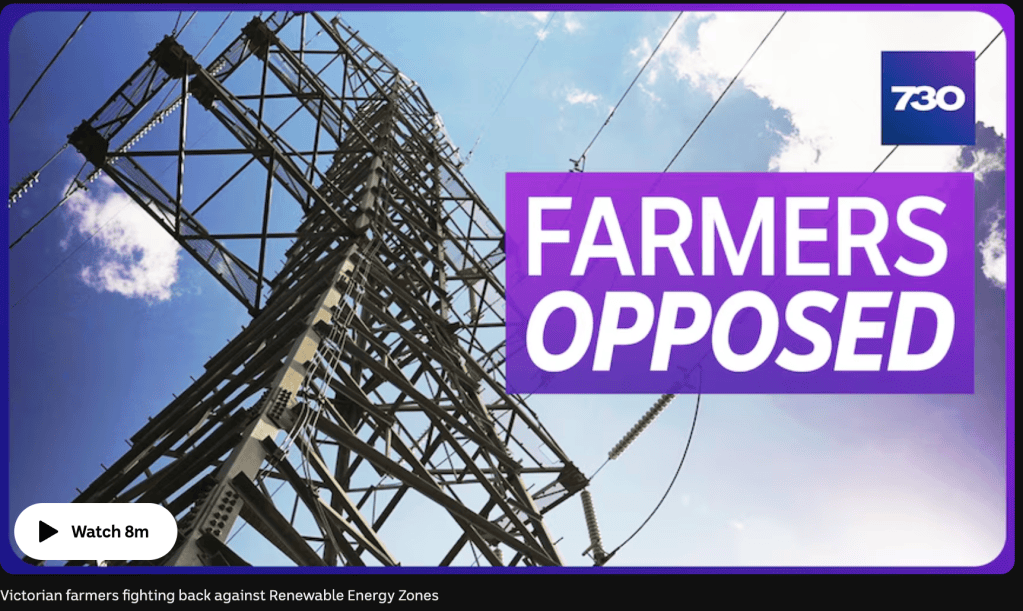
Primary producers are on the front line of both climate risk and the clean energy transition. They face the dual challenge of adapting to environmental change while helping Australia meet its emissions reduction goals. Yet confidence in government policy has been undermined by uncertainty, inadequate protections, and a lack of fair outcomes for regional communities.
Victorian farmers should not have to choose between agricultural productivity, environmental stewardship, and participation in the clean energy economy. This approach will ensure primary producers are genuine partners in the transition, with stronger property rights, fairer economic outcomes, and the confidence to invest in the future of regional Victoria.
A future Victorian Government must restore trust with primary producers by addressing three critical policy challenges.
1. Protecting Farmers’ Carbon Assets and Future Financial Resilience
Victoria’s agricultural sector is experiencing a profound shift in land valuation as carbon markets become part of the broader transition economy. Farmers can generate new income streams by planting trees on marginal land and creating carbon credits for sale to businesses seeking emissions offsets.
However, when carbon credits are sold externally, the associated carbon asset is transferred off the farm’s balance sheet. This may leave primary producers exposed as banks, food processors, and export markets increasingly assess farm-level emissions performance and sustainability credentials.
Policy Commitment
- Prioritise on-farm carbon insetting as the preferred pathway for agricultural carbon projects.
- Develop legislative safeguards to prevent the unintended loss of farm-level carbon assets.
- Work with financial institutions to recognise retained carbon assets as part of farm sustainability and lending assessments.
- Review the Victorian Carbon Farming Program to ensure public investment strengthens long-term farm resilience, not just external offset markets.
- Establish clear guidance for producers on the financial implications of carbon credit sales before contracts are signed.
2. Delivering a Fairer Renewable Energy Transition for Regional Communities
Victoria’s renewable energy transition relies heavily on regional communities hosting transmission lines, substations, wind farms, and other energy infrastructure. Projects such as the Western Renewables Link place significant demands on agricultural landholders and farming businesses.
Despite providing the land that enables the state’s energy transition, many regional customers continue to face disproportionately high network charges and disruption to productive farmland.
Policy Commitment
- Introduce a Regional Energy Fairness Framework to ensure host communities share in the benefits of the energy transition.
- Review electricity network pricing arrangements affecting regional consumers.
- Strengthen compensation and land access rights for farmers impacted by transmission infrastructure.
- Require agricultural impact assessments as a core component of renewable energy infrastructure approvals.
- Establish ongoing community benefit funds for affected farming regions.
- Ensure renewable energy development aligns with internationally recognised “Just Transition” principles.
3. Strengthening Protection of High-Value Agricultural Land
Victoria currently relies heavily on the Environment Effects Statement (EES) process to manage conflicts between agriculture, mining, and major development proposals. While the process provides transparency, it largely assesses projects individually rather than providing long-term strategic protection for prime agricultural land.
This creates uncertainty for farming communities facing proposals for mining, extractive industries, and major infrastructure developments.
Policy Commitment
- Establish a statewide Agricultural Land Protection Framework.
- Identify and map strategic agricultural zones containing Victoria’s most productive soils and food-producing regions.
- Introduce stronger statutory protections for high-value agricultural land against incompatible development.
- Require a clear demonstration of overriding public benefit before extractive industries can be approved on protected agricultural land.
- Incorporate cumulative regional impacts into environmental and planning assessments.
- Align Victorian land-use planning with international best-practice approaches that safeguard critical food production areas.
Google backgrounder
Climate change poses an immediate systemic threat to primary producers (farmers, foresters, and fishers), completely altering traditional growing seasons, shifting land boundaries, and driving down overall profitability. According to long-term economic studies tracking Australian agribusiness, climate-driven seasonal volatility has already caused a sharp 23% downturn in average annual farm profits over recent decades. [1, 2, 3]
Primary producers stand directly on the frontlines of both environmental risk and the clean energy economy, facing dual challenges of climate adaptation and corporate mitigation. [4]
📉 The Core Climate Pressures on Primary Producers
1. Shifting Horizons & Seasonal Compression
- Warmer, Drier baselines: Traditional cropping zones are drying out as reliable winter and spring rainfall patterns contract.
- The Squeeze: Summers feature longer, intensifying heatwaves that inflict acute heat stress on livestock, reducing milk yields in dairy herds and permanently disrupting fruit development. [1, 2, 5]
2. Water Security & Double-Rate Runoff Loss
- The Math: Farm water supplies are declining sharply. For every slight reduction in standard rainfall percentages, surface water runoff into farm dams drops at more than double that rate. [6]
- The Result: Irrigation-dependent growers face shorter allocation limits, leaving them vulnerable to buying expensive water on the open market during droughts. [1, 6]
3. Compounding Disaster Waves
- The Impact: The primary production sector no longer deals with isolated droughts or bushfires. Producers face highly destructive, compounding weather cycles—such as severe bushfires immediately followed by sudden, intense flash flooding that washes away valuable topsoils and destroys storage. [2, 5, 7]
4. Heightened Biosecurity Threat Matrix
- The Risk: Milder winter temperatures fail to kill off destructive insect populations. Changing humidity parameters accelerate the geographic spread of livestock diseases, persistent weeds, and airborne crop fungi into regions historically protected by colder weather brackets. [1, 6]
🛠️ Strategic Adaptation Protocols
Rather than passively absorbing these shocks, primary producers are executing rapid operational pivots to protect business continuity: [1]
- Crop Engineering & Varietal Shifts: Grain growers are switching to fast-maturing, drought-tolerant grain variants engineered to complete grain-fill cycles before harsh summer heatwave windows arrive. [1, 8]
- Soil Health and Moisture Conservation: Broadacre operators use zero-till farming practices and heavy stubble retention to preserve critical underground moisture levels and block erosion. [5, 9]
- Macro Aggregation: Corporate and family operations are systematically expanding average farm footprints. Larger, consolidated farms possess the diverse capital reserves needed to absorb multi-year weather losses that often crush smaller, unhedged holdings. [10]
💼 Financial Realities: The Insetting vs. Offsetting Battle
A massive shift is taking place regarding how agricultural land is valued within the broader global transition economy: [9]
The Offsetting Revenue Stream [9]
Under structural decarbonization frameworks, primary producers can earn alternative income by reforesting marginally productive paddocks. These trees absorb carbon, generating carbon credits that are sold directly to heavy industrial carbon emitters looking to offset their footprints. [9]
The Risk: Capital Lockout
Global banking institutions are strictly aligning corporate loan portfolios with rigorous environmental performance criteria. Major agricultural lenders (such as Rabobank) are factoring on-farm environmental metrics directly into capital allocation and interest rates.
If a primary producer sells all their carbon offsets to a third-party oil or gas corporation, they strip that carbon asset off their own balance sheet. When their bank demands proof of carbon reduction to authorize a low-interest operational loan, the producer’s net emissions profile remains unhedged, potentially locking them out of competitive financing.
📊 Primary Industry Risk Matrix
| Sector [1, 2, 5, 6, 7, 8, 11] | Primary Climate Threat | Key Strategic Adaptation | Financial Exposure |
|---|---|---|---|
| Grain / Cropping | Winter rain failure & spring heat | Zero-till farming; short-season variants | High machinery & fuel inputs |
| Dairy / Livestock | Animal heat stress; feed shortages | Methane-inhibiting feed; sheltered shade sheds | Bank carbon compliance audits |
| Horticulture / Viticulture | Extreme heat bursts; sunburn | Canopy management netting; shifting locations | High crop value per hectare |
| Plantation Forestry | Intense bushfire cycles | Controlled cool burning; species diversification | Un-insurable timber asset risk |
[1] https://www.climatechange.vic.gov.au
[2] https://www.bendigobank.com.au
[3] https://www.climatechange.vic.gov.au
[4] https://agriculture.vic.gov.au
[5] https://www.climatechange.environment.nsw.gov.au
[6] https://www.dairyaustralia.com.au
[7] https://agriculture.vic.gov.au
[8] https://www.climatechange.vic.gov.au
[10] https://www.agriculture.gov.au
[12] https://www.climatechange.vic.gov.au
Best practice policy settings for primary production shift the governing framework from crisis-driven emergency relief to structural, forward-looking resilience. When governments treat climate change as a permanent operational shift rather than a temporary natural disaster, it creates a stable regulatory environment for farmers, foresters, and fishers to adapt. [1]
Globally and across forward-thinking Australian jurisdictions like Victoria, best-practice agricultural policy settings are built on four integrated pillars. [2, 3]
1. De-risking Capital & Accelerating Green On-Farm Upgrades
Best practice avoids direct cash handouts, focusing instead on co-investment frameworks that lower the cost of physical adaptation. [4]
- The Policy Mechanism: Establishing programs like Victoria’s Agriculture Energy Investment Plan to provide structured grant matching.
- The Target Outcome: Accelerating the fast adoption of on-farm micro-solar arrays, grid-isolated battery back-ups, automated precision irrigation networks, and localized micro-grids. This systematically drops ongoing fixed overheads while immunizing the business from central grid disruptions during intense heatwaves or storms. [4, 5]
2. Protecting Carbon Sovereign Rights & Sovereign Ledger Integrity
A major global policy challenge is preventing third-party corporate entities from permanently stripping the carbon offsets from rural land assets.
- The Policy Mechanism: Integrating robust frameworks like the National Farmers’ Federation ([NFF](1.1.9, 1.3.2)) sustainability guidelines into legal mandates. Policies must encourage “insetting”—allowing primary producers to claim carbon-sequestering tree lines, agroforestry, and soil carbon upgrades directly on their own corporate balance sheets first. [5]
- The Target Outcome: Guaranteeing that local producers maintain compliance with strict banking audits and international green-trade export boundaries, rather than leaving them locked out of low-interest finance pools.
3. Institutionalizing Spatial Climate Tools & Extending Knowledge Pools
Farmers cannot adapt to a shifting landscape without access to hyper-localized, data-driven forecasting. [4]
- The Policy Mechanism: Publicly funding deep-data tools such as the Agriculture Climate Spatial Tool and maintaining active, publicly funded regional extension teams. [4]
- The Target Outcome: Moving away from standard historical rainfall averages, instead delivering real-time, 3D modeling on shifting soil moisture profiles, regional water tables, and micro-climate frost windows. This lets growers make high-stakes varietal or infrastructure decisions months before a seed hits the ground. [4]
4. Overhauling Spatial Planning & Mandating Rolling Strip Rehabilitation
To resolve deep structural land-use conflicts, planning codes must establish transparent, legally binding boundary definitions.
- The Policy Mechanism: Enforcing strict, legally mandated Environmental Effects Statements (EES) paired with mandatory, rolling “strip-mining” rehabilitation rules under resource regulations.
- The Target Outcome: Enforcing a legal framework where mining operators must return mined tracts back to their original agricultural productivity levels within a tight, sequential timeframe. This balances the extraction of critical transition minerals without permanently degrading prime cropping soil profiles.
📊 Best-Practice Policy Execution Blueprint
| Policy Focus [5] | Legacy / Sub-Optimal Approach | Best-Practice Setting Target |
|---|---|---|
| Disaster Support | Ad-hoc post-drought emergency cash drops | Mandatory pre-disaster business resilience planning |
| Carbon Markets | Allowing external industries to buy up land offsets | Prioritizing on-farm carbon insetting for bank compliance |
| Extension Services | Static web PDF advice portals | Dynamic, data-driven Spatial Climate Modeling |
| Resource Friction | Permanent zoning carve-outs for mining | Mandated rolling progressive topsoil rehabilitation |
[1] https://www.agriculture.gov.au
[2] https://agriculture.vic.gov.au
[3] https://www.agriculture.gov.au
[4] https://www.climatechange.vic.gov.au
[5] https://agriculture.vic.gov.au
Victoria ranks as a national leader in providing technical resources and micro-grants for primary producers. However, the state lags behind global best practices in addressing infrastructure inequality, resolving macro-level land conflicts, and protecting producers from carbon credit asset stripping. [1]
Victoria’s current agricultural policies compare to international and national best-practice targets across four key criteria:
🟢 Where Victoria Meets or Exceeds Best Practice
1. Data-Driven Spatial Climate Tools
- Best-Practice Target: Giving farmers predictive, parcel-by-parcel 3D soil, moisture, and climate mapping instead of historical averages.
- Victoria’s Performance: EXCEEDS BEST PRACTICE. [2]
- The Evidence: Victoria is a standout performer in this category. The state-backed [Agriculture Climate Spatial Tool (ACST)](1.2.1, 1.2.2) relies on annual updates from the [Victorian Land Use Information System (VLUIS)](1.2.2, 1.2.4). It uses Sentinel-2 satellite imagery to map individual paddock-scale risks across five-day cycles. This enables Victorian farmers to run climate-scenario models that outperform frameworks in most other Australian states. [1, 3, 4]
2. Capital Co-Investment for Energy Resilience
- Best-Practice Target: Moving away from emergency disaster cash hand-outs toward structural, pre-disaster energy resilience upgrades.
- Victoria’s Performance: MEETS BEST PRACTICE.
- The Evidence: The state’s foundational [Agriculture Energy Investment Plan](1.2.3, 1.3.5)—bolstered by consecutive funding rounds—has delivered hundreds of free on-farm energy audits and direct structural grants. This has successfully transitioned hundreds of dairy, horticultural, and livestock operations onto grid-independent micro-solar and automated irrigation systems. [1, 5]
🔴 Where Victoria Falls Short of Best Practice
1. Infrastructure Inequality & Clean Energy Rollout Friction
- Best-Practice Target: Distributing the physical burdens and financial rewards of the green grid transition evenly between urban consumers and regional producers.
- Victoria’s Performance: DOES NOT MEET.
- The Evidence: Victoria faces significant systemic policy friction regarding its renewable rollout. Regional primary producers bear the physical burden of major overhead transmission infrastructure (such as the Western Renewables Link), which slices through prime agricultural land. Regional farming lobbies highlight that Victorian farmers pay up to 50% more in network charges than metro residents despite hosting the transition infrastructure. This dynamic falls well short of international “Just Transition” benchmarks. [6, 7]
2. Protection Against Carbon Credit Asset Stripping
- Best-Practice Target: Mandating “carbon insetting” to ensure tree and soil carbon assets stay on a farm’s balance sheet for future banking compliance.
- Victoria’s Performance: PARTIALLY MEETS. [2]
- The Evidence: While the state runs the $15.3 million Victorian Carbon Farming Program to encourage agroforestry and shelterbelt tree planting, its broader policy settings lack strict guardrails to prevent external heavy industries from buying up those offsets. Without coordinated legislative protections, Victorian primary producers risk selling off their green credentials, leaving them vulnerable to future low-interest bank lending audits. [1]
3. Macro Land-Use Dispute Resolution
- Best-Practice Target: Legally prioritizing prime, food-secure agricultural land boundaries over extractive mineral sand and mining exploration leases.
- Victoria’s Performance: PARTIALLY MEETS.
- The Evidence: Victoria relies heavily on the Environment Effects Statement (EES) framework to resolve mining and farming friction. While this process is transparent, it handles disputes on a case-by-case basis. It lacks the strict, sweeping regional zoning protections seen in jurisdictions like Western Europe, which legally safeguard premium topsoil basins from extractive critical mineral sands projects. [2]
📊 Comprehensive Policy Benchmark
| Policy Setting Vector [2, 7, 8] | Global Best Practice Standard | Victoria’s Current Framework | Comparative Grade |
|---|---|---|---|
| Climate Scenario Forecasting | Hyper-local 3D satellite modeling | [VLUIS integrated ACST Tool](1.2.2, 1.4.5) | 🟢 World Class |
| Mitigation Grants | Direct co-funding for structural efficiency | On-Farm Action Plan Pilot Grants | 🟢 Advanced |
| Grid Equity Pricing | Fair network fees for hosting green lines | Regional producers pay 50% more | 🔴 Sub-Optimal |
| Soil Capital Security | Legislative zoning locks on food bowls | Case-by-case EES planning panels | 🟡 Moderate |
[1] https://www.premier.vic.gov.au
[2] https://www.climatechange.vic.gov.au
[3] https://pmc.ncbi.nlm.nih.gov
[4] https://www.climatechange.vic.gov.au
[5] https://agriculture.vic.gov.au
[8] https://agriculture.vic.gov.au
The relationship between Victorian primary producers and the state government is strained by a series of high-stakes policy clashes. Rural communities feel isolated by decisions coming out of Melbourne, leading to a deep decline in institutional trust. [1, 2, 3]
A recent survey by the Victorian Farmers Federation (VFF) revealed that 92% of local farmers believe the state government has ignored their concerns for too long, with 9 in 10 reporting that the government lacks a positive plan to support the agricultural sector. [2, 3]
1. The Renewable Energy Infrastructure Rollout (The Ultimate Flashpoint)
The push toward the state’s target of 95% renewable energy by 2035 has sparked direct physical confrontations between farmers and state authorities. [4, 5]
- Compulsory Land Access: The government passed highly controversial legislation granting “authorised officers” the power to enter private farmland with the backing of Victoria Police. Landowners who block access face individual fines exceeding $12,000. [6, 7, 8, 9]
- VNI West & The Western Renewables Link: Farmers are actively locking gates and forming massive human blockades—sometimes numbering up to 400 people—to deny state agency VicGrid entry. [4, 7]
- Impact Fears: Primary producers argue that the 80-metre-tall, high-voltage transmission lines will permanently segment prime agricultural land, disable GPS-guided machinery, and create significant biosecurity and bushfire hazards. [1, 10, 11]
- Decommissioning Shortfalls: The VFF has heavily criticized the state for not forcing renewable companies to pay decommissioning bonds, leaving farmers exposed to future clean-up costs for old wind and solar infrastructure. [12, 13]
2. Regional Infrastructure Decoupling and Regional Roads
Farmers argue that while they fuel a multi-billion-dollar food and fibre industry, the economic returns are not being reinvested where it matters. [1, 2, 14]
- Deteriorating Road Networks: The physical state of regional transport links is a massive point of friction. Potholes, poor maintenance, and structural decay on rural freight routes severely impact logistics, damage heavy machinery, and increase the cost of doing business. [1, 2, 15]
- The Emergency Services Levy: The state government’s significant funding hike for the Emergency Services and Volunteers Fund has been labeled a “stealth tax”. Farmers face major upcoming hikes on property levies despite heavily relying on volunteer-run fire brigades (CFA) that they feel the state is squeezing financially. [1, 2]
3. Water Rights & The Murray-Darling Basin
Water security remains a zero-sum game that creates regular political standoffs between regional irrigators and state/federal frameworks. [16]
- Funding Lockouts: In the northern food bowls, irrigation communities feel abandoned by federal water buybacks. Victoria has historically resisted federal buybacks, resulting in a political stalemate that has locked Victorian producers out of critical structural adjustment funds. This leaves farmers facing lower water availability and soaring water market prices. [16]
4. Timber Industry Closures
While more localized than broad-acre farming, the transition away from resource harvesting has deeply destabilized regional hubs. [17]
- Native Timber Phase-Out: The state government’s rapid shutdown of the native timber logging industry has devastated long-standing community economies. Primary producers and contractors in these spaces have expressed extreme anger over transition packages, arguing that decades of localized industry and forest management skills have been discarded. [17, 18, 19]
Summary of Regional Sentiment vs. Government Priorities
| Conflict Dimension | Government Objective | Primary Producer Grievance |
|---|---|---|
| Energy Grid | Fast-track renewable transmission lines. | Violation of property rights and loss of arable land. |
| Taxation & Roads | Balancing state budgets and emergency funds. | Neglected logistics infrastructure and “stealth taxes”. |
| Water Resources | Environmental returns for river health. | Skyrocketing operational costs and loss of irrigation security. |
[3] https://www.skynews.com.au
[12] https://vff.org.au
[13] https://vff.org.au
[14] https://agriculture.vic.gov.au
[16] https://www.weeklytimesnow.com.au
[17] https://www.parliament.vic.gov.au
[19] https://www.parliament.vic.gov.au
The relentless expansion of Melbourne and regional hubs creates severe structural and environmental pressure where residential boundaries meet agricultural zones. [1, 2]
The primary battleground is Victoria’s peri-urban landscape, an area representing just 2% of the state’s land mass but generating over 13% of its total agricultural commodity value. The Victorian Farmers Federation (VFF) warns that prioritizing housing over agricultural longevity in the State Planning Policy Framework is directly threatening food security. [3, 4]
1. Land Banking and Property Speculation
The systematic acquisition of arable properties by large developers ahead of formal rezoning creates a landscape of structural uncertainty. [5]
- The Speculation Trap: Developers purchase highly fertile farmland along growth boundaries (such as Werribee, West Gippsland, and the Geelong corridor) and hold it as a future asset. [5, 6, 7]
- Underinvestment: Once land banking occurs, neighboring generational farmers stop investing long-term capital into their irrigation, soil health, or machinery, anticipating an inevitable residential buyout. [8]
- Artificially Inflated Land Prices: Speculation drives property valuations well beyond agricultural earning capacity, pricing young farmers completely out of the market. [1, 2]
2. Nuisance Complaints and “Right to Farm” Fractures
Urban encroachment brings new suburban residents into direct physical proximity with industrial food production, sparking immediate cultural and legal friction. [1, 5]
- Operational Restrictions: New residents frequently file complaints with local councils regarding standard farming practices, including early morning tractor noise, bird scarers, night harvesting, dust, and smell. [1, 5, 9]
- Planning Framework Failures: The VFF argues that local councils consistently fail to enforce adequate residential buffer zones. This leaves farmers legally vulnerable and forced to alter efficient operational routines to avoid costly litigation. [4, 10, 11]
3. Biosecurity and Trespass Vectors
The physical interface between dense housing estates and active livestock or cropping paddocks creates severe biosecurity risks. [1, 2]
- Domestic and Pest Pressures: Suburban stray dogs, uncontrolled weeds moving from unmanaged lifestyle blocks, and structural pests put commercial herds and crops at risk.
- Illegal Dumping and Trespass: Peri-urban producers face a disproportionate rate of illegal rubbish dumping and recreational trespassing, which damages fencing and risks introducing highly disruptive plant and animal diseases into the food supply chain. [1, 12]
4. Infrastructure and Resource Competition
As suburban populations balloon, local resources are systematically diverted away from primary production to service residential demands. [10, 13]
- Water Displace: Massive residential developments increase competition for local catchments. Drinking water and community pipelines routinely receive priority over the irrigation allocations required for intensive vegetable and fruit crops.
- Logistical Friction: Local freight routes become heavily congested with commuter traffic. Slow-moving, oversized farm machinery is increasingly forced onto roads shared with suburban drivers, leading to accidents and immense transport delays. [14, 15, 16]
Comparison of Core Pressures on the Fringe
| Pressure Point | Urban Development View | Primary Producer Reality |
|---|---|---|
| Farmland Worth | Space for critical housing supply. | Permanent loss of irreplaceable, high-yield soil systems. |
| Water Allocation | Essential for domestic municipal growth. | Reduced irrigation security and higher operational costs. |
| Zoning Boundaries | Flexible margins to absorb growing populations. | Fragmented communities and unviable parcel sizes. |
[2] https://www.parliament.vic.gov.au
[3] https://www.tandfonline.com
[7] https://www.theguardian.com
[9] https://theconversation.com
[10] https://www.farminstitute.org.au
[11] https://www.mdpi.com
[13] https://knowledge.aidr.org.au
[15] https://www.mdpi.com


Leave a Reply