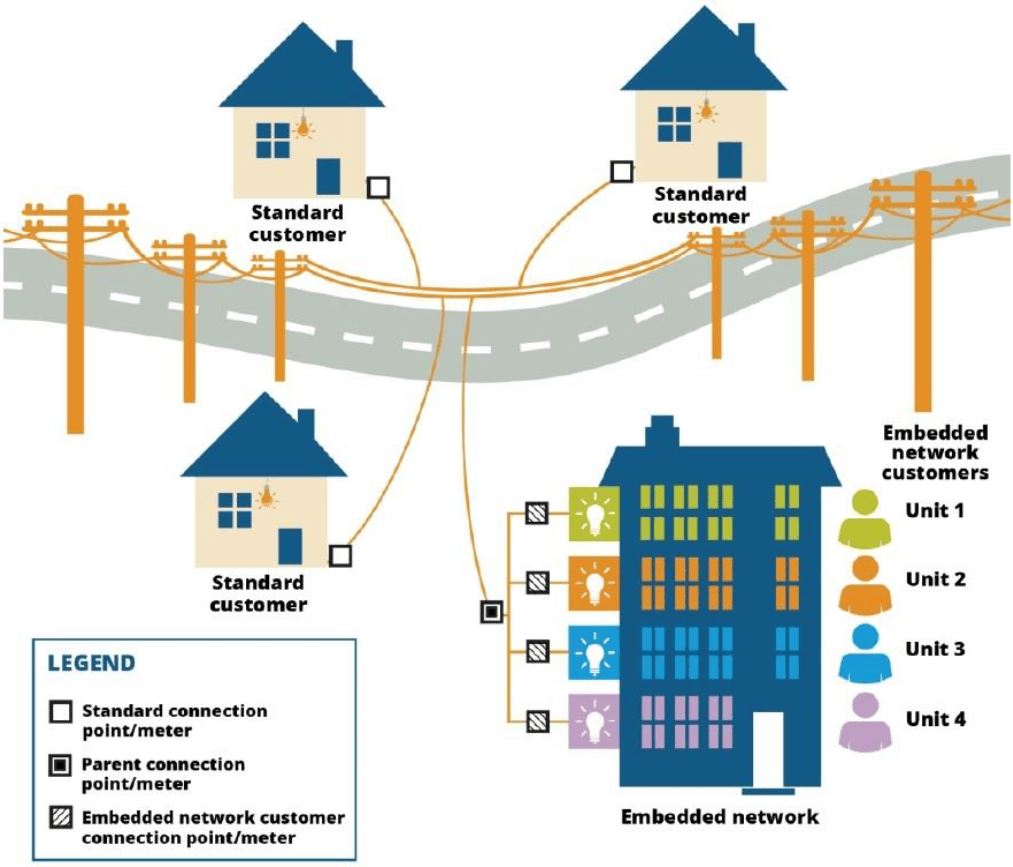
Elrin contacted me about embedded electricity networks and the challenges faced by residents and businesses locked into these arrangements, often with limited ability to choose their provider or secure competitive prices.
The Labor Government introduced interim measures while a broader review was undertaken. I support the public release of that review’s findings and recommendations. Transparency is essential to rebuilding confidence and ensuring affected consumers are heard.
I also support the development of a clear timetable for implementing reforms that improve affordability, increase competition, strengthen consumer protections, and give people in embedded networks greater access to the benefits available to other electricity customers.
CORRECTION – I have kindly received further information from DEECA about the status of the policy reforms.
- The ‘ban’ for post 2023 embedded networks was implemented through a ‘renewable energy condition’ where new residential embedded networks need to have at least 5% on-site renewable energy generation and 100% green power sold to residents. However, this new condition only applies to ‘exempt persons’. We have seen in the past 12 months or so a lot of the major exempt persons who sell to customers in embedded networks get electricity retail licences from the ESC. This was done potentially to avoid the renewable energy condition (as acknowledged in the Parliamentary inquiry into renewable energy for apartments). We consulted earlier this year on extending these requirements to licensed retailers. In practice, this means new embedded networks are still being built and that some are not subject to the renewable energy requirements.
- New price caps which were announced to start on 1 July 2027 are still being developed and implementation will be subject to the Minister for Energy’s approval (of the incoming government). The same applies to any new transparency measures or changes to the current licensing and exemptions framework.
- Long term transition – the blog post ends with a “2031 deadline” where older exempt networks “must either completely upgrade to a standard retail model or progressively transfer their private grid infrastructure back to the local licensed distribution network”. This not factually correct. There is currently no 2031 deadline and those changes have not been proposed or announced.
Google backgrounder
In Victoria, legacy (pre-2023) embedded electricity networks refer to private energy grids built before 1 January 2023 that serve multiple residents (such as in apartments, retirement villages, or social housing) through a single “parent” connection point. [1, 2]
While the Victorian Government implemented a strict ban on new residential embedded networks starting in 2023, older legacy networks operate under a different, transitional regulatory framework. [1, 2, 3, 4]
Current Rules for Legacy Networks
If you live in or manage an apartment building with a pre-2023 embedded network, the key characteristics and protections include:
- Price Caps: Legacy operators cannot charge whatever they want. They are legally capped at the Victorian Default Offer (VDO) as their maximum price, which protects consumers from price gouging. [1, 2]
- The Transition Plan: Under the state’s Embedded Networks Review Reforms, these older networks are steadily being phased out of the old exemption framework. Over a multi-year timeline, operators are required to transition into a new, stricter licensing framework to increase regulatory oversight. [1, 2]
- Consumer Protections: Customers in legacy networks have explicit access to the Energy and Water Ombudsman Victoria (EWOV) to resolve disputes. They are also covered by industry codes regarding life support equipment and electrical safety. [1, 2]
- Market Access: On paper, legacy customers have the right to shop around for a standard retail energy provider. However, in practice, actually switching away from an embedded provider remains difficult due to physical metering hurdles and a lack of on-market competitive offers. [1, 2]
Context on the 2023 “Ban” – renewable energy condition
The ban introduced on 1 January 2023 stopped the creation of traditional residential embedded networks unless the site could prove it sources 100% of its electricity from renewable energy, with at least 5% generated directly on-site (such as via rooftop solar). [1, 2]
Opinions on the effectiveness of this rule are mixed. For instance, discussions on the r/melbourne Reddit forum reveal that some consumers feel the 5% on-site threshold was too low to truly eliminate the network structure, allowing some developers to continue setting up complexes with higher embedded rates. Conversely, other users on the platform noted that they actually pay less than the standard market rate on their pre-2023 networks due to the bulk purchasing power of their building’s corporate plan. [1]
The Victorian Government introduced the ban on new residential embedded networks primarily to stop developers from trapping residents in monopoly power arrangements with no price protection or choice of provider.
Before the 2023 reforms, apartment buyers and renters frequently moved into new buildings only to discover they were legally locked into a single private electricity provider chosen by the developer.
The key drivers behind the government’s intervention included:
1. Eliminating Consumer Exploitation
For years, property developers received financial incentives or free infrastructure from embedded network operators in exchange for giving them exclusive rights to the building’s residents. Because residents could not easily switch providers, operators could charge high rates and add administrative fees, essentially treating residents as a captive market.
2. Restoring True Choice of Retailer
While legacy laws technically allowed residents to buy electricity from standard market retailers, the physical reality made it nearly impossible. Embedded networks use specific “parent” and “child” metering configurations. Most standard retailers refuse to bill customers inside these setups because they cannot access the meter data or handle the network tariffs, leaving residents entirely stuck.
3. Lowering the Cost of Living
The government acted following the Embedded Networks Review, which highlighted that low-income renters, social housing tenants, and retirement village residents were disproportionately affected by these high-cost monopolies. The ban was designed to ensure that anyone moving into a new residential complex would automatically have access to the competitive retail energy market.
4. Accelerating the Renewable Energy Transition
The policy was also used to drive environmental change. By banning traditional fossil-fuel-reliant networks but leaving an exemption for networks that source 100% renewable energy (with 5% generated on-site), the government created a strong financial incentive for developers to install solar panels, microgrids, and battery storage on all new medium- and high-density buildings.
To address the lingering issues with legacy networks, independent regulators, consumer advocates, and the state government have introduced and advanced several credible, systemic reform proposals.
The goal of these reforms is to bridge the gap between “captive” embedded network consumers and standard on-market energy customers.
1. Mandated Price Cuts Beyond the VDO (Commencing 2027) – depending on the incoming government
While legacy networks are currently capped at the Victorian Default Offer (VDO), the Victorian Government recognized that the VDO is a safety-net rate, not the cheapest market deal. [1]
- The Proposal: In mid-2026, the government completed consultations on the Reforming prices for customers in embedded networks paper. [1]
- The Mechanism: The law is being changed to force energy companies to offer lower electricity and gas prices that reflect competitive market rates, rather than just the default cap. [1]
- Expected Impact: Slated to start on 1 July 2027, this is projected to save legacy household customers up to $250 a year, and small businesses up to $600 a year. [1] – to be decided by the incoming government
2. Regulating “Bundled” Services (Hot Water & Gas)
A massive loophole in legacy networks is that operators often overcharge for unmonitored “bundled” utilities like centralized gas cooktops, bulk hot water systems, and air conditioning. [1, 2]
- The Proposal: Bodies like Energy Consumers Australia and the Energy and Water Ombudsman Victoria (EWOV) have pushed for strict regulatory oversight over these hidden costs.
- The Mechanism: Following Victoria’s Gas Embedded Networks General Exemption Order, legacy gas networks are being systematically phased out. Operators must completely transition to standard retail licenses or transfer infrastructure to licensed distributors by 2031. [1, 2, 3]
3. Strict New Tariff Transparency (July 2026)
Historically, embedded operators could hide behind confusing, non-itemised utility bills.
- The Proposal: Backed by the Australian Energy Regulator (AER) Final Decision, stricter billing laws took effect in mid-2026.
- The Mechanism: Exemption holders are now legally required to publish all customer tariff information clearly online. They must show a direct, transparent side-by-side comparison against local standing offers and prominently display Ombudsman contact details on every bill. [1, 2]
4. Parity of Hardship & Family Violence Protections
Consumer law groups previously flagged that embedded network operators often failed to provide the same vulnerable-customer protections as major tier-1 retailers. [1]
- The Proposal: The Consumer Action Law Centre championed a overhaul to align internal policies.
- The Mechanism: As of 2026, all legacy operators must formally introduce trauma-informed training and strict family violence policies (such as account privacy restrictions to protect data from abusers), matching standard market retail rules. [1, 2, 3]
5. Technical Metering Reform (Flexible Trading)
The ultimate hurdle for legacy customers has always been the physical network structure itself, which blocks standard retailers from taking over a specific apartment’s billing. [1, 2]
- The Proposal: The Australian Energy Market Commission (AEMC) and AER are advancing Flexible Trading Reforms.
- The Mechanism: This introduces “Secondary Settlement Points” (SSPs) behind the main building meter. It allows modern data tracking so an off-market resident can seamlessly assign their specific smart meter or EV charger to a standard retailer without needing a physical, expensive rewiring of the building. [1, 2]
The reform proposals outlined above are specifically tailored to Victoria’s state-level legal framework, as Victoria operates on its own unique energy rules under the Essential Services Commission (ESC), separate from the national grid rules managed by the Australian Energy Regulator (AER) in other states.
Because Victoria has the highest concentration of residential embedded networks in Australia, the state government is pursuing a distinct, aggressive path to reform these legacy systems.
Here is how these specific Victorian initiatives are currently being implemented across the state:
The Victorian Reform Roadmap – proposed, not yet fully implemented, dependent on the incoming government
- The ESC Licensing Overhaul: The Essential Services Commission (ESC) is progressively abolishing the old “General Exemption Order” system that legacy Victorian operators historically used to fly under the regulatory radar. Operators are being forced to apply for strict individual licenses, giving the ESC direct power to audit their billing practices, fine them, or strip them of their right to operate.
- The 2027 Victorian Price Cap: The Department of Energy, Environment and Climate Action (DEECA) is currently drafting the exact mechanism for the July 2027 maximum price cap. Instead of using the Victorian Default Offer (VDO) as a lazy ceiling, the new cap will force operators to match competitive market offers, systematically lowering power bills for apartment renters and retirement village residents across Melbourne and regional Victoria.
- EWOV Enforcement: The Energy and Water Ombudsman Victoria (EWOV) has been granted expanded statutory powers. If a Victorian legacy operator fails to provide required hardship assistance, fails to itemise bills, or overcharges for unmonitored bulk hot water, Victorian consumers can lodge a free, legally binding dispute through EWOV.
Is Your Building Compliant?
If you live in Victoria and suspect your building’s legacy network is not keeping up with these changing state laws, you have immediate avenues for recourse.
The implementation timeline for Victoria’s legacy embedded network reforms moves through distinct regulatory phases. The state government’s official timeline managed by the Department of Energy, Environment and Climate Action (DEECA) structures the rollout as follows: [1]
1. Past Milestones (2023–2025)
- 1 January 2023: The strict ban on new traditional residential embedded networks officially took effect.
- 25 February 2025: The Gas Embedded Networks General Exemption Order (GEO) commenced, immediately freezing the expansion of legacy gas networks and restricting exemptions to systems operating prior to this date. [1]
2. Current Consultation & Regulatory Drafting (Mid-2026 – Early 2027) – Impacted by the State Election caretaker, election, and incoming government
- May – July 2026: The government opened public consultations on the Reforming electricity and gas prices for embedded network customers paper. [1, 2]
- September 2026: DEECA finalized the review of stakeholder responses and published its summary. [1]
Late 2026 – Early 2027: The state is currently in the drafting phase for the new regulations, mapping out the exact pricing and licensing mechanisms. [1]
3. The 2027 Price Reform Cliff
1 July 2027: The new competitive pricing framework is scheduled to go live. This marks the official end of operators being allowed to use the Victorian Default Offer (VDO) as a default charging rate, shifting legacy customers onto lower, market-aligned price caps. [1]
4. Long-Term Infrastructure Transition (Up to 2031)
2031 Deadline: Legacy operators face a multi-year wind-down. By 2031, older exempt networks must either completely upgrade to a standard licensed retail model or progressively transfer their private grid infrastructure back to the local licensed distribution network.


Leave a Reply