Heading into the 28 November 2026 state election, Victorian voters are presented with fragmented and extreme options for our schools. The major parties offer competing, rigid philosophies: Labor treats music as a poorly funded, short-term grant experiment, the Coalition pushes a costly $50 million top-down mandate, the Greens demand a massive permanent public payroll expansion, and One Nation views the arts purely through a performance-metric lens.
By combining structured curriculum requirements with flexible, community-driven delivery methods, this platform guarantees universal access for young children. I believe in this balanced model to protect student learning without overloading school budgets, exhausting the weekly timetable, or worsening the specialist teacher shortage.
See also: https://smag-schoolmusicactiongroup.blogspot.com/
Pillar 1: The “Smart Timetable” Guarantee (Hybrid Delivery)
This policy tackles the problem of crowded school timetables by separating early foundation years from older elective pathways. It protects core academic hours while keeping music active.
- Mandatory Foundation Blocks (Prep–Year 3): I am advocating for mandated, classroom-based music blocks during standard school hours for all students from Prep to Year 3. This ensures every young child builds early cognitive and literacy skills regardless of family income.
- The Extended-Day Option (Years 4–12): For older years, my policy champions moving music performance out of the busy daily schedule. Ensembles, bands, and choirs will run immediately before or after school hours, keeping the core day focused on core literacy and numeracy.
- External Music Credits: I propose reforms to state guidelines to let verified private lessons, community youth orchestras, or regional choirs count directly toward a student’s school curriculum credits. This system cuts down the face-to-face teaching load on public school staff.
Pillar 2: The Teacher Sustainability Project (Workforce)
Rather than promising unrealistic hiring sprees during an acute labor shortage, my platform builds a steady, highly qualified workforce through practical training and resource sharing.
- Funded Teacher Micro-Credentials: I support fully funded short-course certifications in recognized music methods for existing generalist primary teachers. This quickly gives classroom teachers the skills and confidence to lead basic music blocks.
- Shared Specialist Hubs: My platform proposes the establishment of regional specialist networks. Instead of leaving small or regional schools with no arts coverage, a single expert music teacher will travel across a cluster of three or four campuses to run advanced instrumental programs.
- The Fast-Track Industry Pipeline: I will place a high priority on a streamlined, subsidised path for professional, working commercial musicians to earn postgraduate teaching qualifications, turning Victoria’s creative sector into a pipeline for classroom talent.
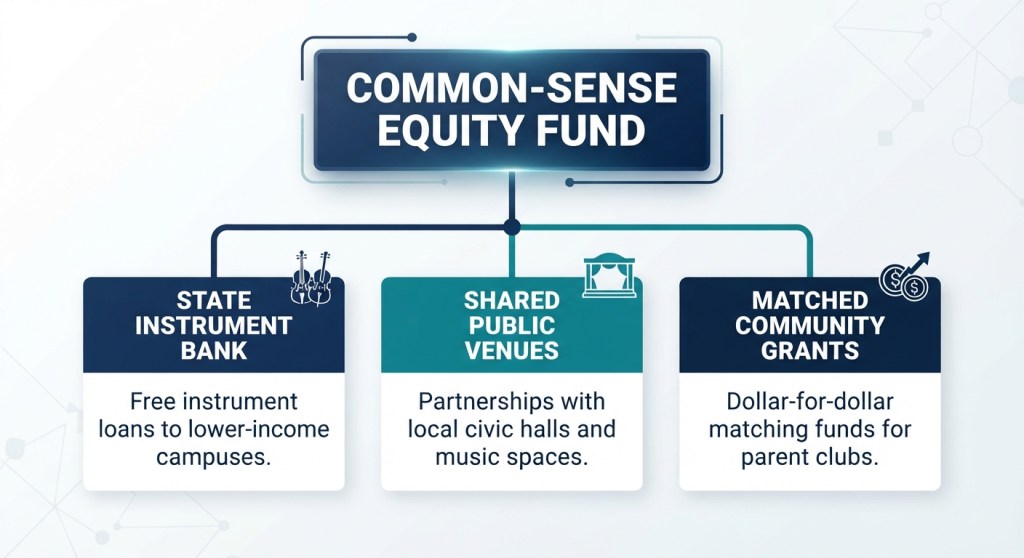
Pillar 3: The Common-Sense Equity Fund (Resources)
This pillar replaces expensive capital school builds with targeted equipment funding and shared public infrastructure, ensuring regional and lower-income schools do not miss out.
- A State Instrument Bank: I will push for a centralised loan system to buy, maintain, and distribute instruments to lower-income schools for free. This directly eliminates the steep upfront costs that prevent disadvantaged students from learning an instrument.
- Shared Public Venues: Instead of spending millions to build new performing arts centres on individual school grounds, I want to secure formal access agreements with local civic halls, council spaces, and regional live music venues for school concerts.
- Matched Community Grants: This funding model introduces a state match, dollar-for-dollar, for any funds raised by school parent committees for music gear. Lower-income schools with limited fundraising capacity will receive a double-matched (two-for-one) state top-up to bridge the resource gap.
Google backgrounder
The history of music education in Victorian government schools is a complex narrative of shifting policy priorities, fluctuating resources, and evolving teaching philosophies. Over a span of more than 170 years, music has transitioned from a basic moral and disciplinary tool into a sophisticated, though occasionally vulnerable, artistic subject. [1, 2, 3]
The Nineteenth Century: Foundations and Singing (1850s–1890s)
Music was first introduced to school education in Victoria during the 1850s. [1, 2]
- The Tonic Sol-fa Method: Early curriculum heavily prioritised vocal music and sight-singing. Schools relied on the Tonic Sol-fa method—a system of teaching sight-singing using syllables (do, re, mi) and hand signs—because it was cheap, did not require sheet music, and allowed generalist teachers to run lessons.
- Moral and Social Purpose: Education authorities viewed group singing as a mechanism for moral discipline, social cohesion, and patriotic alignment rather than pure artistic expression.
- Policy Oscillations: From the outset, the provision of music education fluctuated wildly based on the economic state of the colony. Whenever economic downturns hit, government funding for specialist singing masters was often cut. [1, 2]
The Mid-Twentieth Century: Instigation and Instrumental Music (1950s–1960s)
Following World War II, Victoria began moving away from rigid vocal drill toward broader musical programs.
- The Creative Music Movement: The 1960s marked a significant cultural shift. Discussions by British composer Peter Maxwell-Davies at a 1965 UNESCO conference in Sydney inspired local educators. Local pioneers like Frank Higgins, Keith Humble, and Geoffrey D’Ombrain fought to bring experimental, student-led composition into the classroom. [1]
- Instrumental Music Launch: Instrumental music programs were officially instigated in Victorian government secondary schools during the 1960s. This expanded music from a strictly classroom-based academic subject into a practical performance discipline involving bands, orchestras, and individual instrument tuition. [1, 2, 3]
The Late Twentieth Century: Institutional Reforms (1970s–1990s)
The structure of how music was delivered changed as the state education department underwent massive overhauls.
- Curriculum Frameworks: The 1980s saw the creation of formal state curriculum frameworks. These frameworks attempted to modernise music education by incorporating global traditions, diverse musical genres, and pedagogical approaches like the Kodály and Orff methods.
- Economic Restructuring: During the 1990s, systemic budget cuts and school decentralisation forced many schools to absorb the cost of music specialists locally. This created a stark divide where wealthier school communities could maintain robust music programs, while disadvantaged schools often lost their music teachers entirely. [1, 2]
The Twenty-First Century: Mandates and Access Gaps (2000s–Present)
In the modern era, music has found a permanent legal home in education, though structural delivery hurdles remain.
- The Arts Collection: Music transitioned from a standalone, mandatory subject into one branch of “The Arts” learning area within the Australian Curriculum and the Victorian Curriculum.
- The 2013 Parliamentary Inquiry: A major Parliamentary Inquiry into Music Education revealed severe gaps in classroom delivery. The final report emphasised that many generalist primary teachers lacked the skills and confidence to teach music, leading to an unequal system where some students missed out on sequential music learning.
- The Digital Shift: The COVID-19 remote learning eras proved to be a turning point. Music teachers rapidly pivoted to digital software, online recording tools, and home-based performance methods to keep isolated students connected. [1, 2, 3]
When choosing how to deliver music education to students, schools and policy makers generally contrast incorporating it directly into the core curriculum against alternative delivery methods. Alternative methods include extracurricular clubs, private instrumental tutoring, or community-based youth music programs.
Here is a breakdown of the advantages and disadvantages of each approach.
Music Education inside the Core Curriculum
This model treats music as a formal, timetabled academic subject that every student takes, similar to English, maths, or science.
| Pros | Cons |
|---|---|
| Guaranteed Universal Access: Every student receives music instruction regardless of their family’s financial status, socioeconomic background, or home environment. | Crowded Curriculum Pressure: Fitting music into a rigid weekly timetable reduces the hours available for other high-stakes literacy and numeracy subjects. |
| Sequential, Long-Term Learning: Curriculum frameworks ensure that skills build logically year over year, moving smoothly from early childhood fundamentals to advanced theory. | Assessment and Grading Stress: Forcing a highly creative and expressive medium into standard grading metrics can cause anxiety and stifle artistic exploration. |
| Inclusivity for Diverse Learners: Group classroom activities accommodate students of all abilities, providing vital cognitive, emotional, and social benefits to the whole cohort. | Generalist Teacher Limitations: Primary school teachers are often expected to teach music without sufficient training, which frequently compromises the quality of lessons. |
Alternative Delivery Methods
Alternative methods include optional before- or after-school ensembles, private one-on-one instrumental lessons, and community weekend programs.
| Pros | Cons |
|---|---|
| High Specialisation and Mastery: Students work closely with dedicated instrument experts, allowing them to advance their technical skills much faster than in a general classroom. | Socioeconomic Gaps: Extracurricular and private models require families to pay for tuition, instruments, and travel, which completely excludes disadvantaged students. |
| High Motivation and Engagement: Because these programs are optional, they consist entirely of students who genuinely want to be there, creating a highly focused environment. | Lack of Quality Standardization: Private and community programs operate outside of strict state curriculum checks, making the quality of education highly variable. |
| Flexible Scheduling Options: Moving music outside of regular school hours frees up the daily timetable for other academic priorities and reduces scheduling conflicts. | Isolation from General Learning: When music is separated from the main school day, it loses its connection to other subjects like history, literature, and physics. |
The delivery of music education in Victorian government schools is a regular point of debate, with political parties approaching the issue through the lenses of curriculum reform, equity of access, and general school funding models.
The Australian Labor Party (ALP) – Victorian Branch
The state government approach focuses on systemic, collaborative curriculum frameworks and integrating music under the broader umbrella of “The Arts” and creative industries. [1, 2]
- The Working Group Approach: The Labor government established a dedicated Music Education Working Group to advise on expanding and strengthening music programs across the state. Led by figures like Parliamentary Secretary for Creative Industries Katie Hall MP and Minister for Education Ben Carroll, this group brings together educational stakeholders to coordinate music delivery. [1]
- System Reform Priorities: Rather than carve out music as an isolated funding stream, Labor prioritises broad-scale Victorian Curriculum and Assessment Authority (VCAA) structural reforms ($222.2 million) and large capital infrastructure upgrades. For example, their immediate funding commitments lean toward building major on-campus facilities, such as a $10.73 million performing arts centre at Keilor Downs College. [1]
- Federal Alignment: The state Labor government aligns its efforts with the broader federal “Revive” National Cultural Policy, seeking federal-state partnerships to improve standard education delivery. [1]
The Liberal-National Coalition (Opposition)
The Coalition advocates for a highly structured, standalone curriculum delivery model, positioning music as a core academic discipline that aids broader brain development. [1, 2]
- The $50 Million Policy Package: The Coalition’s explicit blueprint for school music relies on a targeted, ring-fenced funding approach. Their policy centers on introducing mandatory, sequential and continuous music education specifically in state primary schools. [1]
- Standardised Support: To counter the problem of untrained generalist teachers, the Coalition’s plan mandates the state development of high-quality sample lesson plans. [1]
- University Pipelines: Their approach tackles structural workforce shortages by partnering directly with universities to create specialized primary school music teaching courses, guaranteeing a stable pipeline of qualified music educators. They also pledge direct funding for school musical instruments and talent scholarships. [1]
The Australian Greens – Victorian Branch
The Greens approach the music education issue entirely through a lens of strict public equity, universal rights, and addressing the specialized labor shortage. [1, 2]
- The Specialist Guarantee: The Victorian Greens Platform explicitly states that all public school students must have access to free music, drama, and language education. Their core objective is to have a dedicated, qualified arts teacher in every single public school to eliminate geographic and socioeconomic access gaps.
- Focus on Staffing: The Greens reject short-term grants or relying on external charity programs. They campaign on fixing Victoria’s severe specialist teacher shortage by raising educator salaries, lowering workloads, and enforcing permanent staffing benchmarks.
- Cultural Connection: Their broader Arts and Culture Policy prioritises embedding First Nations musical heritage and diverse cross-cultural perspectives into the fundamental rights of student artistic expression. [1, 2, 3, 4]
Industry and Stakeholder Context
While major and minor parties debate funding allocation models, the peak industry body, Music Victoria, continues to pressure all sides of politics to adopt a $6 million a year commitment explicitly earmarked for school music. They argue that regardless of which party is in power, music must be treated as a permanent economic and cognitive contributor that belongs entirely within the core curriculum. [1, 2]
Independent, verified data from recent government and industry reports confirms the economic and cultural impact of music and music education across Victoria and Australia.
Broad Economic Metrics
- The Creative Economy: Data from Creative Victoria Data Insights shows that Victoria’s creative sector contributes $41.1 billion annually to the state. This accounts for an 8.4% share of the total Victorian economy. [1]
- National Industry Scale: Music Australia’s The Bass Line report indicates the entire Australian music industry reached $10.76 billion in revenue, contributing $4.28 billion in direct Gross Value Added (GVA). [1]
The Music Education Sector
According to the landmark May 2026 independent report, More Than Notes on a Page: The Music Education Ecosystem in Australia, music education acts as a massive economic driver: [1]
- Revenue Generation: The music education sector alone generates $1.79 billion in revenues nationwide. [1, 2]
- Gross Value Added: It contributes $1.5 billion in direct GVA. This figure exceeds the total economic contribution of live music performance segment, which sits at $1.4 billion. [1, 2]
- Economic Efficiency: GVA accounts for 85% of total music education revenue. This represents a significantly higher value-add percentage than other subsectors like music retail (20%) or live performance (27%). [1]
- Core Subsectors: Within music education, direct instruction and delivery to students generates $1.529 billion in revenue, resulting in $1.397 billion in direct GVA. Teacher training, research, and pedagogy professional development contribute another $20 million in direct GVA. [1]
Live Venue and Employment Infrastructure
The 2025 Victorian Live Music Venue Audit, commissioned by Creative Victoria and delivered by Music Victoria, presents verified data regarding the state’s commercial performance footprint: [1, 2]
- Total Venues: The audit identified 2,441 live music venues operating across the state.
- Geographic Split: Regional Victoria accounts for 45% of all venues (1,109 spaces), highlighting a strong decentralised cultural footprint. Metropolitan Melbourne holds 40% (964 venues), while outer-metropolitan Melbourne accounts for 15% (368 venues).
- Venue Capacity Scale: Small venues (1–250 capacity) make up 45% of the network, medium venues (251–1,000 capacity) represent 47.4%, and large scale spaces (1,001+ capacity) make up 7.6%.
- Macro Gig Pressures: The number of venues hosting regular weekly gigs has declined 19.4% post-pandemic, dropping from 813 venues in 2019 down to 655 venues. Of these remaining regular presenters, 302 host two or more gigs per week, while 353 host one gig per week. [1, 2, 3, 4]


Leave a Reply