Reforming Australia’s Weed Management System /
Australia’s current weed management regime is critically inadequate—fragmented across jurisdictions, underfunded, and ultimately ineffective. Without decisive reform, invasive species will continue to degrade the nation’s already fragile ecosystems and impose escalating costs on communities, industries and governments.
Weeds represent the second greatest threat to Australia’s biodiversity, after habitat loss. Their impact reaches far beyond conservation, fundamentally altering ecological processes. In particular, invasive plant species change fire behaviour—affecting how fires ignite, spread and intensify—thereby increasing risks to both natural landscapes and human settlements.
The consequences are not confined to rural or remote environments. In urban and peri-urban areas, weeds have a direct impact on human health and wellbeing. Allergies have broader impacts, such as Thunderstorm Asthma, and reducing the amenity of green open spaces with uncontrolled weeds.
Weeds are estimated to cost the Australian economy more than $5 billion annually. Direct crop loss, stock loss, weed control costs and infrastructure damage don’t even include the wider indirect ecosystem consequences.
A reformed weed management system must be comprehensive, consistent and evidence-based.
It must recognise weeds across all contexts—not only in agriculture, but also across environmental, urban, social and infrastructure settings—reflecting the full extent of their impacts.
It must be underpinned by nationally consistent science, monitoring and definitions that account for local ecological conditions, rather than relying on arbitrary jurisdictional boundaries or land-use categories. State agencies often use different mapping software, making it difficult to track “cross-border” invasions in regions like the Murray-Darling Basin.
Strong, harmonised legislation is required at federal, state and local government levels to ensure clear accountability, enforceable standards, and coordinated action nationwide.
Prevention must be prioritised through a firm ban on the importation, propagation and sale of declared exotic weeds. Stopping new invasions is the most effective and cost-efficient strategy available. A plant can be legally sold in one state as a garden ornamental while being a declared noxious weed in the neighboring state.
Weed management must be funded as an ongoing core government responsibility. The current reliance on short-term, piecemeal funding undermines long-term effectiveness and fails to deliver sustained outcomes.
Finally, all policies and interventions must be grounded in robust evidence, drawing on credible national and international research to ensure best-practice approaches are implemented.
Protecting Australia’s biodiversity, economy and communities requires a fundamental shift—from a reactive, fragmented system to a coordinated, well-resourced national framework capable of addressing the scale of the challenge.
See also: Ban gazania
In Australia, land clearing and uncontrolled environmental weeds represent two of the most destructive pressures on native biodiversity, ecosystem health, and agricultural productivity. [1, 2]
While land clearing acts as an immediate, severe structural shock to specific areas, uncontrolled weeds operate as a slower, wide-scale biological invasion that alters entire landscapes. [2, 3, 4, 5]
1. Scale of the Threat
- Land Clearing: Over 500,000 hectares of native woodlands and forests are cleared across Australia every year. This destruction is highly concentrated, with the vast majority occurring in Queensland and New South Wales—primarily driven by agricultural expansion, mining, and urban development. [6, 7, 8, 9, 10]
- Uncontrolled Weeds: The scale of the weed invasion is vast. Australia is burdened by tens of thousands of introduced plant species, and there are now more foreign plant species established in Australia than native ones. Weeds cross all borders, infesting hundreds of millions of hectares across public conservation reserves, private agricultural land, waterways, and marine environments. [1, 3, 6, 11, 12]
2. Immediate vs. Gradual Environmental Impacts
   [LAND CLEARING]                           [ENVIRONMENTAL WEEDS]
          │                                            │
   Immediate Shock                              Gradual Takeover
          ▼                                            ▼
┌───────────────────────────┐                ┌───────────────────────────┐
│ • Total habitat erasure   │                │ • Alters ecosystem traits │
│ • Massive fauna mortality │                │ • Fuel for intense fires  │
│ • Severe soil erosion     │                │ • Smothers regeneration   │
└───────────────────────────┘                └───────────────────────────┘
- Land Clearing (Immediate Shock): Clearing causes total habitat loss. When a machine bulldozes a woodland, the impact is instant: local plants are destroyed, and millions of native animals are killed directly or left to die from exposure and starvation. It breaks continuous forests into isolated fragments, leaving remaining wildlife vulnerable to extinction. [2, 7, 13, 14, 15]
- Uncontrolled Weeds (Gradual Transformation): Weeds do not immediately strip a landscape bare; instead, they slowly change how an ecosystem functions. They outcompete native plants for water, nutrients, and sunlight, which reduces overall biodiversity. Highly invasive transformer species—such as Gamba grass in northern Australia or Buffel grass in arid zones—produce high fuel loads that fuel intense, destructive bushfires that kill mature native trees. [3, 16, 17, 18, 19]
3. Impact on Extinction and Threatened Species
- Primary Driver of Plant Extinctions: According to data from the Invasive Species Council, historical and ongoing habitat destruction via land clearing is the primary cause of plant extinctions in Australia. It threatens more than 1,100 listed species (61% of all threatened terrestrial species under the EPBC Act). For every 100 hectares of woodland cleared, an estimated 2,000 birds, 15,000 reptiles, and 500 mammals are lost. [2, 7, 20]
- Primary Driver of Native Decline: Invasive species, including weeds, threaten more than 70% of Australia’s endangered plants, animals, and habitats. While feral animals drive mammal and bird extinctions, environmental weeds degrade the fragile ecosystems that surviving native fauna rely on for food and shelter. [3, 20, 21, 22, 23]
4. Secondary Landscape Damage
- Clearing Legacy: Stripping trees removes the deep root systems that hold the landscape together. This triggers severe dryland salinity, soil acidification, and extensive erosion. In northern regions, sediment and nutrient runoff from cleared grazing lands washes into river basins, damaging coastal environments and the Great Barrier Reef. [2, 7, 11]
- Weed Legacy: Uncontrolled weeds disrupt natural ecosystem processes like pollination, clog watercourses (such as Water Hyacinth), and degrade agricultural productivity, costing the Australian economy over $4.3 billion annually in management and lost farm yields. [3, 24, 25, 26, 27]
Summary Comparison
| Metric [1, 2, 6, 8, 16, 17, 24, 28, 29] | Land Clearing | Uncontrolled Weeds |
|---|---|---|
| Primary Driver | Agriculture, infrastructure, and mining. | Historical pasture imports, garden escapes, and biosecurity breaches. |
| Nature of Impact | Absolute, immediate ecosystem erasure. | Slow, insidious degradation of ecosystem functions. |
| Geographic Footprint | Concentrated in specific agricultural and development zones. | Pervasive across almost every ecosystem in the country. |
| Reversibility | Extremely difficult; takes decades to centuries for old-growth ecosystems to return. | High effort required; demands continuous, long-term funding to prevent re-invasion. |
[1] https://www.agriculture.gov.au
[3] https://www.hunterregionalweeds.net.au
[4] https://barraboolhillslandcare.org.au
[5] https://www.wettropics.gov.au
[7] https://www.bushheritage.org.au
[12] https://www.hunterregionalweeds.net.au
[13] https://veganaustralia.org.au
[14] https://wilderness.org.au
[16] https://weeds.org.au
[17] https://www.dcceew.gov.au
[18] https://hal.science
[19] https://bioone.org
[21] https://www.theguardian.com
[26] https://www.hunterregionalweeds.net.au
[29] https://www.soe.epa.nsw.gov.au
Australian weed management is a multi-layered effort coordinated between federal, state, and local governments, aimed at protecting Australia’s $90 billion agricultural sector and its unique biodiversity. [1, 2, 3]
As of 2026, the strategy has shifted toward biosecurity technology and rapid response to combat the estimated $5 billion annual cost weeds impose on the economy.
🏛️ Governance Framework
1. Federal Level
The Australian Government provides national leadership through the Australian Weeds Strategy 2017–2027. [4]
- Focus: Managing Weeds of National Significance (WoNS)—32 species (like Blackberry, Gorse, and Lantana) that have major economic and environmental impacts across state borders.
- Border Control: Preventing new invasive species from entering through strict international biosecurity at ports. [5, 6, 7, 8, 9]
2. State & Territory Level
Each state has its own legislation (e.g., the VIC Catchment and Land Protection Act 1994 or the NSW Biosecurity Act 2015). [10]
- Categorisation: Weeds are classified by risk (e.g., “State Prohibited,” “Regionally Controlled,” or “Restricted”).
- Enforcement: State agencies can issue directions to landowners to clear specific weeds. [11, 12, 13, 14, 15]
3. Local Level
Local Councils and Catchment Management Authorities (CMAs) are the “boots on the ground.”
- Responsibility: Managing weeds on roadside verges, local parks, and public bushland.
- Landowners: In Australia, the legal responsibility for weed control on private land rests solely with the landowner. [16, 17, 18, 19, 20]
🌿 Weed Categories
| Category [21, 22, 23, 24, 25] | Description | Example |
|---|---|---|
| WoNS | Weeds of National Significance; high impact, high spread. | Gorse, Blackberry, Serrated Tussock |
| Sleeper Weeds | Invasive plants that have not yet “exploded” but have the potential. | Orange Hawkweed |
| Environmental Weeds | Plants that invade native bushland, outcompeting local flora. | Boneseed, English Ivy |
| Agricultural Weeds | Specifically impact crop yields or contaminate livestock products. | Wild Oats, Capeweed |
🛠️ Management Modernisation (2026)
Australia is currently a world leader in “smart” weed management: [26]
- Biological Control: Using natural enemies (insects or fungi) to manage widespread weeds where chemicals are too expensive. Example: The Smut Fungus used to control Tradescantia.
- Drone Surveillance: Using multispectral cameras to map weed infestations in inaccessible terrain (e.g., the Victorian Alps or Northern Territory floodplains).
- AI “See and Spray”: Farming machinery that uses machine learning to identify weeds and spray them individually, reducing chemical use by up to 90%. [27, 28, 29, 30, 31]
⚠️ Current Challenges
- Climate Change: Warming temperatures are allowing tropical weeds (like Mimosa) to push further south into NSW and Victoria.
- Herbicide Resistance: Many agricultural weeds (like Annual Ryegrass) are becoming resistant to common chemicals like Glyphosate.
- The “Buffer” Gap: Significant friction exists where “neglected” public land (like rail corridors) allows weeds to re-infest neighboring “clean” private farms. [32, 33, 34, 35]
[2] https://www.kentish.tas.gov.au
[4] https://www.agriculture.gov.au
[5] https://www.sciencedirect.com
[6] https://www.surfcoast.vic.gov.au
[7] https://www.agriculture.gov.au
[8] https://www.allpesticides.com
[9] https://www.orterra.com.au
[10] https://www.agriculture.gov.au
[11] https://www.krg.nsw.gov.au
[12] https://resources.austplants.com.au
[15] https://www.sgaonline.org.au
[16] https://www.sorell.tas.gov.au
[17] https://www.mildura.vic.gov.au
[18] https://www.ahc.sa.gov.au
[19] https://www.lanecove.nsw.gov.au
[20] https://www.cumberland.nsw.gov.au
[21] https://www.agriculture.gov.au
[22] https://www.sorell.tas.gov.au
[23] https://www.naturalstate.com.au
[25] https://weeds.org.au
[26] https://groundcover.grdc.com.au
[27] https://www.csiro.au
[29] https://www.yourlifechoices.com.au
[30] https://vocal.media
[31] https://www.csiro.au
[32] https://besjournals.onlinelibrary.wiley.com
[33] https://www.weedsmart.org.au
[34] https://www.weedsmart.org.au
[35] https://environment.nt.gov.au
Despite a robust biosecurity framework, Australia faces significant hurdles in weed management as invasive species adapt to climate shifts and chemical treatments.
⚠️ Strategic Risks
- Climate Change “Sleeper” Weeds: Warmer temperatures are pushing tropical weeds (like Mimosa) southward and allowing sub-alpine weeds to climb higher.
- Herbicide Resistance: A critical threat to the $90 billion agricultural sector. Species like Annual Ryegrass and Wild Radish are evolving resistance to multiple chemical groups faster than new formulas are developed.
- Biosecurity Lag: The “invasion curve” means that by the time a weed is widely noticed, it is often already too expensive to eradicate, shifting the burden from the government to permanent private landholder maintenance.
🏗️ Operational Challenges
| Challenge | Impact | Context |
|---|---|---|
| The “Buffer” Gap | Public land (rail, roads, parks) often acts as a re-infestation reservoir for neighboring clean farms. | Causes significant friction between farmers and state agencies. |
| Labour Shortages | A lack of skilled “boots on the ground” for manual and chemical spraying in regional areas. | 2025–26 reports show a 30% vacancy rate in regional biosecurity roles. |
| Terrain Accessibility | Weeds in the Victorian Alps or NT floodplains are unreachable by vehicles. | Requires expensive helicopter or drone deployment. |
| Social License | Increasing public opposition to large-scale Glyphosate use in urban and peri-urban areas. | Limits the tools available for local councils. |
🏛️ Policy & Funding Gaps
1. Funding “Cliff Edges”
Weed programs are often funded via short-term grants (1–3 years).
- The Gap: Effective weed management (especially for species like Gorse or Serrated Tussock) requires a 10–20 year commitment to exhausted seed banks. When funding stops, the weed returns, wasting previous investment.
2. Fragmented Legislation
While the Australian Weeds Strategy provides a vision, implementation is split across eight states and territories with different “Prohibited” lists.
- The Risk: A plant can be legally sold in one state as a garden ornamental while being a declared noxious weed in the neighboring state.
3. Data Silos
There is no unified, real-time national map of weed infestations.
- The Gap: State agencies often use different mapping software, making it difficult to track “cross-border” invasions in regions like the Murray-Darling Basin.
🛠️ The Innovation Gap
While AI “See and Spray” and drones are emerging, the “cost-to-benefit” ratio for small-scale farmers remains a barrier.
- The Challenge: High-tech solutions are currently accessible only to large-scale broadacre cropping, leaving the “lifestyle block” and “small holder” sectors—which are often the worst for weed neglect—behind.
Urban and peri-urban weed management in Australia is uniquely challenging because it sits at the intersection of high population density, rapid land-use change, and sensitive environmental interfaces.
As of 2026, the focus has shifted from simple eradication to “biosecurity at the fringe,” where the goal is to prevent weeds from escaping gardens and development sites into surrounding bushland.
🏗️ The “Peri-Urban” Challenge
The peri-urban fringe (where city meets country) is the primary “frontline” for new weed invasions.
- Land Disturbance: New housing estates involve massive soil movement, which activates dormant seed banks and spreads weeds like Serrated Tussock via heavy machinery.
- Lifestyles Blocks: Owners of small acreage often lack the equipment or agricultural knowledge to manage invasive species, leading to “weed nurseries” that re-infest productive farmland.
- The “Garden Escapee” Pipeline: Roughly 65% of Australia’s environmental weeds originated as garden plants (e.g., Agapanthus, English Ivy, and Asparagus Fern).
🏛️ Governance & Responsibility
Management in these zones is a “shared responsibility” model, which often leads to jurisdictional gaps.
| Stakeholder | Role | Primary Focus |
|---|---|---|
| Local Councils | Enforce local laws; manage public parks and roadsides. | High-visibility amenity weeds and fire-risk grasses. |
| State Agencies | Manage state forests and major rail/road corridors. | Statewide prohibited species (e.g., Chilean Needle Grass). |
| Land Developers | Manage weeds on “banked” land awaiting construction. | Preventing sediment and weed runoff into local waterways. |
| Homeowners | Legal duty to manage declared weeds on private lots. | Preventing “over-the-fence” spread into neighbors or bushland. |
🌿 Key Weeds of the Urban Fringe
- Fire-Prone Grasses: Species like Chilean Needle Grass and African Lovegrass increase the “fuel load” around homes, significantly raising bushfire risks in the urban-forest interface.
- Woody Weeds: Gorse and Blackberry create harbourage for pests (rabbits/foxes) and are difficult to remove once they establish in rocky peri-urban gullies.
- Aquatic Weeds: Salvinia and Water Hyacinth often escape from backyard ponds into urban wetlands, choking oxygen levels and killing local fish.
🛠️ Modern Management Strategies (2026)
1. “Buffer Zone” Legislation
States like Victoria and NSW have introduced stricter “Buffer Zone” requirements for developers. Before a new subdivision can be titled, the developer must demonstrate a 3-to-5 year weed management plan to protect adjacent conservation areas.
2. Biological Controls
In urban areas where chemical spraying is restricted due to health concerns, biological controls are being prioritised.
- Example: Releasing leaf-feeding beetles to control Tradescantia (Wandering Creeper) in suburban creek lines.
3. Community “Citizen Science”
Apps like WeedScan allow residents to identify and report weeds via AI. In 2026, local councils are using this “crowdsourced data” to deploy rapid-response teams to new infestations before they become unmanageable.
⚠️ Emerging Risks: The “Social License”
There is a growing “Social License” gap in urban weed management:
- Chemical Sensitivities: High public opposition to the use of Glyphosate in school zones and local parks is forcing councils to use more expensive, less effective methods (like steam weeding or hand-pulling).
- Infill Pressure: As backyards shrink, the “green waste” problem grows. Illegal dumping of garden clippings in local reserves remains the #1 cause of new urban weed outbreaks.
Weeds exert a massive, multi-billion dollar pressure on the Australian economy and environment. They are more than just a nuisance; they are a primary driver of biodiversity loss and a significant tax on food production.
💰 Economic Impact
The total annual cost of weeds to the Australian economy is estimated at over $5 billion.
- Agricultural Loss: Weeds reduce crop yields and contaminate livestock products (like wool). The grain industry alone loses over $3.3 billion annually in control costs and lost production.
- Herbicide Expenditure: Australian farmers spend approximately $1.5 billion each year on chemicals to manage invasive plants.
- Livestock Health: Many weeds (e.g., Paterson’s Curse or Lantana) are toxic to cattle and sheep, leading to significant veterinary costs or stock losses.
- Infrastructure Damage: Weed roots damage road surfaces, block irrigation channels, and increase the cost of maintaining rail and power corridors.
🌿 Environmental Impact
Weeds are the second greatest threat to Australia’s biodiversity after habitat loss.
- Species Displacement: Invasive plants outcompete native flora for light, water, and nutrients. This can lead to the total collapse of local ecosystems.
- Habitat Loss: Weeds like Mimosa can transform open wetlands into impenetrable thickets, preventing native birds and animals from nesting or feeding.
- Water Quality: Aquatic weeds like Salvinia choke waterways, reducing oxygen levels and killing fish and native aquatic plants.
🔥 Impact on Fire & Natural Hazards
Weeds fundamentally change the way fire moves through the Australian landscape.
- Fuel Loads: High-biomass grasses like Gamba Grass (NT) and African Lovegrass (VIC/NSW) create significantly hotter and more intense fires than native grasses.
- Fire Bridges: Woody weeds like Gorse act as “fuel ladders,” allowing ground fires to climb into the tree canopy, turning manageable grass fires into uncontrollable crown fires.
🏛️ Impact Summary by Sector
| Sector | Primary Impact | Top “Problem” Species |
|---|---|---|
| Agriculture | Reduced yield; chemical costs. | Annual Ryegrass, Wild Radish |
| Environment | Loss of native species. | Blackberry, Bitou Bush |
| Urban/Social | Health (allergies); fire risk. | Parthenium, Chilean Needle Grass |
| Utilities | Blocked drains; damaged roads. | Willow, Alligator Weed |
⚠️ Human Health Impact
In urban and peri-urban areas, weeds directly affect human well-being:
- Allergies: Species like Parthenium and Privet are major triggers for asthma and hay fever.
- Injury: Thorns and burrs from species like Noogoora Burr or Spiny Burr Grass impact recreational use of parks and beaches.
Weeds are often described as “biological polluters” of native environments. In Australia, they are a primary driver of the extinction of native plant and animal species because they fundamentally change the chemistry and structure of the bush.
🌿 Impact on Native Environments
1. Ecosystem “Transformation”
Invasive weeds don’t just grow alongside native plants; they replace them.
- Structural Change: High-climbing weeds like Bridal Creeper or English Ivy can smother the forest canopy, blocking sunlight and eventually killing mature native trees.
- Monocultures: Weeds like Boneseed or Bitou Bush create dense “green walls” that prevent any native seedlings from germinating, turning a biodiverse forest into a single-species thicket.
2. Altered Fire Regimes
Many invasive grasses are much more flammable than native vegetation.
- Hotter Fires: Species like Gamba Grass (in the north) or African Lovegrass (in the south) create fuel loads that make bushfires significantly hotter.
- Ecosystem Loss: These intense fires kill native trees that would normally survive a cooler “natural” fire, permanently converting forests into weed-dominated grasslands.
3. Soil Chemistry and Water
Some weeds, such as Lantana, use “allelopathy”—they release chemicals into the soil that actively inhibit the growth of other plants. Others, like Willows in river systems, consume far more water than native gums, drying out small creeks and wetlands.
🏡 The Critical Role of Urban Gardeners
Urban gardeners are the “frontline” of weed management. Over 65% of Australia’s environmental weeds are escaped garden plants.
The “Over the Fence” Problem
Seeds from garden plants don’t stay in the backyard. They are spread into nearby bushland by:
- Wind and Water: Light seeds blow into reserves; heavy rain washes seeds into storm drains and local creeks.
- Birds: Many popular garden shrubs have berries (e.g., Privet, Hawthorn, Cotoneaster). Birds eat the fruit and drop the seeds far into national parks.
- Green Waste: Dumping garden clippings in local parks is the #1 cause of new weed infestations in urban areas.
🛠️ How Gardeners Can Help
- Choose “Grow Me Instead”: Swap invasive favourites for non-invasive or local native alternatives.
- Swap: Agapanthus for Native Lily (Dianella).
- Swap: English Ivy for Native Sarsaparilla (Hardenbergia).
- Deadhead Flowers: Prune spent flowers before they turn to seed to prevent wind and bird dispersal.
- Secure Disposal: Never dump green waste in the bush. Use your council “FOGO” bin or a hot composting system that kills seeds.
- Identify and Act: Use apps like WeedScan or iNaturalist to identify if your “pretty” plant is actually a declared weed.
🛡️ The Goal: To create “biosecure” gardens that act as a buffer for our national parks, rather than a source of invasion.
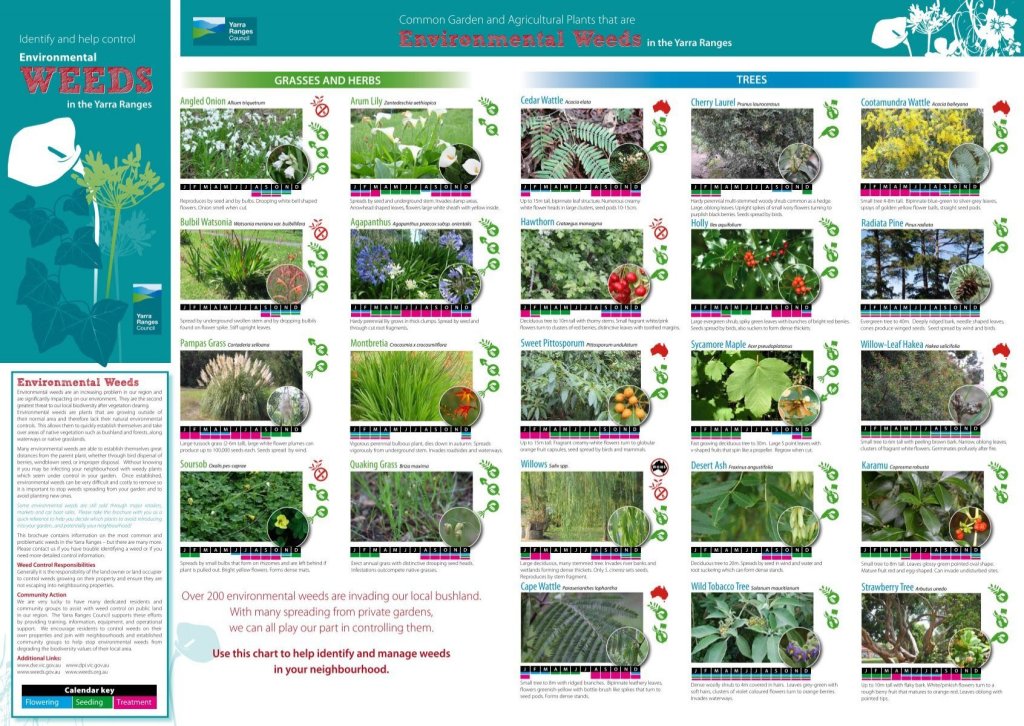
In Victoria, garden escapees are a major threat to our local biodiversity, particularly in the Dandenongs, the Otways, and the peri-urban fringes of Melbourne. [1, 2]
Here are the top offenders that frequently “jump the fence” and invade Victorian bushland:
🌿 The “High Priority” Escapees
- Agapanthus (Agapanthus praecox): While beloved for their hardiness, their seeds and thick rhizomes easily wash into drains and local creeks, choking out native groundcovers.
- English Ivy (Hedera helix): A significant threat in cool, damp gullies. It smothers the ground and climbs mature eucalypts, eventually weighing them down and killing them.
- Sweet Pittosporum (Pittosporum undulatum): While technically a native to parts of East Gippsland, it has become a major weed in Melbourne. Birds spread its sticky seeds into forests where it creates a dense “shady” canopy that prevents other native species from growing.
- Boneseed (Chrysanthemoides monilifera): A yellow-flowered shrub that thrives in coastal and hilly areas. A single plant can produce 50,000 seeds a year, which can remain dormant in the soil for a decade.
- Bridal Creeper (Asparagus asparagoides): One of Australia’s Weeds of National Significance. Its underground tubers form a dense mat that prevents any other plants from accessing water or nutrients. [3, 4, 5, 6, 7]
🏛️ Common Victorian Garden Weeds by Type
| Type [8, 9, 10, 11] | Species | Why it’s a problem |
|---|---|---|
| Climbers | Blue Bell Creeper, Jasmine | Smothers native shrubs; difficult to untangle. |
| Shrubs | Cootamundra Wattle, Privet | Outcompetes local wattles; alters soil nitrogen. |
| Bulbs/Lilies | Watsonia, Freesia | Displaces native orchids and lilies in spring. |
| Groundcovers | Periwinkle, Wandering Trad | Carpets the forest floor; prevents seed germination. |
🛠️ What you can do in Victoria
- Check the “Grow Me Instead” Guide: The Nursery & Garden Industry Victoria (NGIV) provides a list of safe alternatives for every common weed.
- Dispose Safely: Never dump garden clippings in local reserves. Use your green waste (FOGO) bin, as commercial composting reaches temperatures high enough to kill most weed seeds.
- Be Careful with “Natives”: Just because a plant is “Australian” doesn’t mean it belongs in your specific part of Victoria. For example, West Australian Blue Hibiscus can be highly invasive in Victorian bushland. [12, 13, 14]
🔍 Pro-Tip: If you live near a creek or National Park, consider planting indigenous species (plants that occurred naturally in your specific suburb). They require less water and provide the best habitat for local birds and bees. [15, 16]
[1] https://www.conservationcollective.shop
[2] https://idodrivethru.com.au
[8] https://minimalistgardener.com.au
[9] https://www.yarraranges.vic.gov.au
[10] https://www.thetutuguru.com.au
[11] https://www.mpequinelandcare.com
[12] https://www.wcg3280.org.au
[14] https://www.instagram.com


Leave a Reply