The current public Artificial Intelligence debate suffers from a steady stream of misinformation and hyperbole on all sides. This is a basic background piece on “what is AI?”, “what is a data centre?”, “what is the scale of the electricity demand?”, “is this a boom and what does the bust look like?”, and “what can governments do about it?”.
Google backgrounder
Artificial intelligence (AI) is a field of computer science that builds systems capable of performing tasks that typically require human intelligence. These tasks include understanding language, recognizing patterns, making decisions, and learning from experience. [1, 2, 3, 4]
Instead of following rigid, pre-written instructions, modern AI uses algorithms and vast amounts of data to teach itself how to solve problems through a process called machine learning. [2, 5]
How AI Works
AI operates through a simple, three-step loop: [5]
- Data Input: The system gathers massive collections of information, such as text, images, or numbers.
- Pattern Recognition: High-powered math formulas analyze the data to spot connections and trends.
- Prediction & Execution: The system uses those patterns to make a guess, generate a response, or take an action. [1, 2, 5]
Core Types of AI
To understand the landscape of AI, experts generally divide the technology into three categories based on its capabilities: [6, 7]
| Type of AI | Description | Real-World Examples |
|---|---|---|
| Narrow AI (ANI) | Highly skilled at a single, specific task. It does not possess actual awareness or general understanding. | Apple Siri, Netflix recommendations, face ID, and spam filters. |
| Generative AI | A advanced subset of narrow AI that can create entirely new content, from text to art. | OpenAI ChatGPT, Google Gemini, and Midjourney. |
| General AI (AGI) | A completely theoretical type of AI that matches human intellect across any cognitive task. | Does not exist yet (currently limited to science fiction). |
Common Everyday Applications
You likely interact with AI every day without realizing it: [2, 8]
- Virtual Assistants: Voice-activated tools like Amazon Alexa interpret natural human speech.
- Entertainment: Platforms like YouTube and Spotify map your behavior to predict what you want to watch or hear next.
- Navigation: Apps like Google Maps evaluate real-time traffic data to calculate the fastest route.
- Finance: Banks monitor millions of transactions simultaneously using machine learning to instantly flag fraudulent activity. [1, 2, 6, 9]
[8] https://www.letsbemates.com.au
In Australia today, artificial intelligence is deeply embedded across everyday consumer-facing products and services, moving rapidly from back-office systems directly into customer interactions. Rather than just being something people use on a computer, AI has become a standard feature in how Australians shop, bank, travel, and entertain themselves. [1, 2, 3, 4]
The technology is highly visible across major Australian consumer sectors, categorized below:
🛍️ Retail & Supermarkets
The retail sector has seen the most aggressive rollout of conversational and visual AI assistants designed to change how consumers discover products. [4, 5]
- Virtual Shop Assistants: Major Australian brands use generative AI bots to guide shoppers. For example, Kmart features a virtual assistant named Joy for customer queries and virtual apparel try-ons. Bunnings uses Buddy, and Woolworths utilizes Olive to assist with grocery queries and stock tracking. [4]
- Interactive Try-Ons: Brands like Zara allow Australian customers to upload selfies to create 3D avatars, mapping clothing directly to a digital version of their body before buying. [4]
- AI Search Overhaul: Consumers are increasingly starting their shopping journeys on platforms like OpenAI ChatGPT and Google Gemini to cross-compare Australian retail prices, check product specifications, and find the best local deals. [5, 6]
💰 Banking & Finance
Australia’s financial institutions have heavily invested in machine learning to handle customer interactions and safety. [7, 8]
- Customer Support & Optimization: The Commonwealth Bank (CBA) has scaled its AI capabilities significantly to drive personalized financial insights inside its consumer app. Meanwhile, insurance comparison networks like Compare Club use AI to instantly parse coverages and match consumers to policies faster. [7, 8]
- Fraud Detection: Every major Australian bank uses real-time behavioral AI behind the scenes to monitor transaction patterns, instantly flagging or blocking suspicious card activity to prevent scams. [1]
🏎️ Everyday Apps & Paid Subscriptions
- Paid Consumer AI Tools: AI has literally become a line item on the average household budget. According to financial data from Westpac, hundreds of thousands of Australians pay a monthly subscription fee (averaging $37/month) to access premium tiers of ChatGPT, Google Gemini, or design tools like Canva Magic Studio.
- Streaming & Navigation: Services heavily localized for the Australian market—like Spotify, Netflix, Stan, and Kayo Sports—rely entirely on AI recommendation engines to curate home feeds based on local viewing habits. [3, 9, 10]
The Consumer Sentiment Reality Check
While Aussie consumers are heavily utilising AI, recent consumer behavior indexes highlight a strict boundary in public trust:
| Where Aussies Trust AI | Where Aussies Limit AI |
|---|---|
| Product Discovery: 64% of Australians actively use AI assistants to browse, find, and compare products. | Independent Buying: Only 5% of Australians trust an AI “agent” to autonomously complete a purchase or checkout for them. |
| Time Efficiency: 53% of online shoppers state AI helps them spend less time searching for items. | Data Privacy: 83% of Australian consumers explicitly state that businesses must secure consent before using their data to train AI models. |
Because of the rapid growth in these consumer spaces, the Australian Government and the ACCC have prioritized new protections targeting risks like “surveillance pricing” (where AI adjusts prices dynamically based on your browsing history) and deepfake scams. [1, 4, 11]
[5] https://www.channelnews.com.au
[10] https://ecommercenews.com.au
[11] https://www.mlex.com
While consumers often notice AI when interacting directly with a chatbot or a personalized streaming feed, the vast majority of AI in the consumer landscape operates entirely behind the scenes.
According to data from EY Australia, while more than half of Australians deliberately use AI for customer experiences, only 6% to 8% of people realize AI is powering the hidden infrastructure of their daily transactions. [1]
AI is commonly embedded in consumer experiences without the consumer realizing it across several hidden touchpoints:
1. “Surveillance Pricing” and Dynamic Optimization
When shopping online or booking travel, consumers rarely see the standard, static price tag anymore.
- Dynamic Markdown & Pricing: Retailers use AI pricing platforms to calculate “price elasticity”. If an item is sitting in an online cart, or if the local weather suddenly changes, background algorithms instantly adjust the price or offer a targeted discount code to nudge a checkout. [2, 3]
- Ride-Share & Delivery Surges: When booking a ride on Uber or ordering dinner on UberEats or Menulog, hidden machine learning models calculate surge pricing. It doesn’t just look at basic supply and demand; it evaluates real-time traffic speeds, local event calendars, and historical driver behaviors to maximize margins. [2, 4]
2. Micro-Targeted Retail Layouts & Restocking
Before a consumer even walks into a physical store, AI has determined exactly what will be on the shelves.
- Predictive Stocking & Anticipatory Shipping: Supermarkets like Woolworths and Coles align their inventory with predictive AI forecasting. The system cross-references local crop yields, geopolitical disruptions, and upcoming regional weather patterns to ensure shelves are packed with specific goods right when a surge in demand is expected. [3, 5, 6]
- Store-Specific Deliveries: Retailers use machine learning to optimize driver routing and delivery schedules down to the specific layout of individual urban neighborhoods, minimizing the timeframe between warehouse picking and store shelf placement. [6, 7]
3. Invisible Logistics and Supply Chains
The journey an item takes to reach a household is highly automated to save companies billions in overhead. [7, 8]
- Automated Picking & Quality Control: Major supply chains use computer vision AI in Australian distribution centers. High-speed cameras scan up to 10,000 product pallets per hour, detecting micro-flaws, expiration dates, or inventory discrepancies without any human eyes touching the stock.
- Digital Twins: Global consumer goods companies like Unilever map their entire product journeys using a “digital twin”—an AI-driven simulation of the physical world. If a port slows down or a freight truck is delayed, the AI automatically simulates the fallout and reroutes consumer shipments autonomously. [8, 9, 10]
4. Financial Triage and Risk Assessment
The moment a consumer interacts with a bank or an insurance company, their profile is filtered by hidden mathematical formulas.
- Credit & Insurance Underwriting: When applying for a credit card, a personal loan, or a fast insurance quote from networks like Compare Club, the immediate approval or rejection isn’t handled by a person. Background AI screens thousands of behavioral data points to instantly score risk and set a personalized interest premium.
- Silent Scam Interception: Australian banks run continuous AI algorithms that read biometric patterns—such as the unique speed at which a user types or holds their phone—to silently detect whether a customer is being actively manipulated by a phone scammer while inside their banking app. [11]
Why Companies Keep it Hidden
A major reason these systems operate in the dark is consumer trust. Data indexes from Sitecore and independent marketing studies show that up to 74% of consumers react negatively if they feel a brand’s human element has entirely disappeared. Keeping AI confined to logistics, pricing, and infrastructure allows companies to reap massive efficiency gains without triggering consumer alienation. [12, 13]
[10] https://consumergoods.com
[13] https://www.instagram.com
A data centre is a dedicated physical facility used by organizations to house their critical applications and data. It is essentially the physical home of the internet and the backbone of modern cloud computing.
When you stream a movie on Netflix, check your balance on a banking app, or ask an AI tool a question, your device isn’t doing the heavy lifting. Instead, it sends a request over the internet to a data centre, which processes the information and sends it back to your screen.
What is Inside a Data Centre?
If you walked into a modern data centre, you would see rows of tall, steel cabinets called racks filled with specialized electronic equipment. The core components include:
- Servers: High-powered computers without screens or keyboards that process data and run applications.
- Storage Systems: Massive arrays of hard drives and solid-state drives (SSDs) that hold files, databases, and media.
- Networking Gear: Routers, switches, and miles of fiber-optic cables that connect the servers to each other and to the outside world.
The Infrastructure Keeping it Alive
Data centres cannot afford to turn off, even for a second. To keep the computers running 24/7/365, the facility requires a massive industrial infrastructure:
- Power Supply: They consume immense amounts of electricity. They feature heavy-duty Uninterruptible Power Supplies (UPS) and massive diesel generators to keep running during power grid blackouts.
- Cooling Systems: Thousands of computers packed closely together generate extreme heat. Data centres use industrial air conditioners, chilled water loops, or liquid cooling systems to prevent the hardware from overheating and melting.
- Security: These facilities hold highly sensitive data. They are protected by military-grade physical security, including biometric scanners, concrete vehicle barriers, security guards, and continuous CCTV surveillance.
Why the AI Boom is Changing Data Centres
The rise of generative AI has sparked a massive transformation in how data centres are built, particularly in tech hubs like Sydney and Melbourne.
Standard cloud computing tasks (like hosting a website) use traditional CPUs (Central Processing Units). However, training and running AI requires specialized chips called GPUs (Graphics Processing Units), such as those made by NVIDIA. Because AI chips work much harder and process complex math simultaneously, AI data centres require up to ten times more power and cooling than traditional facilities, forcing the industry to rapidly pivot toward advanced liquid-cooling technologies.
In Australia, the evolution of data centres has transformed them from isolated telecom storage closets into massive, hyper-scale facilities that serve as the industrial powerhouses of the modern AI economy.
The number of data centres in Australia has grown to approximately 250 to 300 operational facilities, while total computing power—measured by operational electricity capacity—has surged past 1.4 Gigawatts (1,400+ Megawatts). [1, 2, 3]
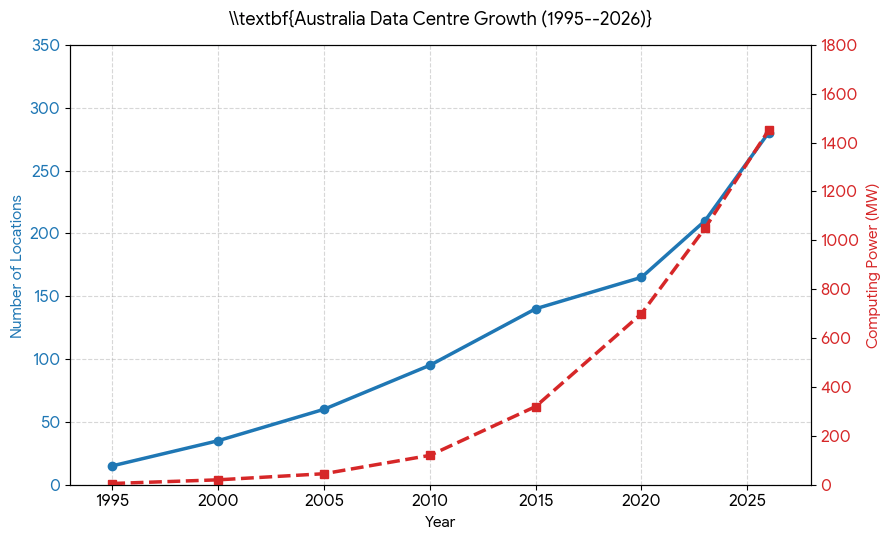
The trajectory of this infrastructure boom since the 1990s reflects this massive scale of expansion:
📈 Historical Growth: Locations vs. Computing Power
| Era / Year | Approximate Operational Locations | Estimated Computing Power (Megawatts) | Key Technology Drivers |
|---|---|---|---|
| 1990s | < 20 facilities | < 10 MW | The Early Dot-Com Boom: Basic telecom switching facilities and on-premise server closets housing early web hosting and corporate databases. |
| 2000s | ~50 facilities | ~50 MW | Colocation Emergence: The shift toward dedicated, third-party facilities. The standard data centre required minimal power per server rack (1–2 kW). |
| 2010s | ~120 facilities | ~400 MW | The Cloud Explosion: Rise of centralized enterprise cloud platforms (AWS, Microsoft Azure). Hyperscale facilities begin appearing in Sydney and Melbourne. |
| 2020 | ~145 facilities | ~700 MW | The Pandemic Surge: Immediate demand spikes driven by remote work, video streaming (Netflix/Stan), and accelerated corporate cloud migration. |
| 2026 (Current) | 250 – 314 facilities | 1,400 – 1,980 MW | The Generative AI Boom: Extreme demands for energy-dense graphics processors (GPUs). National data centre density increased fortyfold over the past two decades. |
Understanding the Metrics: Locations vs. Power Capacity
Historically, evaluating digital growth relied on counting the number of physical locations. However, the rise of modern AI infrastructure has made the measure of computing power (Megawatts) the primary industry standard: [3, 4, 5]
- Why Megawatts (MW) Matter: Data centres draw power to run their computing hardware and to run the cooling infrastructure required to keep it from melting. The more complex an algorithm is, the more electrical power the processor chips pull from the grid.
- The AI Scale-Up: A standard cloud data centre built in 2015 might have required 10 to 20 MW of power. In contrast, modern AI-specific data centres currently built or expanding in Australia (such as the AirTrunk facilities in Sydney) can scale to 130+ Megawatts per single facility. [6]
What the Future Holds: 2026 to 2035
Data from the Australian Energy Market Operator (AEMO) and major financial forecasts indicate that the current expansion is only the beginning of a massive infrastructure pipeline: [7]
- The Investment Boom: The Commonwealth Bank (CBA) estimates that Australia has roughly 6 Gigawatts (6,000 MW) of potential data centre capacity in its pipeline, representing a projected $150 billion investment cycle by 2030. [8, 9]
- Grid Demand: Data centres currently account for roughly 3% of the electricity supplied to Australia’s main energy grid. Driven almost entirely by generative AI processing workloads, AEMO forecasts that this demand will rise nearly seven-fold by 2036, eventually consuming 13% of the grid’s total power. [7, 10]
[8] https://www.commbank.com.au
[9] https://www.commbank.com.au
[10] https://www.energyconnects.com
Current data from Jobs and Skills Australia and the Australian Government’s Department of Employment and Workplace Relations (DEWR) indicates that artificial intelligence is not causing mass unemployment, but it is dramatically altering specific workforce sectors by rewriting daily tasks. [1]
Instead of full job displacement, AI acts primarily as an “augmenter”—taking over routine, rule-based, and cognitive tasks while shifting human labor toward judgment-heavy and empathetic roles. [1, 2]
The workforce sectors predicted to experience the highest impact are divided by their exposure to automation and augmentation:
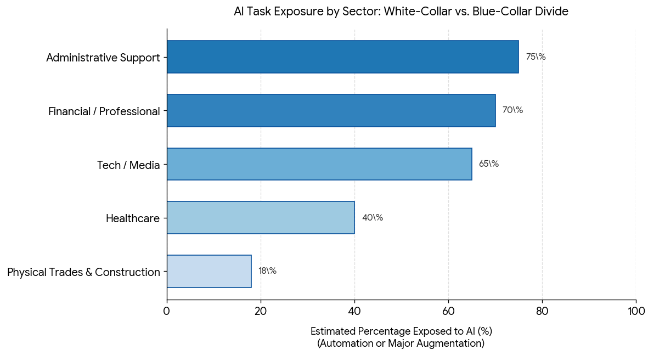
🏛️ 1. Clerical and Administrative Support (Highest Risk of Automation)
Corporate administrative and office support roles face the most immediate structural slowdown in hiring. [1, 2]
- The Impact: Tasks that involve data transcription, documentation record-keeping, and coordination are highly replicable by generative AI. [1]
- The Trend: While these jobs are not disappearing overnight, DEWR data highlights that employment growth in AI-exposed clerical sectors has slowed considerably compared to the rest of the economy. [1]
⚖️ 2. Professional Services: Legal, Finance, & Accounting (High Augmentation)
White-collar sectors are seeing a massive shift in how entry-level and junior workers spend their time. [1, 2]
- The Impact: AI tools can instantly draft standard legal contracts, analyze financial spreadsheets, scan for fraud, and conduct complex research. [1, 2]
- The Trend: Junior workers in corporate environments face an “early career crisis” because the basic documentation tasks they traditionally used to learn the ropes are now automated. According to the PwC AI Jobs Barometer, entry-level white-collar roles are now 7 times more likely to require advanced human-intensive skills like strategic judgment and client empathy much earlier in their careers. [1, 2]
💻 3. Technology, Media, and Telecommunications (High Disruptive Integration)
Paradoxically, the tech sector itself is one of the most disrupted by its own creation. [1]
- The Impact: Large Language Models write, debug, and optimize computer code faster than humans. Software engineering, graphic design, and content writing tasks are heavily augmented.
- The Trend: The Tech Council of Australia reports that 78% of tech leaders are actively restructuring workflows around operational AI to drive internal efficiency rather than just expanding headcount. However, workers who successfully master AI tools command a 62% wage premium in the current Australian market. [1, 2, 3, 4]
📞 4. Customer Service & Sales (Structural Transformation)
The infrastructure behind call centers, digital helpdesks, and retail support is transforming rapidly. [1]
- The Impact: Conversational AI can resolve complex, multi-tiered customer disputes without transferring to a human.
- The Trend: High-turnover call center roles are transforming into quality-assurance positions, where human “agents” supervise and refine the outputs generated by consumer-facing AI systems.
📊 Comparing the Extremes: Task Impact by Sector
The visualization below outlines the predicted depth of AI impact across major Australian workforce segments, demonstrating why physical and human-centric trades remain insulated.
🛠️ The “Insulated” Sectors: Blue-Collar & Human Services
At the opposite end of the spectrum, industries reliant on physical labor, complex environmental navigation, or deep human relationships are experiencing a boom in demand and remain heavily protected from AI displacement: [1, 2]
- Physical Trades: Construction, plumbing, electrical installation, and logistics cannot be replicated by current software models. Deloitte Access Economics forecasts a steady recovery and growth in the blue-collar workforce to support Australia’s infrastructure pipeline.
- Human Services & Healthcare: Sectors like aged care, nursing, disability support, and early childhood education grew by 2.5% over the last year. While AI assists with medical scanning and reporting, the core execution of the work requires human touch and emotional labor. [1, 2, 3]
(no footnotes)
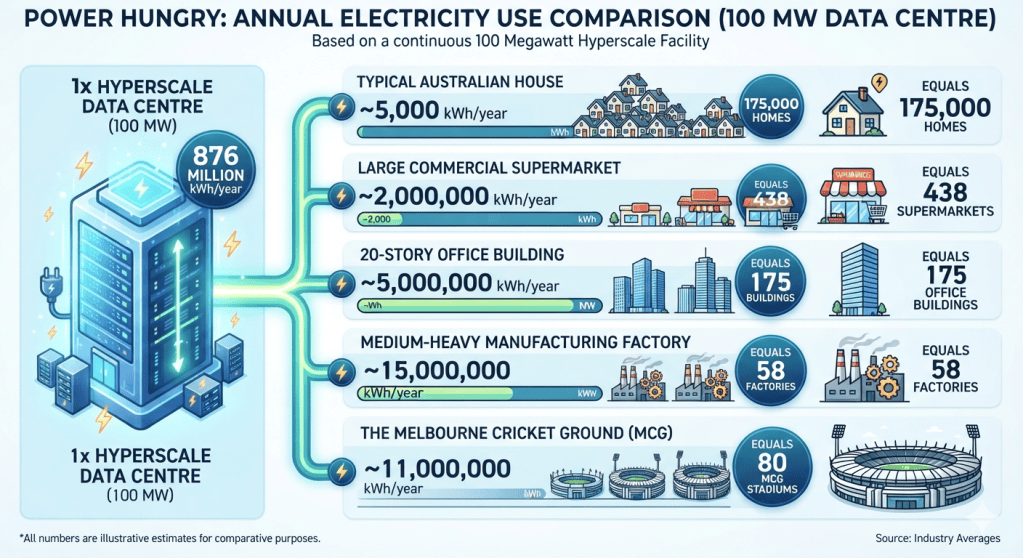
To understand the scale of a data centre’s power usage, it helps to look at a standard mid-to-large hyperscale data centre, which continuously draws 100 Megawatts (MW) of power. [1, 2]
Because data centres operate continuously (24 hours a day, 365 days a year), a 100 MW facility consumes roughly 876,000,000 Kilowatt-hours (kWh) of electricity annually. [3, 4]
The table below directly contrasts a standard 100 MW data centre’s annual power consumption against a typical Australian home, a commercial supermarket, an office tower, an industrial factory, and the iconic Melbourne Cricket Ground (MCG).
Annual Electricity Consumption Comparison
| Comparison Target | Average Annual Power Use (kWh) | How Many Equal One 100 MW Data Centre? |
|---|---|---|
| 1x Hyperscale Data Centre (100 MW) | 876,000,000 kWh | Baseline |
| Typical Australian House | ~5,000 kWh | 175,000 homes |
| Large Commercial Supermarket | ~2,000,000 kWh | 438 supermarkets |
| 20-Story Commercial Office Building | ~5,000,000 kWh | 175 office buildings |
| Medium-Heavy Manufacturing Factory | ~15,000,000 kWh | 58 factories |
| The MCG (Stadium) | ~11,000,000 kWh | 80 MCG stadiums |
🏠 1. Versus a House
An average Australian household consumes about 5,000 kWh of electricity per year. A single large data centre uses enough electricity to power a mid-sized city of 175,000 homes. [5]
🛒 2. Versus a Supermarket
Supermarkets are highly energy-intensive due to massive commercial refrigeration systems running 24/7, alongside baking ovens and intensive lighting. A standard large supermarket consumes roughly 2 million kWh per year. A data centre matches the footprint of over 430 supermarkets.
🏢 3. Versus an Office Building
A typical 20-story corporate skyscraper uses roughly 5 million kWh annually, primarily driven by daytime HVAC (heating, ventilation, and air conditioning), elevators, and lighting. A single data centre matches the power grid demands of 175 high-rise office towers combined.
🏭 4. Versus a Factory
An average industrial manufacturing plant or assembly factory consumes roughly 15 million kWh annually to run heavy machinery, conveyor systems, and production lines. A single data centre consumes as much power as nearly 60 factories.
🏟️ 5. Versus the MCG
The Melbourne Cricket Ground (MCG) is an enormous facility, but stadiums mostly experience massive power spikes during game days to run the towering light systems, broadcast equipment, and catering. Thanks to extensive energy efficiency upgrades, the stadium uses roughly 11 million kWh a year. A single continuous 100 MW data centre consumes the equivalent electricity of 80 MCG stadiums running year-round. [6, 7, 8]
[1] https://www.energyintel.com.au
[4] https://semiconductorsinsight.com
[7] https://www.energymagazine.com.au
[9] https://www.hanwhadatacenters.com
[10] https://www.afr.com
[11] https://www.climatecouncil.org.au
[12] https://www.afr.com
The regulation of data centres across Australia’s three tiers of government is anchored by specific constitutional heads of power and delegated state and local legislation.
The division of regulatory authority and the legislative frameworks that govern it are outlined below:
🏛️ 1. Federal Government (The Commonwealth)
The Commonwealth does not have plenary (unlimited) power. It must rely on explicit “heads of power” found within Section 51 of the Australian Constitution to pass laws like the SOCI Act and upcoming AI and digital infrastructure frameworks:
- The Corporations Power (s 51(xx)): Allows the Federal government to regulate “foreign corporations, and trading or financial corporations.” Since virtually all hyperscale data centre operators are proprietary corporate entities, the Commonwealth uses this power to mandate corporate cyber-security, data governance, and reporting duties.
- The Communications Power (s 51(v)): Grants authority over “postal, telegraphic, telephonic, and other like services.” Because data centres function as critical nodes in the national telecommunications networks, this power justifies data infrastructure and internet routing governance.
- The Defence Power (s 51(vi)): Gives the Commonwealth power to protect the nation. This underpins national security interventions, foreign ownership vetoes, and strict protective security rules for facilities holding state data.
- Constitutional Supremacy (Section 109): If a Federal law passed under these powers conflicts with a state law, the Federal law overrides the State law to the extent of the inconsistency.
🗺️ 2. State and Territory Governments
Under the Australian Constitution, the States retain residual powers—broad legislative authority to make laws for the “peace, order, and good government” of their respective jurisdictions. States use these constitutional powers to regulate land, water, and electricity:
- State Planning Statutes: Powers are drawn from state-specific acts such as the Planning and Environment Act 1987 (Vic) or the Environmental Planning and Assessment Act 1979 (NSW). These acts grant State Planning Ministers the legal right to create fast-track mechanisms (like Victoria’s Development Facilitation Program) to strip planning authority away from local councils for critical projects.
- Environmental Protection Acts: State environmental laws empower state EPAs to regulate industrial pollution, air quality emissions, and massive on-site hazardous material storage (such as backup generator diesel).
- Utility & Water Legislation: State acts governing water resources and electricity industries allow state-owned corporations to set connection conditions and protect localized natural resource thresholds from heavy data server cooling needs.
🏡 3. Local Government (Municipal Councils)
Local governments have no independent constitutional recognition in Australia. They are entirely “creatures of state statute” and derive their legal authority strictly via power delegated down by State Parliaments:
- Local Government Acts: Power is explicitly granted via state legislation, such as the Local Government Act 2020 (Vic) or the Local Government Act 1993 (NSW). This legislation legally empowers councils to pass municipal bylaws and issue localized structural directives.
- Delegated Planning Schemes: While councils handle everyday building assessments, their authority to approve or refuse a data centre is entirely dependent on the specific powers delegated to them by the State Planning Minister under state planning frameworks.
- Public Health and Nuisance Laws: Delegated public health acts allow local council officers to issue fines or operational restrictions on data centres failing to comply with local 24/7 noise decibel limits.
Halting digital infrastructure expansion triggers distinct trade-offs between macro-economic innovation and resource conservation.
With AEMO forecasting that data center energy demand could jump from 5 to 34 terawatt-hours by 2036, community groups, the Greens, and environmental advocates are actively calling for building moratoriums.
🚫 Scenario 1: If No More Data Centres Are Built in Australia
A total freeze on all new standard cloud and enterprise data centres would cause a severe digital capacity crunch.
- Cloud Capacity Bottlenecks & Higher Costs: Existing facilities would hit maximum capacity. As digital workloads grow for banks, hospitals, and streaming platforms, server space would become a premium, driving up cloud subscription fees for Australian businesses.
- Loss of Digital Sovereignty: Because companies cannot build new storage locally, future datasets would have to be hosted offshore in hubs like Singapore or the US. This compromises compliance with local frameworks like the Privacy Act 1988.
- Increased Latency: Moving everyday processing offshore introduces millisecond delays, slowing down automated manufacturing, real-time financial trading, and medical technologies.
- 🎉 The Benefit: Massive relief for the national energy transition. Halting standard expansions prevents billions of dollars in new grid connection costs and saves millions of litres of regional water supplies.
🤖 Scenario 2: If No Additional AI Data Centres Are Built
AI data centres require highly dense, power-hungry GPU clusters that run far hotter than traditional servers. Freezing only AI-specific infrastructure impacts advanced computing fields directly.
- Technological “Brain Drain”: Without local high-density AI rigs, Australian developers and research bodies cannot train large language models (LLMs) locally. Tech startups and top-tier AI researchers would migrate to countries with active infrastructure.
- Economic Stagnation in Advanced Tech: Advanced industries like sovereign defense modeling, automated logistics, and localized medical research would stall, as they would be unable to run heavy deep-learning algorithms within Australian borders.
- Dependence on Foreign Tech Monopolies: Australia would become a pure importer of AI services, renting processing power entirely from American or Asian cloud providers.
- 🎉 The Benefit: Major protection for consumer power prices. Activists highlight that single mega-projects—like the 1GW Mamre Road campus—can emit emissions equivalent to over 500,000 cars if powered by fossil fuels. A freeze protects local communities from industrial noise pollution, grid instability, and the prolonged life of old coal-fired power plants.
Expanding the global scope to nations with large landmasses and federal government systems highlights a distinct trend: much like Australia, regulatory power is heavily divided between a national framework and decentralized state/provincial governments that control their own independent power grids.
The policy responses for Canada, Germany, and the United States include:
🇨🇦 1. Canada
Canada features a vast geography where electrical grids are managed entirely at the provincial level. High-density AI interest has caused provinces to implement localized capacity caps and custom utility tariffs to prevent grid distress:
- British Columbia: Implemented strict legislative rules limiting aggregate power allocations via BC Hydro. For the two-year period starting February 2026, the province capped total new allocations to 100 MW for conventional facilities and 300 MW for AI data centres, with an absolute single-project cap of 145 MW.
- Alberta: Filed its formal Data Centre Regulation in June 2026 to manage transmission-connected facilities pulling 75 MW or more. Under provincial Bills 8 and 12, a new infrastructure levy takes effect in December 2026 to ensure tech operators fund their own grid integrations rather than shifting costs to consumers. Crucially, Alberta now legally permits data centres to construct and run their own on-site private power generation for energy independence.
- Quebec and Ontario: Quebec introduced a steep premium tariff rate hike (up to 13 cents per kWh) for new data centres drawing over 5 MW. Concurrently, Ontario is utilizing its Protect Ontario by Securing Affordable Energy for Generations Act to implement a dedicated, higher-priced consumer rate class for any data facility exceeding 1 MW.
🇩🇪 2. Germany
Germany operates under a federal structure (Länder) balanced against overarching European Union climate mandates. The nation recently revised its strict environmental legislation to keep pace with the AI computing boom:
- The Energy Efficiency Act (EnEfG): Following a major April 2026 regulatory reset to comply with the EU Energy Efficiency Directive, Germany mandates that all data centres commissioned after July 2026 must meet a strict Power Usage Effectiveness (PUE) target of 1.2 or lower. Existing facilities must scale down to 1.3 by 2030.
- Renewable Sourcing Shift: To avoid a sudden energy supply gap, the German Federal Ministry amended its laws to extend the deadline for data centres to achieve 100% renewable power sourcing by three years, setting a firm target of 1 January 2030.
- Mandatory Auditing & Waste Heat: As of 2026, any facility with a power capacity of 1 MW or more must legally implement and certify an independent Energy & Environmental Management System. Furthermore, facilities must actively repurpose their operational footprint, with a target to utilize 20% of their server waste heat by 2028.
🇺🇸 3. United States
As the country with the largest volume of global data infrastructure, the US utilizes a highly decentralized approach spanning federal tracking and localized county zoning:
- Federal Data Gathering: The federal government focuses heavily on transparency. The US Energy Information Administration (EIA) has pioneered a mandatory Data Center Energy Consumption Survey to accurately map localized utility demands for macroeconomic grid planning.
- State and County Zoning Caps: Because state bodies govern utility domains, regions experiencing a hyper-dense buildout (such as Northern Virginia or Ohio) are bypassing state-level inaction. Counties are writing custom municipal ordinances to enforce stringent boundary noise decibel limits, air quality inspections on backup diesel arrays, and strict water-table extraction reporting.
- Nuclear and “Firm” Power Mandates: Because intermittent wind and solar cannot support AI server clusters 24/7, state grid operators are approving bespoke commercial partnerships allowing tech enterprises to directly underwrite and source dedicated, off-grid clean firm energy from private nuclear reactors.
An artificial intelligence (AI) “bust” represents a severe macroeconomic correction where the massive financial capital poured into building AI infrastructure fails to generate the commercial revenue required to justify its cost.
With tech giants on track to spend between $700 billion and $900 billion on capital expenditures (CapEx), a market “bust” would be triggered by a widening CapEx-to-revenue gap, where enterprise adoption flatlines because the software fails to deliver measurable productivity gains.
An AI bust would manifest across four distinct phases:
📉 1. The Financial Wall Street Correction
- Tech Stock Plummet: The hyper-concentrated stock market would suffer a major pullback. Valuations for the “Magnificent Seven” and chip manufacturers would experience severe contractions, similar to South Korea’s historic tech-led stock index drops.
- Bond Yield and Debt Pressure: Rising interest rates and elevated bond yields would make the massive debt loads used to fund AI buildouts unsustainable, triggering downgrades in credit ratings.
- Infrastructural Liabilities: Massive tech companies would be forced to write down billions in hidden liabilities, such as decades-long, uncommenced data center leases and “take-or-pay” energy contracts that cannot easily be reversed.
🏢 2. The Stranded Infrastructure Crunch
- Ghost Data Centres: Unfinished or newly built data centres would see sudden cancellations or freezes in server equipment orders. Empty industrial warehouses originally slated for mega-watt power expansions would sit vacant.
- Hardware Glut: The secondary market would be flooded with cut-price, used graphics processing units (GPUs). Chip suppliers would face an overnight inventory crash as customers halt advanced computing orders.
- Grid and Utility Relief: The immense strain on global energy grids would abruptly ease. Power utilities would see projected industrial demands collapse, resulting in cancelled solar, wind, and nuclear supply contracts.
💼 3. The Startup and Venture Capital Collapse
- The “Wrapper” Mass Extinction: Hundreds of venture-backed software startups that simply packaged foundational models into basic user interfaces would go bankrupt.
- The Compute Repossession Cycle: Venture firms would stop funding companies whose primary expense is renting expensive cloud servers, leading to widespread closures and severe technology sector layoffs.
- Pivots to Cash Flow: Surviving tech firms would abandon speculative “AI-first” narratives, pivoting back to traditional SaaS metrics like net cash flow and immediate profitability.
⚙️ 4. The Pragmatic Technology Pivot
- The Trough of Disillusionment: AI would not disappear. Instead, it would follow the path of the internet after the Dot-Com crash, transitioning from an overhyped investment vehicle into a quiet, commoditized utility feature.
- Mandatory Human Verification: Expectations of fully autonomous “Superhuman Intelligence” would be replaced by the reality that AI output requires continuous human verification, capping its short-term productivity upside.
A prudent national or provincial risk management approach must shift structural liabilities away from taxpayers and public infrastructure, ensuring that a sudden tech correction or AI market “bust” does not leave local communities with stranded assets or inflated utility bills.
With data centre power consumption projected to surge from 3% to 13% of the grid over the next decade, governments must enforce a comprehensive strategy balancing rapid digital growth with macroeconomic protection.
⚡ 1. Energy Grid Insulation & Market De-risking
To protect household energy security, regulatory frameworks like the Australian Energy Market Commission (AEMC) are introducing strict grid-connection standards:
- Mandatory Take-or-Pay Agreements: Grid operators must enforce binding, upfront capital contracts. If a data centre operator halts construction midway through a project or goes bankrupt, the private company remains legally liable for the dedicated transmission line costs. This stops electrical bills from being passed on to standard households.
- Enforced Demand-Side Flexibility: Governments should mandate that any facility pulling 10 MW or more must feature automated load flexibility. During extreme heatwaves or winter peaks, the energy regulator must have the legal authority to throttle data centre power allocations to prioritize residential heating and cooling.
- On-Site Energy Firming: Regulators must require data centre developers to construct or underwrite their own new co-located renewable generation and battery storage. This ensures they add supply to the grid rather than merely consuming existing baseline electricity.
🗺️ 2. Adaptive Zoning & “Dual-Use” Infrastructure
Provincial and state planners can mitigate land-use risks by enforcing adaptive, modular building codes:
- Flexible Zoning Mandates: Data centres should be restricted strictly to designated industrial buffers away from schools, residential housing, and prime agricultural land. If an AI bust occurs, structures must be designed under “dual-use” guidelines, allowing standard shell warehouses to be cheaply converted into standard logistics hubs or advanced manufacturing facilities.
- Hazardous Asset Containment: Because facilities can store millions of litres of diesel for emergency backup generators, state EPAs must enforce strict containment and chemical safety limits. This insulates local water tables from industrial leakage if a facility is suddenly abandoned.
- Waste Heat Integration: Following models like Germany’s Energy Efficiency Act, councils should require that data centres be built near established district heating networks or agricultural greenhouses. This forces the operational footprint to actively repurpose server waste heat into the local economy, maximizing community utility.
🔒 3. Financial and Sovereign Protections
To buffer the financial sector from downstream speculative tech exposures, macroprudential frameworks are tightening corporate governance:
- Step-Change Financial Vetting: Regulators like the Australian Prudential Regulation Authority (APRA) mandate that institutional financiers assess data centre developers on true tenant cash flows rather than volatile, over-leveraged tech valuations.
- Sovereign Cloud Cloud-Bursting: Government procurement policies managed under frameworks like the Digital Transformation Agency (DTA) must enforce cloud-bursting protocols. If a primary commercial cloud provider faces localized technical insolvency or cyber-disruption, sovereign state operations must be able to migrate instantly to alternate domestic nodes without data loss.
The coordinated response to Australia’s data centre boom relies on a strict division of labor across all three tiers of government. The Federal Government enforces macro-economic grid rules and national security, State Governments manage energy generation carve-outs and fast-tracked industrial zoning, and Local Councils handle direct community setbacks.
The table below integrates the responsible layers of government, their legislative mechanisms, and their specific regulatory interventions:
National Regulatory Matrix for Australian Data Centres
| Challenge & Policy Response | Responsible Layer | Enabling Legislative / Constitutional Power | Specific Regulatory Action |
|---|---|---|---|
| Grid Cost Protection | Federal (AEMC / AER) | Section 51(xx) (Corporations Power) & ** s 51(v)** (Communications Power) | Enforcing 100% user-pays connection agreements so hyperscalers fund grid upgrades instead of everyday consumers. |
| Energy Carve-Outs & Firming | State & Territory | Residual Constitutional Powers over state-owned utilities and grids | Exercising the National Cabinet compromise to allow facilities in QLD/NT to plug into state-owned fossil fuel and gas “firming” reserves. |
| The 2027 Unified Rulebook | Federal (National Cabinet Initiative) | Section 51 (Triggering a unified model bill enacted via State Parliaments) | Preparing the early-2027 Mandatory Framework to set national baselines for water efficiency and load-throttling. |
| Land Use & Industrial Zoning | State (Planning Ministers) | Planning and Environment Act 1987 (Vic) / Environmental Planning & Assessment Act 1979 (NSW) | Utilizing Fast-Track Development Facilitation Programs to bypass standard council planning delays for critical infrastructure. |
| Community Setbacks & Buffers | Local Government | Delegated Authority via State Local Government Acts | Mandating strict boundary setbacks from homes, schools, and green wedges while setting 24/7 noise decibel caps. |
| National Security & Data Integrity | Federal (Home Affairs / DTA) | Section 51(vi) (Defence Power) | Enforcing the SOCI Act 2018 for cyber-reporting and the Hosting Certification Framework for sovereign data clearance. |
🌐 How the Layers Interact (The Grand Bargain)
This apparatus functions like a regulatory pipeline:
- The Federal Government sets the macro-economic baseline (e.g., you must pay for your grid connection under the AEMC framework).
- The State Government selects exactly where that grid connection can handle the load using its fast-track planning powers.
- The Local Council steps in at the very end to police the physical perimeter of the property, ensuring that giant cooling fans do not disturb the local neighborhood.
Energy privatisation plays a definitive role in how data centres scale, stripping state governments of direct grid control and turning large-load data connections into a highly profitable, privately contested market. Because Victoria fully privatised its electricity generation, transmission, and distribution assets in the 1990s, the state cannot simply order utilities to freeze data centre connections. Instead, it must rely on complex regulatory market interventions and state planning overrides to manage grid stability.
The unique impacts of energy privatisation on Victoria’s data centre boom include:
📈 1. Intense Commercial Incentives to Connect
In a privatised grid, network operators profit by building new infrastructure and connecting heavy energy users.
- The Transmission Advantage: Private monopolies like AusNet Services actively court data centre developers to build high-capacity, grid-level linkages.
- First-Mover Projects: This commercial drive allowed AusNet to energise Australia’s first transmission-level data centre in Melbourne’s west. Privately negotiated deals prioritize “speed to market” for tech giants over holistic, long-term public energy planning.
⏳ 2. Infrastructure Lag and the Cost-Shifting Risk
Because the physical grid is split across separate private distribution companies, expanding infrastructure to support massive data loads is a slow, heavily regulated process.
- The Funding Battle: Private distributors cannot build speculative multi-million dollar upgrades without approval from the Australian Energy Regulator (AER). If they build prematurely, the capital costs risk being rolled into the Regulated Asset Base (RAB), which inflates household electricity bills to underwrite private data facilities.
- The Capacity Mismatch: Data centres can be constructed in under two years, but private transmission infrastructure upgrades often take five to ten years to clear regulatory hurdles and community consultations.
🌫️ 3. The “Phantom Demand” Data Asymmetry
In a public asset model, the government holds complete data transparency over connection requests. In Victoria’s privatised model, commercial nondisclosure creates a critical visibility gap.
- Speculative Applications: Hyperscalers lodge separate connection requests across multiple private networks simultaneously to test feasibility.
- Overinflated Projections: This creates vast amounts of speculative “phantom demand”, blinding public planners as to which data centre projects are legitimate and which will never materialize.
🛡️ 4. How Victoria Is Forcing Control Back
Because the state government cannot directly command the private grid, it is using legislative detours to manage the data center footprint:
- The 25-Year Blueprint: The state’s planning body, VicGrid, has been forced to explicitly rewrite its Transmission Plan to retroactively model data centre expansion patterns.
- Planning Diversions: Rather than managing the crisis through energy laws, the state uses the Development Facilitation Program (DFP) to steer data center approvals into integrated utility zones, bypassing local council friction and grid blindspots entirely.
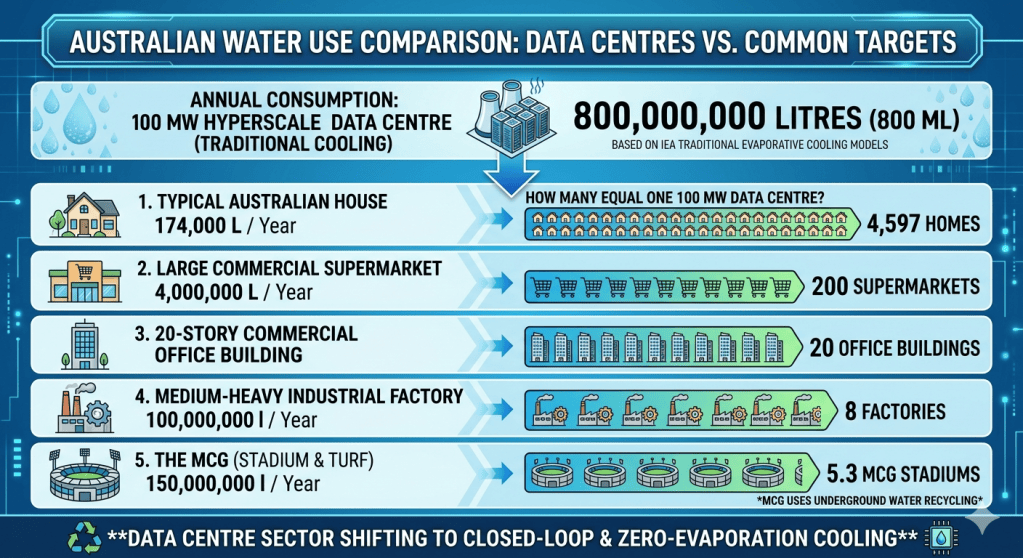
To evaluate the scale of a data centre’s water footprint, it helps to examine a standard 100 Megawatt (MW) hyperscale facility using traditional evaporative cooling systems.
According to data tracked by the International Energy Agency (IEA), a data centre of this capacity consumes roughly 2 to 2.5 million litres of water per day, resulting in an annual consumption of approximately 800,000,000 litres (800 Megalitres).
While the tech sector is rapidly shifting toward closed-loop, zero-evaporation cooling to engineer water out of existence, traditional setups place massive localized demands on utilities. The table below directly contrasts a 100 MW data centre’s annual direct water consumption against standard household, commercial, industrial, and stadium baselines in Australia.
Annual Water Consumption Comparison
| Comparison Target | Average Annual Water Use (Litres) | How Many Equal One 100 MW Data Centre? |
|---|---|---|
| 1x Hyperscale Data Centre (100 MW) | 800,000,000 L | Baseline |
| Typical Australian House | ~174,000 L | 4,597 homes |
| Large Commercial Supermarket | ~4,000,000 L | 200 supermarkets |
| 20-Story Commercial Office Building | ~40,000,000 L | 20 office buildings |
| Medium-Heavy Industrial Factory | ~100,000,000 L | 8 factories |
| The MCG (Stadium & Turf) | ~150,000,000 L | 5.3 MCG stadiums |
🏠 1. Versus a House
According to the latest Australian Bureau of Statistics (ABS) Water Account, the average Australian household consumes 174,000 litres of water per year. A single traditional 100 MW data centre evaporates enough drinkable water to support a suburban community of more than 4,500 homes.
🛒 2. Versus a Supermarket
Commercial supermarkets consume water primarily through refrigeration condensers, produce misters, in-store bakeries, and sanitation, averaging roughly 4 million litres annually. A single data centre matches the localized water footprint of 200 supermarkets.
🏢 3. Versus an Office Building
Large commercial office towers consume substantial water through plumbing and evaporative cooling towers mounted on roofs to support central air conditioning. A typical 20-story building draws about 40 million litres per year. A hyperscale data centre’s intensive cooling demands match the requirements of 20 commercial high-rises.
🏭 4. Versus a Factory
An average water-intensive manufacturing factory or chemical assembly plant uses roughly 100 million litres annually for parts washing, cooling machinery, and steam generation. A single 100 MW data centre out-consumes 8 industrial factories combined.
🏟️ 5. Versus the MCG
The Melbourne Cricket Ground (MCG) requires significant water to maintain its world-class turf, run its catering operations, and support game-day facilities, drawing roughly 150 million litres a year. However, the venue mitigates its footprint by using an underground water recycling facility that filters Class A recycled water for toilet flushing and surrounding parklands. A single traditional data centre matches the consumption of over 5 MCG stadiums.
Artificial intelligence (AI) drives global economic productivity, accelerates scientific breakthroughs, and optimizes critical infrastructure. While its energy footprint is high, the technology delivers massive improvements across healthcare, environmental management, and everyday business operations.
🏥 1. Healthcare and Medical Science
- Accelerated Drug Discovery: AI screens billions of chemical compounds in days instead of years to find new treatments.
- Early Disease Detection: Machine learning algorithms identify tumors and cancers on medical scans faster and more accurately than human eyes.
- Personalized Medicine: AI models analyze genetic data to tailor medical treatments specifically to an individual patient’s DNA.
⚡ 2. Climate, Energy, and Sustainability
- Grid Optimization: Smart grids use AI to forecast energy demand and balance renewable solar and wind power in real time.
- Precision Agriculture: AI-powered drones and sensors monitor crops to minimize water usage and chemical pesticide application.
- Climate Modeling: Advanced models track deforestation, predict severe weather patterns, and optimize carbon capture systems.
💼 3. Economic Productivity and Automation
- Eliminating Routine Labor: AI automates repetitive administrative tasks like data entry, invoicing, and basic customer service.
- Supply Chain Efficiency: Predictive algorithms track logistics to reduce warehouse waste and optimize international shipping routes.
- Financial Fraud Prevention: Banking systems scan millions of global transactions instantly to detect and block identity theft.
🔬 4. Advanced Engineering and Research
- Materials Science: AI simulates new molecular structures to invent lighter airplane metals and longer-lasting electric vehicle batteries.
- Sovereign Defense Systems: Governments utilize AI for real-time threat detection, cybersecurity defense, and complex logistics planning.
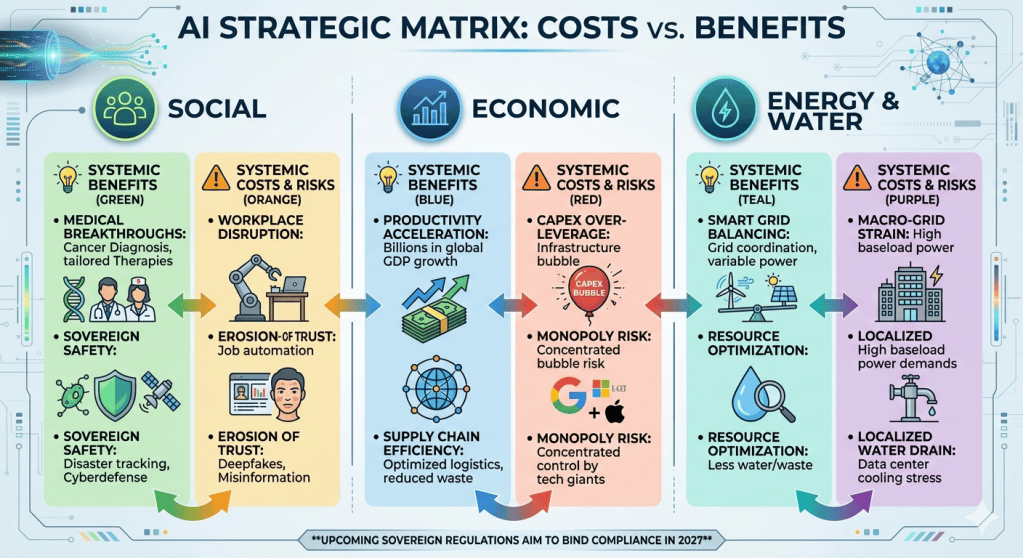
The rapid expansion of artificial intelligence introduces a complex matrix of systemic trade-offs. The table below directly contrasts the critical societal dividends against the real-world operational and structural costs:
📊 Strategic Matrix: AI Costs vs. Benefits
| Dimension | 💡 Systemic Benefits | ⚠️ Systemic Costs / Risks |
|---|---|---|
| Social | • Medical Breakthroughs: Early cancer diagnostics and customized genetic therapies. • Sovereign Safety: Enhanced cyberdefense capabilities and real-time natural disaster tracking. | • Workplace Disruption: Sudden automation of white-collar and administrative roles. • Erosion of Trust: Mass generation of synthetic deepfakes, misinformation, and copyright disputes. |
| Economic | • Productivity Acceleration: Automation of routine processes adds trillions to global GDP. • Supply Chain Efficiency: Advanced logistics routing reduces material waste and transportation bottlenecks. | • CapEx Over-Leverage: Severe risk of an infrastructure bubble if software revenues fail to justify capital costs. • Monopoly Risk: Consolidation of infrastructure control within a handful of offshore tech giants. |
| Energy & Water | • Smart Grid Balancing: AI dynamically coordinates renewable solar and wind inputs. • Resource Optimization: Machine learning reduces general industrial water use and factory waste. | • Macro-Grid Strain: Hyperscale AI data centres drive massive baseload power demands. • Localized Water Drain: Evaporative cooling systems place high stress on local municipal water tables. |
🗒️ 1. Social Dynamics
- The Dividend: AI saves lives by analyzing massive biochemical datasets to compress decades of traditional pharmaceutical research into days. On a national security front, it protects critical digital infrastructure by detecting cyber threats at machine speed.
- The Toll: The rapid deployment of LLMs triggers widespread anxiety over white-collar displacement. Concurrently, the proliferation of sophisticated voice clones and hyper-realistic deepfakes places immense strain on legal frameworks, democratic processes, and corporate compliance structures.
📈 2. Economic Realities
- The Dividend: By streamlining logistics, predictive maintenance, and corporate administrative workflows, AI functions as a powerful macroeconomic deflationary force. It unlocks new efficiencies in advanced manufacturing and financial services.
- The Toll: Building these capabilities requires unprecedented capital expenditure. If enterprise software adoption stalls due to persistent accuracy issues, the resulting over-leverage could trigger a severe technology sector correction, stranding billions in physical assets and impacting tech-concentrated investment portfolios.
💧 3. Energy & Water Footprints
- The Dividend: AI is an essential tool for fighting climate change. It manages complex multi-directional electrical grids, optimizes agricultural irrigation to save water, and redesigns industrial processes to minimize carbon emissions.
- The Toll: AI computing requires high-density graphics processing units (GPUs) that draw exponentially more energy and run far hotter than standard servers. This forces data centres to run intensive cooling mechanisms, creating a direct resource competition with local agricultural zones and residential utility baselines.


Leave a Reply