
The withdrawal of local councils from childcare, aged care, and other frontline community services is one of the biggest changes in Victoria’s local government sector. Due to state-imposed rate caps and rising costs, many councils have stopped providing these services directly and transferred them to private companies or large non-profit organisations.
This shift has created several challenges:
- Loss of local knowledge: Council staff often had strong relationships with residents and understood local needs. Larger providers covering wider areas may experience higher staff turnover, resulting in clients seeing different carers regularly.
- Regional service gaps: In rural and remote areas, private providers may find it unprofitable to operate. When councils withdraw, some communities risk having limited or no local care services available.
Measuring the impact of these changes is difficult. When services move from councils to multiple private providers, data collection becomes fragmented. Smaller providers may lack the systems and resources needed to report detailed outcomes, creating gaps in the available data.
Government funding and procurement processes often prioritise short-term cost savings over long-term community benefits. While outsourcing may reduce costs initially, preventative and community-based services can generate greater social value over time by helping people stay healthier and independent for longer. For example, if an older person’s health worsens after a council stops providing home care, it can be difficult to determine whether the decline was caused by the service change, natural ageing, or other health factors.
Google backgrounder
The widespread exit of local councils from child care, aged care, and other frontline social services is one of the most critical structural shifts in Victorian local government history [the 2026–27 State Budget’s reduction in road rehabilitation funds].
Faced with strict state-mandated property rate caps and rising operational costs, dozens of municipal councils across Victoria have officially terminated their roles as direct service providers, handing these portfolios over to private corporations and large non-profit charities [the 2026–27 State Budget’s reduction in road rehabilitation funds]. [1, 2, 3]
🧓 1. The Mass Exit from Aged and Home Care Services [4]
The historic role of the local “council district nurse” or council-funded cleaner has almost entirely disappeared across Victoria.
- The Catalyst (The Federal Market Shift): The introduction of the federal Support at Home program completely upended how elderly care is funded. The Commonwealth transitioned away from providing block grants directly to councils, moving instead to a marketised “fee-for-service” system where funding follows individual consumer choice. [5, 6]
- The Local Reaction: Councils found they could no longer compete with large, specialized private and charitable care providers without incurring massive municipal deficits. Over 60 of Victoria’s 79 councils—including massive regional shires like Mildura, Wellington, and the Surf Coast, alongside metro hubs like Bayside and Knox—formally exited the Commonwealth Home Support Programme (CHSP). [7]
- The Succession: Councils handed their entire existing client databases and staff over to major non-profit charities (such as Mecwacare, Uniting, and Villa Maria Catholic Homes) or private operators who now manage in-home cleaning, meals on wheels, and personal care. [8, 9, 10, 11]
🧸 2. The Retreat from Early Childhood Education & Child Care
Dozens of Victorian councils have shut down or transferred their municipal center-based long day care and kindergarten operations.
- The Catalyst (The 15-Hour Reform Deficit): The roll-out of the state’s “Free Kindergarten” reforms required centers to shift to a mandatory 15-hour-per-week educational model. This structural change demanded massive capital expansions, extra staffing resources, and extended operational hours.
- The Local Reaction: Operating under strict state property rate caps, councils lacked the spare capital to upgrade aging municipal buildings or absorb rising early childhood educator wages. Councils like Knox City Council and Yarra Ranges Council made the highly controversial decision to exit direct long day care delivery. [12, 13]
- The Succession: In most instances, councils maintain ownership of the physical brick buildings but lease the operations out to major non-profit early learning providers (like Sparkways or ECMS) or private commercial operators, removing the ongoing wage and compliance risks from the council’s balance sheet. [14, 15, 16]
🩺 3. The Downscaling of Other Frontline Social Services
The local government exit is expanding beyond care sectors into broader community, youth, and maternal portfolios: [17]
- National Disability Insurance Scheme (NDIS) Exits: Following the full implementation of the NDIS, councils systematically pulled out of delivering specialized disability support services. Managing the strict, highly competitive federal individual pricing caps proved financially unviable for municipal structures, causing a full transition to private disability providers. [18, 19]
- Maternal and Child Health (MCH) Vulnerability: While councils are still legally mandated to deliver basic universal MCH checks, many regional and outer-metropolitan councils are struggling to maintain the service. Due to severe nurse shortages, councils are outsourcing specialized, higher-tier vulnerable family outreach programs back to state health networks or community health charities. [20]
⚖️ The Policy Debate: Efficiency vs. The “Thin Market” Trap
- The Case for Exit (Fiscal Survival): Council finance directors (FinPro) argue that these exits are a structural necessity. By removing highly volatile, labor-intensive social portfolios from their ledgers, rate-capped councils can protect their core financial viability and redirect scarce ratepayer funds back into mandated community assets, such as repairing crumbling regional roads, drainage grids, and public parks [the 2026–27 State Budget’s reduction in road rehabilitation funds].
- The Case Against Exit (The Loss of Local Trust): Community groups and regional advocates note that private and charitable providers frequently fail to service remote areas. When a council exits a service in an outer rural micro-town (population < 5,000), it can trigger a total “thin market” failure. Private operators often refuse to service isolated properties due to travel costs, leaving vulnerable regional seniors and families stranded without local care options. [21]
[1] https://participate.nillumbik.vic.gov.au
[2] https://www.perthnow.com.au
[3] https://www.theweeklysource.com.au
[4] https://www.agedcareinsite.com.au
[6] https://www.ngshire.vic.gov.au
[7] https://www.education.vic.gov.au
[9] https://www.theweeklysource.com.au
[10] https://www.mecwacare.org.au
[11] https://www.theage.com.au
[12] https://sgsep.com.au
[13] https://mountainviews.mailcommunity.com.au
[16] https://yoursay.manningham.vic.gov.au
[17] https://www.parliament.vic.gov.au
[19] https://communitycarereview.com.au
[20] https://berwicknews.starcommunity.com.au
When local governments exit direct social service delivery, the empty space is filled by a mix of non-profit organisations, private corporations, and family networks. [1, 2]
The transition is structured entirely through the Federal Government’s consumer-directed funding systems, like the Support at Home program and the National Disability Insurance Scheme (NDIS). Under this model, funding is tied directly to the individual resident rather than being block-granted to the council. [1, 3, 4, 5, 6]
🏛️ Who Fills the Gap?
The market is absorbing council clients through three main types of alternative providers:
- Large Non-Profit & Faith-Based Organisations: Providers like UnitingCare, Brotherhood of St Laurence, and Villa Maria Catholic Homes dominate the transition. Councils prefer these groups because they often share a community-centric mission.
- Commercial & Private Care Corporations: For-profit entities (such as HomeCare Australia or Mecwacare) use their large economies of scale to absorb thousands of regional and metropolitan clients quickly. [7, 8, 9]
- Family Carers & Next of Kin: Advocacy groups highlight that when commercial providers face staff shortages or scheduling delays, informal family networks are forced to step in to handle basic daily tasks. [2]
🔄 How the Transition Occurs
The transfer of care from local councils to incoming providers follows a strict, government-mandated transition framework. [10]
[Council Exit Decision] ──> [Expression of Interest (EOI)] ──> [Federal Provider Match] ──> [Individual Client Handover]
1. The Expression of Interest (EOI) Process
Before a council can officially switch off its services, it works with the Federal Department of Health and Aged Care. The government runs a competitive tender or EOI process to find approved private or non-profit providers that have the capacity to take on the local client load. [10]
2. Automatic Client Migration
To prevent immediate service gaps, clients are usually transferred en masse. The federal government reallocates the funding packages directly to the newly appointed provider. For example, when the Rural City of Wangaratta announced its exit, it established structured deadlines to phase out services and transition clients step-by-step. [1, 10, 11]
3. Council’s New Role as a “Navigator”
Councils do not completely disappear. They shift into an advisory role, using their municipal offices to help confused or vulnerable residents sign up for My Aged Care, assess their needs, and select an external provider. [10]
⚠️ Challenges of the New System
While the gap is being logistically filled, the transition faces severe structural friction:
- The Loss of Local Knowledge: Council staff often knew their community intimately. Private providers operating across massive geographic areas can struggle with high staff turnover, meaning clients often have a different worker visiting their home each week. [1, 12]
- Regional Care Deserts: In thin markets—such as remote parts of Victoria or New South Wales—private providers cannot make a profit. When the local council leaves, these areas risk becoming “care deserts” with no available providers to fill the gap.
[3] https://agedcaredecisions.com.au
[5] https://www.latrobe.edu.au
[6] https://helloleaders.com.au
[7] https://www.ngshire.vic.gov.au
[9] https://search.proquest.com
[10] https://www.wangaratta.vic.gov.au
[11] https://wisechoiceihc.com.au
[12] https://www.instagram.com
Measuring outcomes in social policy—especially during a structural transition like a local government service exodus—requires shifting from tracking outputs (e.g., how many hours of care were paid for) to tracking outcomes (e.g., whether a resident’s quality of life actually improved). [1]
In Australia, this measurement is governed by formal frameworks, specific metrics, and complex data collection challenges. [2]
📋 Core Evaluation Frameworks
Social policy outcomes are primarily measured using three main national frameworks:
- The Australian Health Outcomes Collaboration (AHOC): Focuses on standardized, patient-reported health and wellbeing metrics.
- The Aged Care Quality Standards Framework: Managed by the Aged Care Quality and Safety Commission. Following recent Royal Commission reforms, it mandate-tracks clinical safety, consumer choice, and dignity outcomes.
- The NDIS Outcomes Framework: Measures life changes for participants across eight domains, including daily living, choice and control, social participation, and employment. [3, 4]
📊 Key Metrics Used to Measure Outcomes
When evaluating if the transition from council to private/non-profit care is successful, researchers and policymakers track metrics across three distinct categories:
| Measurement Category | Specific Key Performance Indicators (KPIs) |
|---|---|
| Participant Well-being | • ASCOT Score: Adult Social Care Outcomes Toolkit measuring control, dignity, and safety. • PROMs: Patient-Reported Outcome Measures tracking functional independence. |
| Market & Service Quality | • Staff Continuity Rate: Percentage of visits conducted by the same worker. • Unmet Demand: Number of approved care hours left unspent due to local staff shortages. |
| Systemic & Financial Efficiency | • Hospital Readmission Rates: Frequency of elderly clients entering acute care due to failed home support. • Cost per Care Unit: Total public spend per individual positive outcome achieved. |
⚠️ Challenges in Measuring Outcomes Effectively
Accurately capturing data during a policy shift is incredibly difficult due to structural flaws in how data is collected:
1. The “Data Silo” Problem
When services move from a centralized local council to dozens of fragmented private providers, data collection becomes heavily decentralized. Small private providers often lack the digital infrastructure or administrative resources to report comprehensive outcome data, leading to blind spots in national databases.
2. Short-Term Output Bias vs. Long-Term Outcome Value
Government procurement processes traditionally reward short-term financial savings over long-term social value. This friction is best understood by comparing how funding models impact long-term community health.
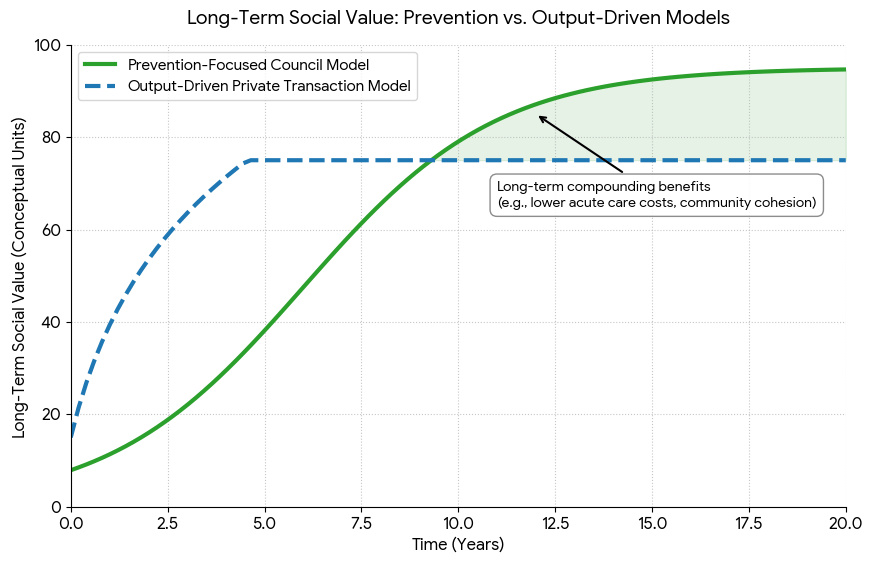
As illustrated above, a transaction-focused model may show immediate, short-term cost efficiencies. However, over time, a prevention-focused model yields significantly higher cumulative social value by keeping residents healthier and out of hospitals for longer.
3. Attribution Attrition
If an older person’s health declines six months after a council exits home care, it is statistically difficult to prove whether the decline was caused by the change in service provider, natural aging, or independent medical factors.
💡 Modern Measurement Innovations
To solve these measurement gaps, Australian social policy is shifting toward newer data methodologies:
- Social Return on Investment (SROI): A framework that assigns a calculated financial value to non-financial outcomes (e.g., proving that $1 spent on local social groups saves $3 in future mental health or hospital costs). [5]
- Integrated Data Analytics: Utilizing initiatives like the Australian National Data Commissioner’s frameworks to securely link federal Medicare data, state hospital presentations, and aged care records to see the true trajectory of clients after a council exits.
[1] https://www.relationships.org.au
[2] https://www.sciencedirect.com
[3] https://dataresearch.ndis.gov.au


Leave a Reply