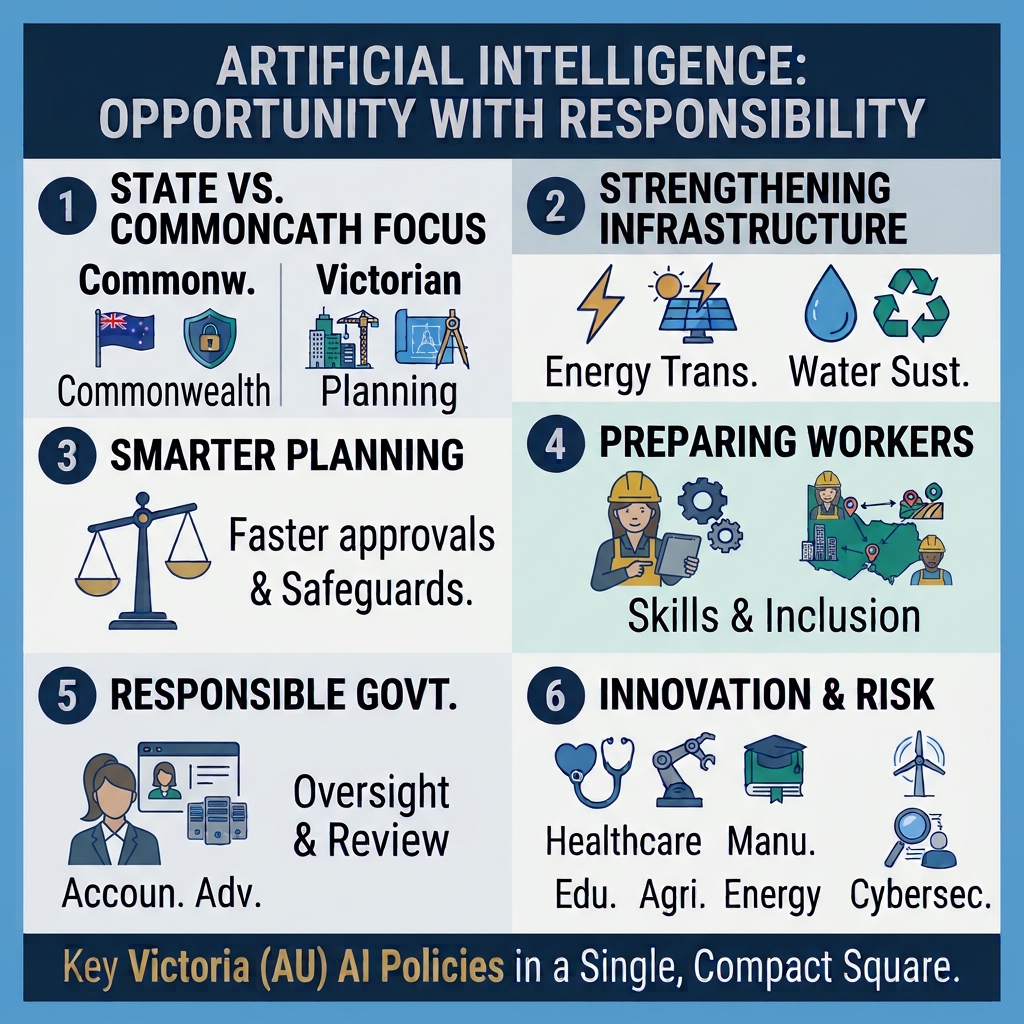
Artificial intelligence will reshape Victoria’s economy, creating new opportunities for productivity, innovation and better public services. The question is not whether AI will arrive, but whether Victoria is prepared to benefit from it.
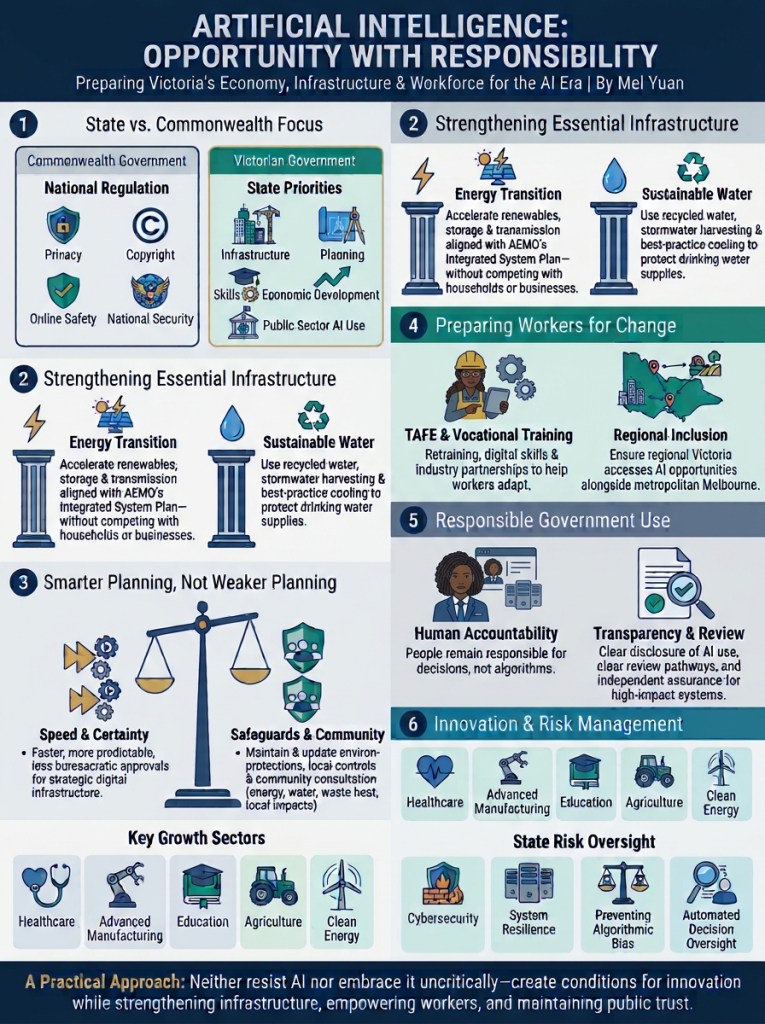
Many aspects of AI regulation, including privacy, copyright, online safety and national security, are matters for the Commonwealth Government. Victoria should focus on the areas it controls: infrastructure, planning, skills, economic development and government use of AI.
AI Infrastructure Must Strengthen Victoria’s Essential Systems
The rapid growth of AI will drive demand for electricity, water and digital infrastructure. Rather than treating this as a burden, Victoria should use AI investment to help deliver the infrastructure the state already needs.
Large AI and data centre projects should contribute to new renewable energy, storage and transmission investments aligned with AEMO’s Integrated System Plan. AI demand should help accelerate the energy transition, not compete with households and existing businesses for limited capacity.
Major developments should also demonstrate sustainable water management. Where practical, they should use recycled water, stormwater harvesting and best-practice cooling technologies to minimise pressure on drinking water supplies and the environment.
Smarter Planning, Not Weaker Planning
Victoria should remain an attractive destination for technology investment and high-skilled jobs.
Planning approvals for strategically significant digital infrastructure should be faster, more predictable and less bureaucratic. But environmental protections, local planning controls and community consultation must remain in place and be updated to address the specific challenges posed by AI infrastructure, including energy demand, water consumption, waste heat and impacts on surrounding communities.
The goal should be faster approvals and stronger standards.
Preparing Workers for Change
The greatest challenge posed by AI is likely to be workforce disruption rather than the technology itself.
Victoria’s TAFE, vocational and skills systems should focus on helping workers adapt to changing labour markets through retraining, digital skills development and industry partnerships. Regional communities should also have access to emerging AI-related opportunities, not just metropolitan Melbourne.
Responsible Use of AI in Government
Government should use AI where it improves services and reduces administrative costs, but accountability must always remain with people.
Victorians should be able to understand when AI is being used in public administration, who remains responsible for decisions, and how those decisions can be reviewed. High-impact government AI systems should be subject to independent assurance, transparency and human oversight.
Supporting Innovation While Managing Risk
Victoria should encourage AI innovation in sectors where it already has strengths, including healthcare, advanced manufacturing, education, agriculture and clean energy.
At the same time, the state should manage risks within its own jurisdiction, including cybersecurity, resilience of government systems, algorithmic bias in public services and oversight of automated decision-making.
A Practical Approach
Victoria should neither resist artificial intelligence nor embrace it uncritically.
The role of government is to create the conditions for innovation while ensuring investment strengthens the state’s energy and water systems, workers have pathways into new opportunities, and the public can trust how AI is used.
If we get the settings right, AI can help make Victoria more productive, more competitive and better prepared for the future.


Leave a Reply