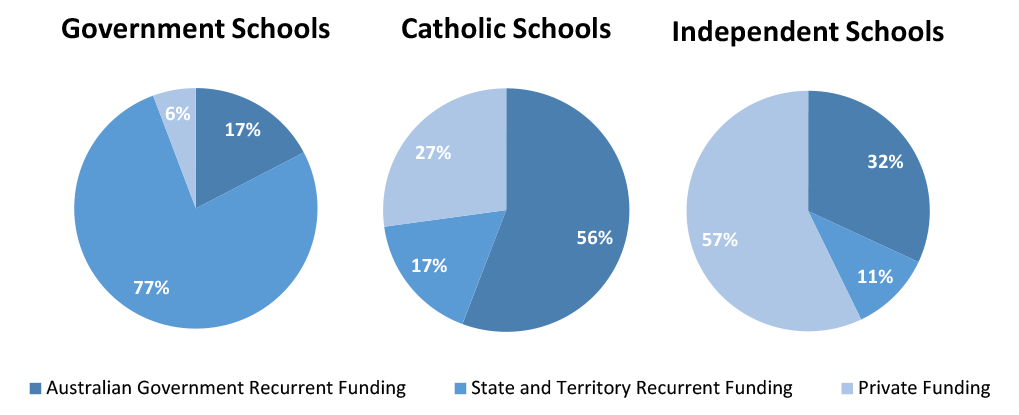
Australia’s school system is weighed down by a fundamental structural problem: responsibility and control are split between two levels of government. The result is predictable—duplication, inefficiency, and constant blame-shifting. The solution is equally clear. The Federal Government should step back from direct involvement in school education and return to a focused role: setting benchmarks, monitoring performance, and holding the system accountable—while leaving delivery entirely to the states and territories.
Federal intervention in school funding was a product of its time. In the post–World War II era, rapid population growth and expanding educational demand justified national involvement. But what may have once filled a gap has now become unnecessary overlap. Today, both levels of government fund and influence schools, yet neither holds full responsibility. This “all care, no responsibility” model is not just inefficient—it actively undermines outcomes.
The Commonwealth should stop acting as a parallel operator and instead pass its education funding directly to the states using existing formulas. There is no need for a federal bureaucracy to sit in the middle. The Department of Education’s school funding function could be wound down, with funding distributed alongside other consolidated revenue. This would eliminate duplication and restore a clean line of accountability: states run schools, and states are responsible for outcomes.
This approach is not radical—it is a return to first principles. The Constitution has always placed the responsibility for schooling with the states. Over time, that clarity has been eroded by federal funding strings and policy interventions. Re-establishing that division would not weaken the system; it would strengthen it by aligning authority with responsibility.
There is still a clear and important role for national oversight. NAPLAN should remain as a system-wide health check, providing transparency on how students and jurisdictions are performing. Likewise, ACARA should continue to manage national curriculum coordination and assessment frameworks. These are sensible, light-touch mechanisms that enable comparison and accountability without distorting delivery.
What should go is the heavy-handed use of tied grants and centrally designed funding formulas. The Schooling Resource Standard, with its complex loadings, attempts to impose a one-size-fits-all model on a highly diverse country. It assumes Canberra can determine what is “fair” for every student—from a remote community in the Northern Territory to a school in inner Melbourne. It cannot. Real equity requires local knowledge, flexibility, and responsiveness—qualities that only states, and ultimately schools themselves, can provide.
The current system doesn’t just fail in theory—it wastes real resources. Hundreds of federal public servants are employed to administer, negotiate, and oversee programs that duplicate state functions. Redirecting those funds could put more teachers in classrooms. But that is only the visible cost. The deeper cost lies in the endless cycle of negotiations, reporting, compliance, and political point-scoring that consumes time and energy across the entire sector.
Every hour spent arguing over funding agreements or meeting federal reporting requirements is an hour not spent improving teaching and learning. Every duplicated process is a drain on a system that should be focused on students.
Stripping back federal involvement would not reduce investment in education—it would make that investment more effective. By giving states full control over funding and delivery, backed by national benchmarking, Australia could build a simpler, more accountable, and more responsive system.
The choice is not between national standards and local control. We can—and should—have both. But that requires discipline: Canberra must resist the urge to intervene in delivery and instead focus on its proper role as steward of system performance.
Australia does not need two governments trying to run its schools. It needs one level of government fully responsible, fully accountable, and fully empowered to deliver.
Google backgrounder
The core flaw in Australia’s school funding system is a structural division of responsibilities that creates a perverse funding mismatch, where the Federal Government primarily finances private schools while State Governments are left to fund the under-resourced public system. [1, 2]
This parallel administration distorts the original, needs-based intent of the Gonski reforms [Gonski], resulting in systemic funding deficits, political blame-shifting, and infrastructure backlogs that hit regional and disadvantaged communities hardest. [3, 4, 5]
📉 1. The 80% Cap Loophole (The Public School Deficit) [6, 7]
Under the current National School Reform Agreements (NSRA), public school funding is split into a 20:80 partnership [NSRA]:
- The Formula: The Federal Government caps its contribution to public schools at exactly 20% of their School Resourcing Standard (SRS)—the minimum funding required to meet student needs. State Governments are responsible for providing the remaining 80% [NSRA]. [8, 9, 10]
- The Accounting Trick: Most states, including Victoria, historically used a legislative clause allowing them to deduct up to 4% of their share for non-classroom costs (such as capital depreciation, standardized testing, and regulatory bureaucracies). [11, 12]
- The Reality: As a result of this loophole, public schools in almost every state are left structurally underfunded, receiving only 95% to 96% of their real SRS baseline. Conversely, non-government (private and Catholic) schools routinely hit or exceed 100% of their SRS because the Federal Government acts as their primary financial backer (covering 80% of their public funding baseline). [13, 14, 15, 16, 17]
🏛️ 2. Political Blame-Shifting and Fiscal Warfare
Because two separate layers of government hold distinct purse strings, school funding has degenerated into an adversarial political tug-of-war:
- The Conflict: During federal-state funding negotiations, the Commonwealth and State Treasuries routinely try to force each other to pick up the shortfall. The Federal Government accuses states of hoarding cash and underfunding their own public networks, while states argue that federal favoritism toward the private sector starves the public system of vital investment.
- The Consequence: This institutional friction stalls long-term planning. Schools are left unable to commit to permanent specialist staff, literacy programs, or behavioral support teams because their funding relies on volatile, short-term political agreements rather than a stable, unified ledger. [18, 19]
🧱 3. The Infrastructure Divide (Volatile Capital Allocations)
There is a massive structural gap in how school buildings, laboratories, and technology assets are funded: [20]
- The Private Advantage: Non-government schools can tap into wealthy independent building funds, tax-deductible parent donations, and dedicated federal capital grants. This allows them to build state-of-the-art sporting precincts, modern theaters, and advanced STEM labs. [21, 22, 23]
- The Public Squeeze: Public school infrastructure relies entirely on highly volatile state capital budgets. In high-growth metropolitan corridors, state funding is swallowed up by building massive new schools to keep pace with population booms. This leaves established schools—particularly in outer regional and rural micro-towns—starved of asset maintenance capital, forcing students to learn in decaying buildings or aging portable “demountable” classrooms. [24]
🍎 4. The Postcode Lottery and Regional Teacher Flight
The fragmented funding model fails to solve the compounding workforce crisis hitting country schools:
- The Squeeze: Underfunded public schools lack the independent financial flexibility to offer localized salary incentives, fully subsidized housing, or reduced face-to-face teaching hours to attract staff.
- The Inequality: While metropolitan private schools use independent wealth to headhunt specialized mathematics, science, and foreign language educators, regional public schools suffer from chronic staffing shortages. This forces non-specialist teachers to cover advanced subjects, locking in a systemic academic disadvantage for regional and rural children based entirely on their postcode. [25]
[1] https://www.tandfonline.com
[5] https://www.tandfonline.com
[12] https://onlinelibrary.wiley.com
[13] https://www.sstuwa.org.au
[15] https://isa.edu.au
[18] https://www.theaustralian.com.au
[20] https://apo.org.au
[22] https://www.emilford.com.au
[23] https://australiainstitute.org.au
[25] https://www.innercitynews.com.au
Serious proposals for education funding reform in Australia focus on fully funding the Gonski School Resourcing Standard (SRS), unifying public and private sector funding models, removing state capital infrastructure caps, and establishing long-term regional teacher incentive funds.
These frameworks, advanced by the Australian Education Union (AEU), independent think tanks, and regular federal-state education minister reviews, aim to eliminate the highly politicised funding gaps between public and private systems. [1]
💰 1. Full 100% Gonski Funding (Closing the SRS Gap) [2]
- The Proposal: Forcing a structural renegotiation of the National School Reform Agreements (NSRA) to ensure every public school in Australia is funded to 100% of the School Resourcing Standard (SRS). [3]
- The Mechanism: Currently, the federal government contributes 20% of the public school SRS baseline, while states are supposed to provide 80%. However, due to historic legislative loopholes, most states stall their share at 75% to 79%, leaving public schools structurally underfunded. The proposal mandates a strict, legally binding 20:80 split with no exemptions or accounting adjustments. [4, 5, 6, 7]
- The Goal: To pump billions of dollars directly into disadvantaged public classrooms, specifically targeting literacy, numeracy, and additional support staff.
🏛️ 2. A Single Centralised Funding Body (The National Education Pool)
- The Proposal: Dismantling the parallel federal-state funding divide by creating an independent, non-political National Education Funding Commission.
- The Mechanism: This model eliminates the current distortion where the federal tier primarily finances private schools (80% of their public funding) and states finance public schools. All public and private school funding would be pooled into a single federal bucket and distributed out based strictly on a student’s socio-educational needs, completely bypassing state treasury interference. [8]
- The Goal: To remove political favoritism from school funding and establish a uniform, needs-based financial ledger across all sectors.
🏫 3. Dedicated Public Infrastructure Capital Funds
- The Proposal: Establishing permanent, long-term state-federal capital infrastructure funds specifically reserved for public school upgrades and new constructions.
- The Mechanism: While private schools leverage multi-million-dollar independent building funds, public school infrastructure relies entirely on volatile state capital budgets. This reform creates an untied, rolling federal-state asset fund to fast-track modern laboratory installations, structural expansions, and classroom tech rollouts.
- The Goal: To stop the reliance on portable “demountable” classrooms on city fringes and prevent the decay of historical school buildings in outer regional towns.
🍎 4. Pooled Regional Teacher Placement & Retention Funds
- The Proposal: Creating a specialized, jointly funded state-federal workforce fund to permanently solve the chronic teacher shortage in outer rural and regional schools.
- The Mechanism: Instead of deploying temporary short-term grants, this fund provides structural financial packages. Teachers who relocate to regional hubs or micro-towns receive fully subsidized regional worker housing, a mandatory 20% salary loading bonus, and accelerated career promotion pathways funded directly out of the national pool.
- The Goal: To stop the “postcode lottery” of education quality, ensuring regional children have access to the same specialized mathematics, science, and languages teachers as metropolitan private school students.
[1] https://news.aeuvic.asn.au
[2] https://centralnews.com.au
[3] https://www.education.gov.au
[5] https://centralnews.com.au
When isolating the analysis exclusively to countries with federal systems, Australia’s approach to school funding stands out for its high level of centralisation and severe division of public-private responsibilities [NSRA].
In other major federations—such as Canada, Germany, the United States, and Switzerland—the central (federal) government is either completely excluded from school funding or plays a strictly limited, non-interventional role, leaving states or provinces with total financial autonomy. [1, 2, 3]
📊 School Funding Dynamics Across Major Federations
| Federation [4, 5, 6] | Federal Government Financial Share | Primary Revenue & Allocation Tool | Public vs. Private Funding Rules | Impact on Regional & Rural Schools |
|---|---|---|---|---|
| Australia | High (~40% of public school caps; ~80% of private school caps) [NSRA]. | Split-Tier System: Inter-governmental agreements (Gonski formula via NSRA) [NSRA]. | Private schools are heavily subsidized by federal cash while retaining elite fees. | Highly politicised; regional public schools face chronic funding deficits due to state loopholes. |
| Canada | 0% (Zero federal funding or constitutional power). | Provincial Unitary Pool: Income and property taxes collected centrally at the province level. | Public funding is legally banned for elite independent schools in major provinces. | High regional equity; provinces guarantee identical per-pupil funding to remote rural zones. |
| Germany | Extremely Low (<3% federal capital grants). | State Ledger / Shared Tax Split: Set via corporate bargaining across the 16 Länder. | Private schools receive operational subsidies but are legally banned from charging high fees. | Enforced uniform quality; strict state civil-service laws force elite teachers into rural villages. |
| United States | Low (~10% via targeted federal safety-net grants). | Local Dispersal: Heavily reliant (45%) on ultra-local municipal property tax brackets. | Constitutional ban on direct public funding for private religious schools (varies by state vouchers). | Extreme inequality; wealthy suburbs have elite public schools, while poor rural/inner-city areas decay. |
| Switzerland | 0% (Zero federal intervention in compulsory schooling). | Canton Unitary Pool: Managed entirely via localized cantonal and municipal income taxes. | Private sector is tiny (<5%) and receives virtually zero public tax subsidies. | Superb rural equality; mountain villages are heavily subsidized via internal cantonal wealth transfers. |
🏛️ Deep-Dive: How Other Federations Erase the Split-Tier Mess
🇨🇦 Canada: Eliminating the Federal Layer Entirely
Canada represents the exact opposite of Australia’s split-tier model. The Canadian federal department of education does not exist; it has no constitutional authority, collects zero education tax, and distributes zero school grants. [7]
- The Mechanism: In provinces like Ontario or Alberta, the provincial government holds full financial accountability. It pools all provincial income and property taxes into a single baseline ledger and distributes it directly to school boards using a strict per-pupil needs formula.
- The Strategic Advantage: Because there is no federal layer, there is zero opportunity for cross-tier blame-shifting or cost-shifting. Furthermore, major provinces legally refuse to hand public dollars to elite private schools. This forces wealthy families to stay invested in the public system, ensuring that remote timber, mining, and agricultural towns receive identical structural funding per student as downtown Toronto.
🇩🇪 Germany: Civil-Service Control and Equal Living Conditions
Germany’s basic law (Grundgesetz) mandates that all states must cooperate to ensure “equivalent living conditions” across the federation.
- The Mechanism: The federal tier is blocked from dictating school policy. Funding is driven by a shared tax pool where states receive a fixed slice of national VAT and income tax. The individual states (Länder) use this money to pay teachers directly as permanent, tenure-tracked state civil servants (Beamte).
- The Strategic Advantage: Because teachers are employed directly by the state government rather than individual school boards, the state can legally order top-tier educators to relocate to remote agricultural villages or struggling industrial zones. This completely bypasses Australia’s workforce crisis, guaranteeing that a regional student has access to the exact same caliber of mathematics or science teacher as a student in a wealthy city suburb.
🇺🇸 United States: The Hazard of Ultra-Local Autonomy
The United States operates the most decentralized federal school funding model in the world, serving as a warning case for extreme geographical inequality.
- The Mechanism: The federal government contributes a minor 10% slice exclusively targeted at high-disadvantage safety nets (Title I funding). The remaining 90% is split between the state government and ultra-local municipal school districts. These local districts raise their funds directly through local neighborhood property taxes.
- The Strategic Disadvantage: Because school budgets are directly tethered to localized real estate values, wealthy suburban enclaves generate immense independent school budgets, while adjacent working-class rural or inner-city districts decay. It completely eliminates the state-federal funding wars seen in Australia, but locks in deep, systemic educational inequality based entirely on a student’s neighborhood boundary.
🇨🇭 Switzerland: Cantonal Sovereignty and Direct Democracy
The Swiss Confederation leaves 100% of compulsory schooling administration and funding in the hands of its 26 individual cantons.
- The Mechanism: Each canton sets its own school tax rates, structures its own curriculum, and manages its local school buildings. To prevent remote alpine valleys from falling behind wealthy banking hubs like Zurich, cantons use internal municipal equalization funds to smooth out revenue.
- The Strategic Advantage: Like Canada, the total absence of federal policy interference prevents political gridlock. Because the private school sector is statistically negligible and receives no public tax subsidies, community focus is entirely locked into optimizing the local public school infrastructure, keeping remote mountain villages highly liveable and academically competitive.
[2] https://orb.binghamton.edu


Leave a Reply