The Victorian economy is experiencing a mixed economic landscape, highlighted by an annual Real State Final Demand growth of 3.5% for the March 2026 quarter. But the Victorian economy faces many structural constraints and headwind risks that need addressing.
Over a quarter of all Victorian workers (28.5%) find employment within public-predominant sectors, emphasising the state’s reliance on government-supported jobs to sustain consumer demand. Substantial infrastructure investments have accumulated significant public debt. Credit agencies warn that debt interest payments could consume a growing portion of revenue by 2030.
Sectors like Financial & Insurance Services yield massive economic output per capita (9.0% of IGVA) but only command a modest slice of the state’s workforce (4.2%) due to high asset and transaction values. Digital Technologies lives directly inside the high-performing Professional, Scientific & Technical Services bracket (9.0% of IGVA). Government policy treats tech as a cross-cutting multiplier intended to automate and elevate productivity in other sectors like finance and logistics. These workforces are likely to be negatively impacted by AI.
The Agribusiness and Circular Economy priority sectors are locked in significant land-use conflicts over transmission lines, battery storage and wind farms. This will be further exacerbated by the high growth potential of extractive industries. Nationwide data highlights critical mineral and battery material mining as some of the fastest-growing industries through 2026. Victoria possesses substantial critical minerals, heavy mineral sands, and grid-scale storage operations.
Managing the Transition of Major Infrastructure Projects
As major construction projects mature, Victoria must carefully manage workforce and supply chain impacts.
The next government must:
- Plan a measured transition from the peak of the Big Build.
- Retain skilled workers through reskilling and redeployment initiatives.
- Focus future investment on productivity-enhancing infrastructure and innovation.
Preparing for AI and Workforce Change
Technology will reshape professional services, legal services, accounting, consulting, and administration.
I will work towards programs:
- Support workers to retrain and adapt to technological change.
- Invest in lifelong learning and digital skills.
- Ensure AI adoption complements human expertise rather than replacing opportunity.
Revitalising Tourism and Hospitality
Tourism and hospitality remain important employers and contributors to local economies.
The next government must:
- Increase support for events, attractions, and regional tourism.
- Improve business resilience against inflation and energy cost pressures.
- Promote Victoria as a leading destination for domestic and international visitors.
Delivering Practical Energy and Environmental Outcomes
Victoria must balance economic development, environmental responsibility, and community expectations.
The land-use conflicts plaguing regional areas must be resolved with:
- Support for sensible renewable energy development.
- Improved community engagement on land-use decisions.
- Encouraging investments that deliver both economic and environmental benefits.
Securing Victoria’s Education Export Advantage
International education remains one of Victoria’s most valuable export industries.
Victoria must stand up to the Federal government’s migration slowdown to:
- Strengthen Victoria’s reputation as a world-leading education destination.
- Support pathways between education, research, and industry.
- Advocate for policy settings that maintain international competitiveness.
- Leverage education exports to support jobs, innovation, and economic growth.
Delivering a More Productive, Innovative and Prosperous Victoria
Victoria’s future prosperity depends on combining strong public services, globally competitive industries, regional growth, and technological innovation. By investing in people, productivity, and high-value industries, we will create secure jobs and build an economy that works for every Victorian.
Google backgrounder
The Victorian economy is experiencing a mixed economic landscape, highlighted by an annual Real State Final Demand growth of 3.5% for the March quarter alongside a nominal Gross State Product (GSP) of $637.4 billion. While headline growth has been supported by strong long-term business investment and population growth, the state faces growing macroeconomic challenges, including a rising unemployment rate that sits at 5.1% as of mid-2026. [1, 2, 3]
Key Economic Indicators
The latest data provided by the Department of Treasury and Finance outlines the state’s current fiscal health: [1, 4]
- Real State Final Demand: 3.5% annual growth.
- Unemployment Rate: 5.1%.
- Participation Rate: 67.6%.
- Consumer Price Index (CPI): 3.2% annual growth.
- Wage Price Index (WPI): 3.1% annual growth. [1, 3]
Strategic Growth Pillars
The government’s ongoing Economic Growth Statement targets 5 key priority sectors to diversify and advance the economy: [5, 6, 7, 8, 9]
- Agribusiness: Reached a record gross value of $22.2 billion and remains Australia’s top food and fibre exporter.
- Advanced Manufacturing & Defence: A $39.2 billion sector supporting more than 275,000 local jobs.
- Health Technologies & Medical Research: Victoria hosts 40% of Australia’s ASX-listed medical technology companies.
- Digital Technologies: Contributes over $35 billion annually and is heavily integrated with new AI mission statements.
- Circular Economy: Focused on driving the state toward net-zero emissions by 2045. [7, 10, 11]
Emerging Structural Pressures
Independent economic reviews and rating agencies highlight notable headwinds impacting everyday performance: [2]
- Labour Market Desynchronisation: Despite high workforce participation, Victoria holds nearly a third of Australia’s total unemployed population. [1, 3]
- Rising Debt Servicing Costs: Substantial infrastructure investments have accumulated significant public debt. Credit agencies warn that debt interest payments could consume a growing portion of revenue by 2030. [12, 13]
- Global Disruptions: Rising fuel and energy supply risks stemming from international conflicts present ongoing inflationary challenges for local businesses. [14]
Health Care and Social Assistance is Victoria’s largest sector by economic output and employment, representing 9.0% of the state’s Industry Gross Value Added (IGVA) and employing over 591,400 people. [1, 2]
The structural overview of Victoria’s largest industries showcases a strong service-driven economy, with the top five sectors alone generating 43% of the state’s overall value. [2]
Largest Contributing Sectors to Victoria’s Economy
The following data incorporates output shares documented by Invest Victoria alongside standard workforce statistics released by Jobs and Skills Australia: [2, 3, 4, 5]
| Sector | Share of State Output (% of IGVA) | Estimated Employment (Persons) | Workforce Breakdown (% of Total State Jobs) |
|---|---|---|---|
| Health Care & Social Assistance | 9.0% | 591,400 | 15.5% |
| Financial & Insurance Services | 9.0% | 160,200 | 4.2% |
| Professional, Scientific & Technical Services | 9.0% | 368,400 | 9.7% |
| Construction | 7.0% | 357,900 | 9.4% |
| Manufacturing | 6.0% | 275,000 | 7.2% |
| Education & Training | 5.0% | 315,200 | 8.3% |
| Retail Trade | 5.0% | 338,500 | 8.9% |
| Public Administration & Safety | 5.0% | 179,200 | 4.7% |
| Transport, Postal & Warehousing | 5.0% | 186,300 | 4.9% |
| Wholesale Trade | 5.0% | 114,400 | 3.0% |
Key Structural Observations
- High Output, Lower Employment: Sectors like Financial & Insurance Services yield massive economic output per capita (9.0% of IGVA) but only command a modest slice of the state’s workforce (4.2%) due to high asset and transaction values. [2, 6, 7]
- High Employment, Lower Value-Add: Conversely, Retail Trade and Education & Training are highly labor-intensive, supporting massive pools of local jobs while individually making up smaller fractions of total monetary output. [2, 8]
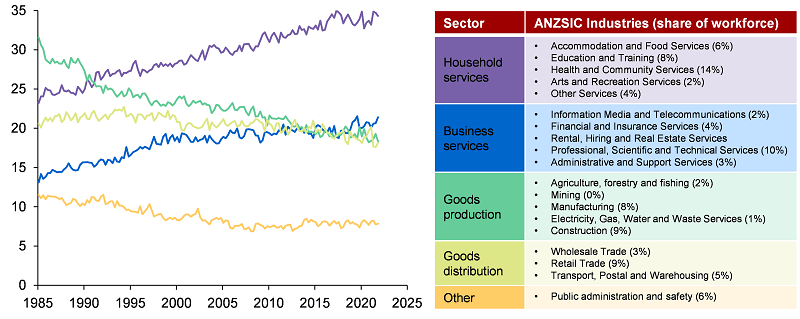
- The Dominance of Services: Over the last decade, growth has progressively leaned into local household and business services, making up more than one-third of overall employment across the territory. [9, 10]
Public-Predominant Sectors
These industries rely directly on state and federal budgets, universal public funding models (like Medicare or NDIS), or direct government workforce employment.
| Sector | Primary Funding / Nature | Share of State Output (% of IGVA) | Estimated Employment | Workforce Share |
|---|---|---|---|---|
| Health Care & Social Assistance | Publicly integrated (Medicare/NDIS) | 9.0% | 591,400 | 15.5% |
| Education & Training | Government schools, TAFE, universities | 5.0% | 315,200 | 8.3% |
| Public Administration & Safety | State departments, emergency, defence | 5.0% | 179,200 | 4.7% |
| Subtotal (Public-Predominant) | Service & community infrastructure | 19.0% | 1,085,800 | 28.5% |
Private-Predominant Sectors
These industries operate under market-driven commercial competition, business-to-business transactions, and consumer retail spending.
| Sector | Primary Funding / Nature | Share of State Output (% of IGVA) | Estimated Employment | Workforce Share |
|---|---|---|---|---|
| Financial & Insurance Services | Private enterprise, banking, funds | 9.0% | 160,200 | 4.2% |
| Professional, Scientific & Tech | Corporate services, legal, consulting | 9.0% | 368,400 | 9.7% |
| Construction | Mixed commercial, civil, residential | 7.0% | 357,900 | 9.4% |
| Manufacturing | Commercial exports, local industry | 6.0% | 275,000 | 7.2% |
| Retail Trade | Private consumer commerce | 5.0% | 338,500 | 8.9% |
| Transport, Postal & Warehousing | Commercial logistics and supply chains | 5.0% | 186,300 | 4.9% |
| Wholesale Trade | Business-to-business trade channels | 5.0% | 114,400 | 3.0% |
| Subtotal (Private-Predominant) | Market commerce and industry | 46.0% | 1,800,700 | 47.3% |
Key Macroeconomic Realities
- The Public Job Engine: Over a quarter of all Victorian workers (28.5%) find employment within public-predominant sectors, emphasizing the state’s reliance on government-supported jobs to sustain consumer demand.
- The Private Productivity Premium: Private-predominant industries account for a much higher concentration of production value relative to their headcounts. Combined, they claim 46.0% of economic output while utilizing 47.3% of the workforce, driven by highly automated fields like financial and professional services.
- The Mixed Realities: Sectors like Construction and Health Care feature heavy overlap. While construction is categorized under private industry execution, it remains deeply dependent on the state’s aggressive Big Build public transport infrastructure pipeline.
The 5 priority sectors identified in Victoria’s Economic Growth Statement are strategic subsets designed to supercharge growth, meaning they do not align 1:1 with standard ANZSIC industry classifications. Instead, they are high-value niches embedded across or directly driving the major sectors on the league table. [1, 2, 3]
Their positions, contributions, and corresponding baseline industries in the economic rankings are detailed below. [4, 5]
Priority Sectors Placement on the Industry League Table
| Priority Sector | Broad Industry League Table Equivalent | League Table Rank (by Output) | Sector’s Embedded Contribution |
|---|---|---|---|
| Digital Technologies | Professional, Scientific & Technical Services | #2 (Equal) | Drives the $35.6B digital economy and 30% of Australia’s tech workforce. |
| Health Technologies & Medical Research | Health Care & Social Assistance | #2 (Equal) | Powers Victoria’s lead in hosting 40% of Australia’s ASX medical tech firms. |
| Advanced Manufacturing & Defence | Manufacturing | #5 | Formulates the core of Victoria’s $39.2B, 275,000-job manufacturing base. |
| Agribusiness | Agriculture, Forestry & Fishing | Outside Top 10 | Makes up Australia’s #1 food/fibre export pipeline, valued at over $15B annually. |
| Circular Economy | Electricity, Gas, Water & Waste Services | Outside Top 10 | Drives net-zero infrastructure across renewable energy zones and waste sectors. |
Mapping the Strategic Footprint
- Advanced Manufacturing & Defence (Ranked #5 in Manufacturing):
While overall traditional manufacturing sits at 6.0% of state output, the state’s strategic focus is heavily geared toward high-value advanced industrial capabilities and commercial defense exports to buffer against the decline of low-skill production. [6, 7, 8] - Digital Technologies (Embedded in Rank #2 Professional Services):
This priority sector lives directly inside the high-performing Professional, Scientific & Technical Services bracket (9.0% of IGVA). Government policy treats tech as a cross-cutting multiplier intended to automate and elevate productivity in other sectors like finance and logistics. [9, 10] - Health Technologies & Medical Research (Embedded in Rank #2 Health Care):
While standard healthcare is highly public and labor-intensive (15.5% of jobs), this specific priority carve-out isolates highly profitable commercial niches. It leverages Victoria’s university ecosystem to capture 54% of Australia’s pharmaceutical exports. [7] - Agribusiness (Spans Agriculture & Wholesale Trade):
Raw agriculture sits lower on the absolute domestic league table for economic value, but it carries outsized strategic value. It acts as the backbone of Victoria’s regional economy and forms half of the state’s total goods export wealth. [4, 7] - Circular Economy (Spans Utilities & Construction):
This niche operates outside the top ten on its own, but it functions as a regulatory and infrastructure priority. Government initiatives focus on transforming raw building supply chains, optimizing recycling, and fast-tracking investments across renewable energy grids. [3, 7, 11, 12]
Several major high-growth sectors are missing from the Victorian Government’s official strategic footprint, despite driving a large portion of the state’s economic output, tax revenue, or employment. The Economic Growth Statement purposefully overlooks these traditional or non-niche sectors to focus state resources on high-tech areas. [1, 2, 3, 4, 5]
The most prominent growth sectors omitted from the priority framework include the following areas:
1. Construction and Infrastructure (“The Big Build”)
- Why it is missing: The framework isolates the Circular Economy, but omits general civil, commercial, and residential construction. [1, 6]
- Economic Reality: Powered by the state’s aggressive infrastructure pipeline (such as the Metro Tunnel and Airport Rail), construction generates 7.0% of overall Gross Value Added (GVA) and supports over 357,900 jobs. [7]
- The Disconnect: Omitting it allows the government to focus industry policy on tech innovation rather than managing the severe labor supply and materials shortages currently plaguing the broader building sector. [8]
2. Professional, Corporate, and Legal Services
- Why it is missing: The footprint highlights Digital Technologies, but sidelines the broader non-digital corporate services ecosystem. [1, 9]
- Economic Reality: Professional, Scientific, and Technical Services sit as the second-largest sector in Victoria, contributing 9.0% of total output and employing 368,400 people.
- The Disconnect: While law, corporate accounting, management consulting, and marketing are massive wealth and employment drivers, they are viewed as self-sustaining marketplace utilities rather than sectors requiring specialized government growth incentives.
3. Visitor Economy, Tourism, and Hospitality
- Why it is missing: Traditional services like accommodation, cafes, and major events are missing from the core list of five priorities.
- Economic Reality: According to industry tracking by Invest Victoria, the hospitality and visitor sector has experienced substantial post-pandemic growth. Tourism and events receive ad-hoc funding but lack standalone designation as a primary future growth pillar.
- The Disconnect: Hospitality is highly sensitive to consumer sentiment, high inflation, and energy price volatility. The government favors high-margin export sectors (like medical technology) over localized service economies. [1, 4, 10, 11, 12, 13, 14]
4. Direct Renewable Energy and Mining/Extractive Resources
- Why it is missing: Energy transition efforts are filtered through the lens of the Circular Economy, while standard extraction is treated separately.
- Economic Reality: Nationwide data highlights critical mineral and battery material mining as some of the fastest-growing industries through 2026. Victoria possesses substantial critical minerals, heavy mineral sands, and grid-scale storage operations.
- The Disconnect: Traditional extractive resources face distinct environmental and community regulatory friction. The strategic footprint avoids grouping raw resource extraction with its preferred “green economy” branding. [1, 15, 16, 17, 18]
5. Education Services and International Student Exports
- Why it is missing: While the government operates a specialized Yes to International Students Fund, education is absent from the core priority footprint.
- Economic Reality: Education and training make up 5.0% of Victorian economic output and serve as a vital employment anchor, supporting 315,200 local workers. International education historically ranks as one of the state’s single largest service exports.
- The Disconnect: The sector faces heavy structural headwinds from federal migration changes and cap policies, making its growth outlook highly volatile and difficult to control through independent state-level industry statements. [1, 9, 19, 20, 21]


Leave a Reply