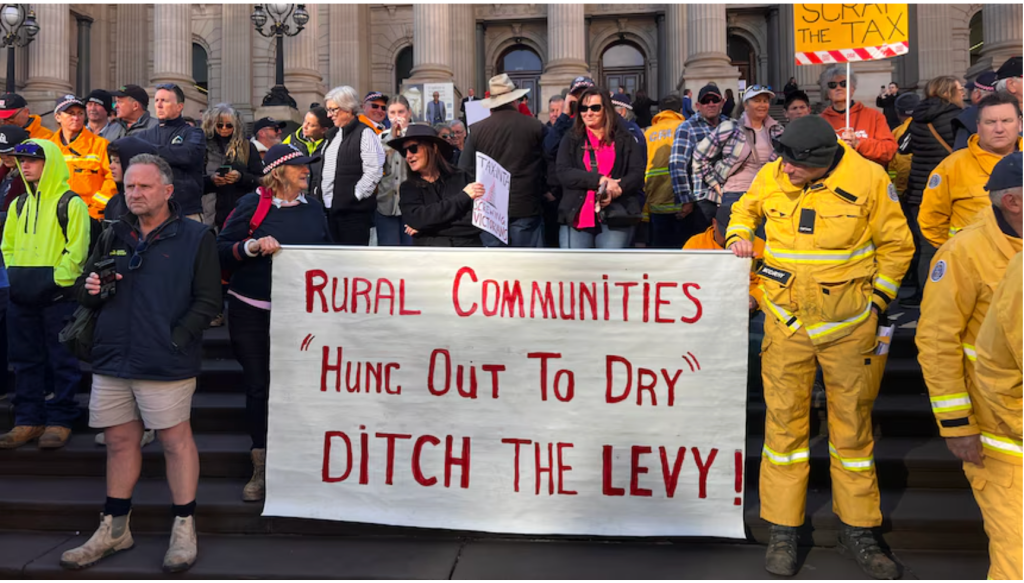
The government’s changes to the Fire Services Property Levy (FSPL) place an unfair, disproportionate financial burden on regional property owners. This policy fails to guarantee that increased tax revenues will be reinvested into frontline regional emergency services.
I call for an immediate overhaul of the funding mechanism to ensure transparency, regional equity, and guaranteed funding for both professional and volunteer emergency services.
1. Stopping the Regional Funding Disparity
Regional Victorians pay a higher proportion of the emergency services bill relative to the infrastructure and professional coverage they receive.
- The Problem: Regional communities rely heavily on volunteer brigades but face steep cost increases.
- Our Commitment: I oppose any levy increases that do not directly correspond to an increase in local, tangible emergency service assets.
2. Ending the Consolidated Revenue “Black Hole”
The current levy directs funds straight into the State’s consolidated revenue fund rather than a dedicated account.
- The Problem: This structure allows the government to use emergency funds to plug general budget deficits. Regional fire stations are left with no guarantee of seeing a single dollar of the tax hike.
- Our Commitment: I demand the immediate ring-fencing of all emergency services levies so that every dollar collected is legally mandated to fund emergency services.
3. Protecting and Supporting Volunteer Firefighters
Decades of political and industrial turmoil have eroded morale within volunteer organizations like the Country Fire Authority (CFA).
- The Problem: While individual volunteer discounts exist, they do not compensate for the systemic underfunding of the CFA apparatus itself.
- Our Commitment: I support structural guarantees that safeguard the autonomy, equipment funding, and operational capabilities of the CFA.
Proposed Structural Alternatives
I support moving away from the current centralized tax model toward proven, equitable funding structures:
- The Proximity-Based Model (The Queensland Approach): Implementing a user-pays tier where property owners pay fees proportional to their physical proximity to 24/7 professional stations.
- The Direct Local Funding Model (The US Approach): Ring-fencing emergency service taxes directly for the specific municipal or regional districts where they are collected.
Conclusion
The government in Melbourne is short-changing regional Victorians. We stand for a transparent, fair, and decentralised funding model that respects regional taxpayers and directly secures the future of both professional emergency services delivery in regional areas and local volunteer fire brigades.
Google backgrounder
The Fire Services Property Levy (FSPL) in Victoria was permanently overhauled and replaced by the Emergency Services and Volunteers Fund (ESVF). [1, 2]
This structural tax shift effectively doubles the emergency tax burden on most Victorian property owners. Local councils continue to collect the levy via annual rate notices, but the money is funnelled directly to the [State Revenue Office (SRO)](1.1.1, 1.2.2) to fund the state’s broader emergency apparatus. [1, 3, 4, 5]
🔄 The Major Changes: FSPL vs. ESVF
1. Broadened Scope
Under the old FSPL, funds exclusively covered [Fire Rescue Victoria (FRV)](1.1.9, 1.3.6) and the [Country Fire Authority (CFA)](1.1.9, 1.3.6). The upgraded ESVF pool is now the primary funding source for a broader range of frontlines. It incorporates VICSES, Triple Zero Victoria, Forest Fire Management Victoria, the State Control Centre, and Emergency Recovery Victoria. [3, 4, 5, 6, 7]
2. Sharp Rate Rises
The tax utilizes a formula combining a flat fixed charge with a variable rate multiplied against the property’s Capital Improved Value (CIV). The variable rate has effectively doubled for most sectors. [1, 4, 5]
3. Active Volunteer Exemptions
Active emergency service volunteers and life members are eligible for a 100% exemption from the levy on their principal place of residence, acknowledging their unpaid service to the community. [8]
📊 Current 2026–27 Official Levy Rates [7]
The [State Revenue Office](1.2.2, 1.3.2) has finalized the official fixed and variable tax brackets:
| Property Classification [1, 4, 7, 9, 10] | Fixed Annual Charge | Variable Rate (Cents per $1,000 of CIV) |
|---|---|---|
| Residential (PPR / Vacant) | $139 | 17.3 ¢ (Up from historic 8.7¢ baseline) |
| Commercial | $282 | 133.0 ¢ |
| Industrial | $282 | 133.0 ¢ |
| Primary Production (Farmland) | $282 | 28.7 ¢ (Rate frozen due to seasonal pressure) |
| Public Benefit | $282 | 5.7 ¢ |
⚡ Critical Friction Points and Controversies [6]
1. The Landlord and Tenant Flow-Through
While owner-occupiers face a predictable increase, non-principal place of residence (non-PPR) owners (landlords and holiday-home owners) face compounding pressures. They pay the higher non-residential fixed charge base ($282) alongside the doubled variable rate. Because many commercial and residential leases permit the pass-through of statutory outgoings, this change directly triggers rent hikes for tenants. [7, 11, 12]
2. The Primary Production Backlash
The state government initially proposed a 189% increase to the farmland variable rate (hiking it from 28.7¢ to 83¢). Following fierce agricultural pushback, intense lobbying from the Victorian Farmers Federation (VFF), and widespread regional protests, the state government retreated. The variable rate for primary producers has been temporarily frozen at 28.7¢ to insulate farmers battling volatile drought conditions. [3, 9, 13]
3. The Structural Tax Inequity Debate
The levy is projected to generate $1.6 billion annually, a significant increase from the old $600 million FSPL baseline. Regional advocacy groups argue that regional and rural property owners pay a disproportionately high variable bill due to large land holdings, effectively cross-subsidizing expensive metropolitan career firefighting overheads while regional volunteer brigades struggle with aging fleet updates. [4, 14, 15]
[1] https://www.sro.vic.gov.au
[2] https://discover.data.vic.gov.au
[3] https://www.argentadvisory.com.au
[4] https://haytonkosky.com.au
[6] https://www.mornpen.vic.gov.au
[7] https://www.sro.vic.gov.au
[8] https://www.dbalawyers.com.au
[9] https://www.sro.vic.gov.au
[10] https://www.sro.vic.gov.au
[12] https://www.argentadvisory.com.au
[13] https://www.dbalawyers.com.au
[16] https://www.sro.vic.gov.au
The introduction of Victoria’s Emergency Services and Volunteers Fund (ESVF) exposes clear structural, financial, and strategic differences when compared with interstate frameworks and international best practices. While Victoria has moved toward a single, broad-based tax model, its implementation faces sharp domestic pushback regarding cost-shifting, landholder equity, and bureaucratic transparency. [1, 2, 3]
An analysis of how Victoria stacks up against interstate and international benchmarks highlights these key dynamics.
🇦🇺 State-by-State Comparisons (National Framework)
Victoria is following a broader national trend away from old insurance-based levies, but its chosen property calculation model remains highly unique. [1]
- New South Wales (The Insurance Outlier): NSW remains the final major Australian state utilizing a legacy insurance-based funding system. The Emergency Services Levy (ESL) is added directly to commercial and residential property insurance premiums. While this shields non-insured or under-insured landowners from a direct tax on their rates notice, critics and economists note that it artificially drives up insurance premiums, penalizing those who responsibly protect their assets. [4, 5, 6, 7]
- Queensland & Western Australia (The Flat-Fee Tier System): Queensland and WA utilize a property-based levy collected via council rates, but they apply a strict service-level tier system. Properties located within a five-minute response zone of a 24/7 career station pay the highest bracket. Conversely, remote regional farmlands covered by local volunteer bushfire brigades pay a minor fraction. [4, 5, 8, 9, 10]
- The Victorian Deficit: Unlike QLD and WA, Victoria applies a uniform variable rate across broad geographic regions based on Capital Improved Value (CIV). This approach has triggered intense rural protests. Regional landowners argue they are slugged with massive bills due to high farm values, while receiving lower operational coverage than metropolitan areas. [2, 11, 12]
🌐 International Funding Comparisons
Global funding models differ based on whether they view fire protection as a localized municipal utility or a centralized state security asset.
- United Kingdom & Europe (The General Taxation Model): In the UK, France, and Germany, fire services are predominantly funded directly out of the general pool of local and national income taxes, rather than a separate property levy. The European Union tracks fire protection as a baseline public utility expense, averaging between 0.4% to 0.5% of total government expenditure across member nations. This eliminates sudden spikes on property rates bills but subjects fire agencies to shifting political budget cuts during economic downturns. [12, 13, 14]
- United States (The Special District Model): The US relies heavily on localized Fire Protection Districts. These are independent, ring-fenced government authorities with the legal power to levy a dedicated local property tax. Every dollar raised within that micro-district stays inside that specific community to directly fund local personnel and engines. This provides maximum financial transparency, contrasting sharply with Victoria’s model where regional taxes are pooled centrally by the State Revenue Office. [3, 11]
📊 Funding Model Performance Summary
| Jurisdiction [1, 4, 5, 6, 7, 9, 11, 12, 13] | Primary Funding Source | Equity / Fairness Rating | Strategic Assessment |
|---|---|---|---|
| Victoria | Property Value (CIV) via [SRO Central Pool](1.1.1, 1.1.7) | 🟡 Moderate | Consolidates funds cleanly but penalizes high-value farmland. |
| New South Wales | Insurance Premium Top-Ups | 🔴 Sub-Optimal | Penalizes insured owners; allows uninsured owners a free ride. |
| Queensland | Rates-based Service Tiers | 🟢 Advanced | Fair alignment; you pay explicitly for the proximity of career staff. |
| United States | Local Fire District Property Taxes | 🟢 Advanced | Hyper-transparent; 100% of locally raised tax funds local engines. |
| United Kingdom | Central & Local General Income Tax | 🟡 Moderate | Zero property bill stress but exposed to shifting political budget cuts. |
[1] https://www.parliament.vic.gov.au
[4] https://theconversation.com
[5] https://www.dpfem.tas.gov.au
[6] https://www.apartments.com.au
[9] https://www.apartments.com.au
[11] https://www.pitcher.com.au
[13] https://www.epsu.org
[14] https://ec.europa.eu


Leave a Reply