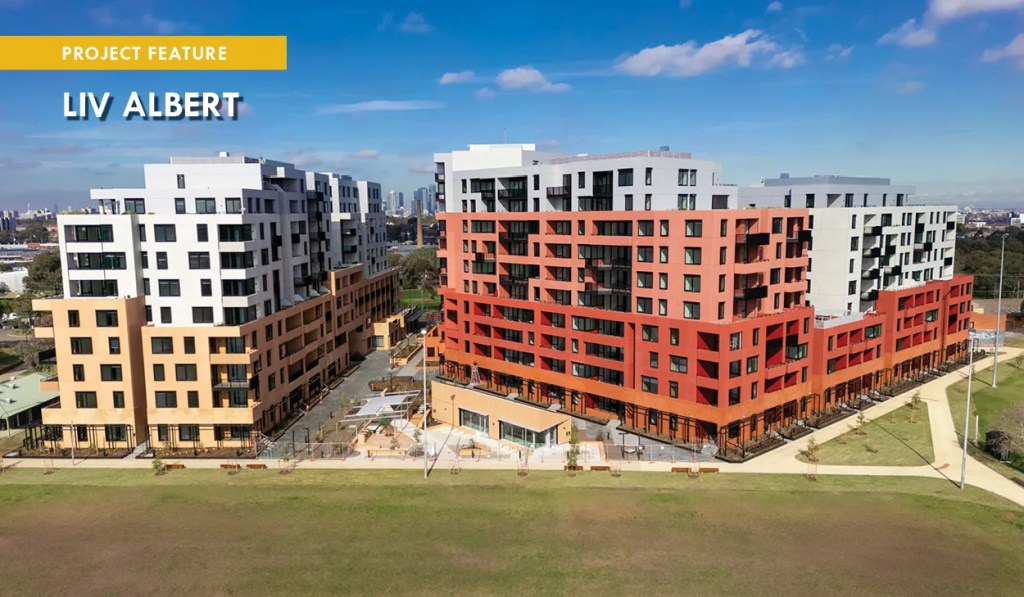
On paper, this is the perfect Brunswick development – 8.2 star energy efficiency, premium location, encompassing “affordable housing”, targeting 50% of Brunswick residents who rent, with “premium” innercity-style amenities. It’s even backed by the state-owned Green Energy Finance Corporation to show a “new way” in the industry for sustainable green design. 15 apartments are offered as “affordable housing” at 30% discounted rent and managed by National Affordable Housing (NAH), a registered community housing provider.
Instead of proving a Sustainable “New Normal” for the Industry, it’s proven that the touted $700 annual energy savings aren’t a value proposition for renters at the rental price premium demanded. At least in Brunswick.
Merri-bek Council didn’t want it, at least in part due to the egregious overshadowing of the neighbouring parklands. But the State Government does want it because Supply, Supply, Supply is the mantra, and it ticks the “affordable housing” box. The Commonwealth Government wanted. it, as it is an institutional investor through the GEFC.
So it’s back to the drawing board for Mirvac in choosing its next site after Brunswick’s rejection of this high concept, high cost housing choice.
Aligning Sustainable Housing with Genuine Affordability and Community Outcomes
However, the project also illustrates a critical policy gap.
1. Misalignment Between Sustainability and Rental Affordability
The anticipated operational savings—approximately $700 per year—do not materially offset the higher rental costs associated with a premium development model. For renters, weekly housing costs remain the dominant decision factor. As a result, modest energy savings are insufficient to justify a meaningful rent premium, particularly in price-sensitive markets such as Brunswick.
Policy implication:
Energy efficiency alone cannot be relied upon as a value proposition for renters unless:
- rent levels remain competitive with standard housing stock, or
- operating savings are significantly larger and more visible.
Without this alignment, sustainability features risk being perceived as a cost driver rather than a benefit.
2. Limited Impact of Small-Scale Affordable Housing Inclusion
While the inclusion of discounted units is positive, the scale remains limited relative to the overall development. As such, it does not materially shift affordability outcomes across the broader tenant population.
Policy implication:
To meaningfully address rental affordability:
- a larger proportion of dwellings must be genuinely affordable, or
- alternative mechanisms (subsidies, incentives, or planning concessions) must ensure affordability extends beyond a small subset of units.
3. Planning Tensions and Community Impacts
The project also demonstrates ongoing tensions between different levels of government.
- Local government concerns centred on amenity impacts, particularly significant overshadowing of public open space.
- State policy priorities emphasised increasing housing supply and meeting strategic targets.
- Commonwealth involvement focused on demonstrating scalable sustainable housing through institutional investment.
Policy implication:
Housing delivery cannot rely solely on supply metrics. Projects must balance:
- density and yield
- environmental performance
- and the protection of local public amenity
Failure to do so risks eroding community support and delaying delivery outcomes.
4. Lessons for Future Development Policy
Combining high sustainability standards, premium positioning, and limited affordability does not yet produce a broadly acceptable or scalable model.
Key policy directions:
- Integrate sustainability without inflating rents
Encourage design efficiencies and construction methods that deliver high performance without requiring significant rent premiums. - Expand meaningful affordable housing provision
Move beyond token allocations toward a scale that materially impacts rental markets. - Strengthen alignment between levels of government
Ensure that state housing objectives and local planning outcomes are coordinated, particularly regarding amenity impacts such as overshadowing. - Support market transition through targeted incentives
If governments seek industry-wide adoption of high-efficiency design, direct financial mechanisms may be required to bridge the cost gap rather than relying on tenant willingness to pay.
Conclusion
This case demonstrates that current “high concept” sustainable developments are not yet delivering a viable “new normal” for renters. Without closer alignment between sustainability, affordability, and planning outcomes, such projects risk remaining niche rather than transformative.
A recalibrated approach is required—one that prioritises genuine affordability alongside environmental performance, while maintaining community amenity and market viability.
Google backgrounder
LIV Albert (historically developed as LIV Albert Fields) is Mirvac’s milestone Build-to-Rent (BTR) residential precinct located at 395-397 Albert Street, Brunswick. [1, 2]
Delivered in a joint venture with Mitsubishi Estate Asia and the Clean Energy Finance Corporation (CEFC), the newly opened urban village provides 498 homes built and managed exclusively for renters. The project stands on a highly historic footprint, consolidating land tracts that once housed the 19th-century Hoffman Brickworks and Quarry. [3, 4]
The design architecture, premium resident facilities, and world-class sustainability metrics define this community precinct:
🏗️ 1. Master-Planned Design & Public Integration
Rather than operating as a closed gated community, the development is explicitly engineered to act as a porous extension of Brunswick’s public parklands. [5]
- The Collaborative Architecture: The precinct was designed via a high-profile local collaboration between design firms Fieldwork, Breathe, and Openwork. [2]
- The Parkland Axis: The design features a broad north-south pedestrian walkway that cuts through the site. This links Albert Street directly into the adjacent Clifton Park and Gilpin Park, opening up a 20-hectare green playground right on the residents’ doorstep. [4, 5, 6]
- The Neighborhood Pavilion: At the axis intersection, a public landscaped pavilion serves as a central meeting space and nature-play zone shared between residents and the wider local Brunswick community. [4, 5, 6]
🌿 2. Elite Sustainability Metrics & Cost Savings
LIV Albert operates as a leading blueprint for environmentally responsible, fossil-fuel-free housing in Australia. [3]
- The 8.2-Star Energy Record: The development has achieved an average 8.2-star NatHERS (Nationwide House Energy Rating Scheme) rating. This ranks as the highest energy efficiency rating achieved across any Mirvac apartment building in company history, saving residents up to $700 annually on standard utility bills. [3]
- 100% Fossil-Fuel Free: The complex is entirely disconnected from the natural gas network. All heating, cooling, cooking, and hot water assets run strictly on centralized electric networks backed by massive solar arrays and natural refrigerant-based central heat pumps. [4, 7, 8, 9]
- Green Travel Infrastructure: To support local active transport networks, the design prioritizes pedestrian and bike movements, incorporating high-capacity bicycle storage lockers tailored explicitly for heavy cargo e-bikes. [6]
🧘♂️ 3. Dedicated Renter Amenities & Benefits [3]
Because the property is a dedicated BTR build, residents are treated as long-term customers rather than short-term tenants, unlocking major lease flexibility and amenity inclusions: [5, 8, 10, 11]
- The In-Building Facilities: Residents gain unlimited access to a premium, on-site co-working hub, a fully equipped gym, a private cinema room, a yoga and Pilates studio, and a massive level-top terrace balcony complete with communal dining rooms and BBQ facilities. [12, 13, 14]
- Whitegoods & Maintenance Included: Every studio, 1, 2, and 3-bedroom layout comes fitted with premium whitegoods and integrated appliances. An active, on-site Mirvac management team handles property maintenance and prompt repairs directly. [15]
- Pet-Friendly Mandate: Unlike standard private rentals, the building operates under a welcoming pet-friendly policy, integrating pet-wash stations and neighborhood alignment for residents with dogs. [6, 12]
📊 LIV Albert Layout Profile & Pricing Snapshot
Weekly rental pricing brackets for available residences map across the following ranges: [16]
| Residence Configuration [15, 16] | Integrated Internal Inclusions | Primary Lifestyle Target | Current Market Rental Bracket |
|---|---|---|---|
| Studio Apartments | Private balcony, full kitchen, whitegoods | Low-maintenance city professionals | Contact leasing team |
| 1-Bedroom / 1-Bath | Full storage options, acoustic glazing | Singles or couples seeking city fringe access | Contact leasing team |
| 2-Bedroom / 2-Bath | Double balcony, separate living zones | Share-houses and young independent families | ~$795 – $885 per week |
| 3-Bedroom / 2-Bath | Premium panoramic city views, storage lock-up | Downsizers and established family spaces | ~$1,250+ per week |
[1] https://www.realestate.com.au
[2] https://milieuproperty.com.au
[4] https://www.breathe.com.au
[5] https://www.fieldworkprojects.com.au
[8] https://automaticheating.com.au
[9] https://www.architectureanddesign.com.au
[11] https://www.universityliving.com
[14] https://www.domain.com.au
[15] https://www.livmirvac.com
[16] https://www.realestate.com.au
The rollout of LIV Albert by Mirvac has generated significant community friction. While the build-to-rent (BTR) development is praised for its high energy ratings and open parkland connections, it faces sharp localized criticisms regarding its impact on housing affordability, urban planning, and its sluggish initial tenant uptake. [1]
The active issues, public complaints, and local reception surrounding the precinct break down as follows:
📉 1. The Rate of Uptake & Vacancy Concerns
Six months after its official opening, the precinct is experiencing a confrontingly slow rate of tenant uptake, leading to prominent vacant windows along Albert Street.
- The Premium Stand-off: Local residents and housing market commentators note that the 498-apartment complex appears mostly empty. Observers report that Mirvac is keeping asking rents high to protect long-term capitalization yields, preferring to hold the building mostly vacant rather than dropping prices to meet local demand. [2, 3, 4]
- The Devaluation Drag: This slow absorption matches historical financial friction. Mirvac had to absorb a $42 million devaluation during the construction phase after being forced to reduce the final total number of apartments while navigating high post-pandemic tier-one building material costs. [1]
💰 2. Criticisms Over Housing Affordability & “Monopoly Pricing” [3]
The primary backlash from local advocacy groups, including the Brunswick Good Karma Network, targets the project’s premium pricing model during a severe cost-of-living crisis. [3, 4]
- The Exclusion of Low-Income Renters: With two-bedroom units commanding up to $885 per week, vulnerable locals, disabled residents, and lower-income families report being completely locked out of the building. [3]
- Average Rent Inflation: Community advocates criticize institutional BTR developers for using their financial scale to demand a “rental premium” (charging 10% to 15% above standard private rentals for identical floor space). Locals complain that keeping hundreds of new apartments vacant at high price points artificially drives up average median rents when real estate agents conduct local lease reviews across Brunswick. [4]
- The “Pure Profit” Grievance: Left-wing council coalitions and local activists have labeled the development a “discredit to the community,” arguing that Merri-bek Council should not have permitted a pure, profit-driven BTR model without legally mandating a high, fixed percentage of subsidized social or rent-to-own housing. [3, 5]
💨 3. Architectural Planning & The “Wind Tunnel” Effect
From an urban design perspective, the physical massing of the development has drawn sharp criticism from local architects and neighbors.
- The VCAT Override Legacy: Merri-bek City Council initially unanimously voted to reject the project’s early design plans, citing unacceptable visual bulk, excessive height (8 to 11 storeys), and overshadowing impacts on Gilpin Park. However, Mirvac successfully bypassed local council objections by appealing directly to the Victorian Civil and Administrative Tribunal (VCAT), which legally overrode the council veto to grant the planning permits. [6, 7]
- The Microclimate Wind Tunnel: Architecture critics tracking the site note that the thin, concrete street corridors created between the towering 11-storey blocks act as a severe microclimate wind tunnel. The funnelled wind speeds create an uncomfortable pedestrian environment along the internal public footpaths while threatening the survival of young, newly planted tree saplings. [2]
- Layout Efficiency Inefficiencies: While the building achieves an elite 8.2-star NatHERS rating for insulation, early viewings from local apartment dwellers criticize individual internal floorplans, flagging minimal usable space, awkward room shapes, and poor spatial layouts relative to the high weekly price point. [4]
📊 Summary Matrix of LIV Albert Inefficiencies
| Complaint Domain [1, 2, 3, 4, 7] | Primary Trigger / Mechanism | Concrete Community Impact | Core Strategic Conflict |
|---|---|---|---|
| High Vacancy Rate | Rigid premium pricing to protect corporate capital yields | Hundreds of units sitting empty six months post-launch | Profit preservation vs. immediate local housing supply needs |
| Affordability Backlash | Asking rents reaching $885+ per week for 2-beds | Displaces low-income earners, disabled residents, and students | Institutional BTR premium pricing inflates neighborhood median benchmarks |
| Planning Override | VCAT legally bypassing Merri-bek Council rejections | 11-storey visual bulk encroaching on local parks | State-centralized density targets overriding local community planning control |
| Microclimate Failure | Tight architectural gaps between high-rise blocks | Extreme localized wind tunnel effect on walkways | High aesthetic density compromising pedestrian comfort levels |
[2] https://paulvanherk.substack.com
[6] https://www.merri-bek.vic.gov.au
[7] https://brunswickvoice.com.au
The Clean Energy Finance Corporation (CEFC) invested $75 million in equity into Mirvac’s Build-to-Rent (BTR) Venture to solve a specific problem: renters are traditionally locked out of the benefits of green energy housing. [1, 2, 3, 4]
Because Australia’s 11 million homes generate over 10% of national carbon emissions, the CEFC used its capital as a “green bank” to force higher environmental standards in a sector that desperately lacks them. [5, 6, 7]
The CEFC’s core motivations for backing the project include:
1. Decarbonising the Residential Property Sector
The CEFC targets the built environment to accelerate Australia’s transition to net-zero emissions. By stepping in as a cornerstone investor, they mandated that every project in the Mirvac venture must target net-zero carbon emissions in operations. LIV Albert exceeded expectations by achieving a stellar 8.2-star NatHERS rating, which means the building requires drastically less energy to heat and cool. [5, 6, 8, 9]
2. Exploiting the “Split Incentive” of Build-to-Rent
In a traditional “build-to-sell” model, developers have no incentive to install expensive green tech because they sell the units and walk away. Private landlords similarly avoid these costs because the tenant pays the electricity bill.
- The CEFC’s Leverage: Because Mirvac retains long-term ownership of a BTR asset, the CEFC saw a unique opportunity. They knew Mirvac would be financially incentivised to maintain efficient operations over decades, making it the perfect vehicle to deploy sustainable infrastructure at a massive scale. [5, 10]
3. Delivering Cost-of-Living Relief to Renters
The CEFC intentionally structured the investment to ensure low-emission living isn’t just a luxury for wealthy homeowners. [1, 2]
- The Result: The green infrastructure funded by the CEFC (like all-electric systems, high-performance glazing, and energy monitoring) directly drops renter utility bills. For example, a two-bedroom apartment at LIV Albert saves its tenants up to $700 a year in energy costs. [2, 8]
4. Creating a Sustainable “New Normal” for the Industry [11]
As a government enterprise, the CEFC’s mandate is to fund pioneer projects that prove green commercial initiatives are profitable. By funding highly successful communities like LIV Albert, they create a blueprint for other developers. They demonstrate to the wider Australian property market that building 100% renewable, high-performance apartment blocks attracts premium capital and secures stable, long-term tenants. [5, 8, 12, 13, 14]
If you’d like to dive deeper into the financial mechanics, let me know if you want to explore:
- The specific green technologies (like regenerative lifts or solar packages) used across the LIV portfolio
- How the CEFC monitors and tracks data on energy savings
- The other institutional partners (like Mitsubishi Estate Asia) who co-invested in this fund [10, 13, 15]
[12] https://www.theurbandeveloper.com
Yes, Mirvac’s build-to-rent (BTR) portfolio—branded under the “LIV” banner—is widely considered an operational and commercial success [1, 2, 3] .
Mirvac pioneered the corporate BTR model in Australia, establishing a $1.8 billion asset venture backed by institutional heavyweights like Mitsubishi Estate Asia and the Clean Energy Finance Corporation (CEFC). Nationally, their stabilised portfolio maintains a highly robust 95.3% occupancy rate. [2, 4, 5, 6, 7]
1. LIV Indigo (Sydney Olympic Park) – The Proven Pilot [8, 9]
- The Success: Launched in 2020 as Sydney’s first major corporate BTR development, LIV Indigo served as proof of concept. It achieved rapid stabilization, reaching near-full occupancy within its first year despite launching during pandemic lockdowns. [10, 11, 12, 13]
- Resident Feedback: Tenants consistently praise the “anti-landlord” approach. Reviews on platforms like Reddit’s R/Melbourne BTR threads highlight the speed of on-site maintenance (e.g., appliance or electrical fixes resolved within 24 hours) compared to traditional real estate agents. [3, 10, 14]
- The Catch: Like LIV Albert, residents openly acknowledge paying a 15% to 20% premium over the local suburb median just for the lifestyle perks. [3, 15]
2. LIV Munro (Queen Victoria Market, Melbourne) – The Scale Test [16]
- The Success: Opened in late 2022, LIV Munro tested the appetite for premium BTR right in the heart of Melbourne’s CBD. It leased out ahead of internal corporate projections, drawing in corporate professionals and expats who wanted immediate, fuss-free housing. [15, 17, 18, 19]
- Resident Feedback: Positive sentiment heavily centers on the no upfront bond policy, the ability to legally paint or nail fixtures into walls, and the strict pet-friendly guidelines. [10, 20]
- The Catch: Some criticism surfaced regarding the “transient” feel of the building, given the high volume of incoming international tenants, and the premium cost of its inner-city baseline rents. [15]
3. LIV Aston (North Wharf, Melbourne) – The Growth Stage [21]
- The Success: Opened in mid-2024 at North Wharf, LIV Aston demonstrated what Mirvac calls “strong leasing momentum”. It successfully integrated a diverse mixed-use precinct combining commercial offices, retail space, and 474 BTR apartments. [1, 3, 17, 21, 22]
Summary of Success vs. Failure Points
| Where Mirvac BTR Succeeds [3, 4, 5, 10, 14, 15] | Where Mirvac BTR Faces Friction |
|---|---|
| High Build Quality: Noticeably better insulation and acoustic soundproofing than standard speculative builds. | The Price Wall: Irritates local renters by creating an exclusive enclave out of reach for average earners. |
| Decarbonisation: Consistently hits 7.5 to 8.2-star NatHERS ratings, reducing tenant utility bills. | Lock-in Ecosystem: Subscriptions, gym, and amenity fees are bundled, giving tenants little room to downsize costs. |
| Long-Term Security: Tenants can sign 3 to 5+ year leases with rent increases capped transparently. | Limited Stock: Demand outstrips supply, keeping waitlists for lower-priced configurations long. |
[8] https://www.theweeklysource.com.au
[10] https://www.theguardian.com
[11] https://rocketagency.com.au


Leave a Reply